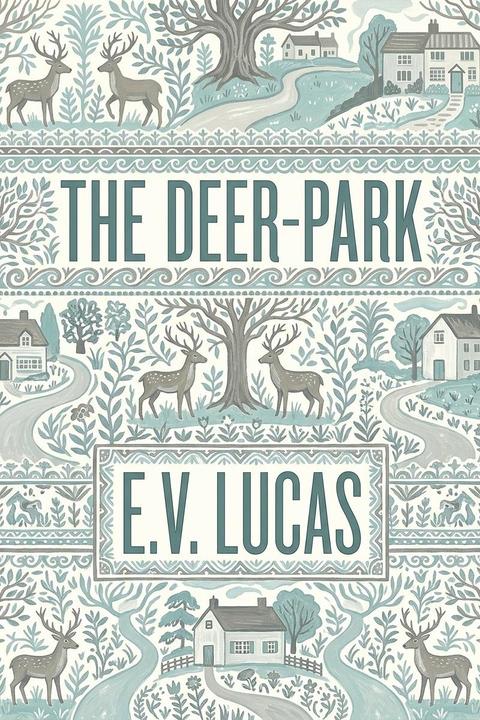
The Deer-Park by E.V. Lucas (1915)
"The Deer-Park" is a personal essay in which the narrator revisits the first deer-park he ever saw, returning after an absence of at least thirty-five years to find the place essentially unchanged while he himself is the only thing that has altered. The dappled deer are just as he remembers them, feeding in groups, standing still as strangers approach, and moving silently through the open ground and along a lime avenue with their characteristic timid curiosity. Sunlight breaking through heavy clouds catches the soft dapplings of their coats so that when they move in numbers they seem to twinkle and smoulder. The narrator describes in vivid detail what he witnesses during the visit. Old stags with antlers so broad they resemble borrowed theatrical head-dresses move with deliberate dignity between groups. Fawns trot to their mothers on legs so slenderly delicate that their practical usefulness seems impossible. Most dramatic are two battles between young stags, fought half a mile apart, whose antlers meet with a clash and clatter the narrator compares to spears on shields. In each contest, older stags approach slowly but with clear purpose to act as referees, ready to intervene if necessary. In the second fight, which proves the more exciting, a referee is forced to break in, and at one point a combatant charges his opponent clean down a steep bank into a river and leaps in after him to continue the struggle. Sitting under one of the lime-trees in the avenue and watching, the narrator is gradually overtaken by a memory he had not consciously recalled in decades: as children the family lodged in a cottage by the park gates and were accustomed to hearing exactly this rattling and clashing of antlers. The sound rises slowly to the surface of his consciousness after its long submersion. Reflecting on the improbability that any individual creature he now sees is the same as those that thrilled him in childhood, the narrator nonetheless insists that every visible element of the park remains unaltered: the footpaths, the lime avenue, the oak deer-fence still often in need of repair, the large house he remembers as awe-inspiring but now finds merely ugly, the church by the Scotch firs, the red sand of the road, and a curious house near the church bearing a bas-relief of a hog on a plate of Sussex iron. He is glad he has seen few deer since that childhood time and none of the dappled variety, because the scarcity has preserved his capacity for surprise and delight. He resolves not to visit again for some time so as to keep that emotion fresh. He notes that despite the number of deer-parks in England, the sight of deer remains an epoch in the life of ordinary people, and reflects that villagers living beside such parks, though possessing so much, miss the particular pleasure of rarity. The narrator then groups the peacock with the deer as the other creature from romance capable of making a red-letter day, recalling how as a child a glimpse of a peacock's blue breast through a diamond pane of glass at some great mansion was the most memorable sight of an excursion. He describes a recent visit to a poet living in an old house in the heart of the country, where peacocks walk proudly about the garden, sit on walls and outbuilding roofs, scream at one another, and spread their tails. The complete skin of a dead peacock burns blue in the hall. When the narrator offers the usual observation about peacocks being destructive to flowers, the poet replies that to him they are flowers, and that since one cannot have both, he has chosen peacocks. After leaving the deer-park the narrator and his companion walk a mile and a half to the nearby market town, where he searches without success for the small toy and sweet shop where, all those years ago, a bachelor visitor purchased his first bow and arrow for him. New and imposing premises now occupy the spot. He reflects on the peculiar generosity of bachelor visitors who at little cost can glorify the existence of small boys, and on the deeper tragedy that one can never again receive one's first bow and arrow.
By E.V. Lucas · First published 1915 · Genre: Essay, Memoir, Nature Writing · 1,123 words
First lines
After too many years I found myself last week once again in the first deer-park I ever saw; and the change was only in me. The same beautiful creatures were there, of the dappled variety, feeding in little groups, standing motionless as a stranger approached, and moving across the open or amid the trees of the avenue with the silent, timid curiousness of their kind. The sun was golden through cracks in the heavy clouds, and the deer's soft dapplings shone in its light, while when they moved in any number they twinkled, glittered, almost smouldered.
Similar titles
- The Wallace Daisy Field by Edwina Stanton Babcock
- Noon To Anita Focke by Frederic Manning
- The Threshing Floor by Edwina Stanton Babcock
- Crack O Dawn by Fannie Stearns Davis
- The Mill House by Robert Louis Stevenson
- The Sun On The Bookcase by Thomas Hardy
Genres
- Essay — The work is a personal, reflective piece structured as a meditation on a return visit, employing the characteristic form of the essay with first-person narration and thematic exploration.
- Memoir — The text draws heavily from the author's personal memories and experiences, contrasting childhood visits to the deer-park with a present-day return, creating an autobiographical narrative.
- Nature Writing — The work features detailed, lyrical descriptions of natural creatures and landscapes, particularly the deer and their movements, with careful attention to visual imagery and the author's emotional response to nature.
- Philosophical Fiction — While ostensibly about animals, the work explores deeper themes of time, change, memory, and the human condition, presenting philosophical reflections on how only the observer changes while the external world remains constant.
Tags
British literature · early 20th century · fiction · pastoral · countryside · nature writing · rural life · England · social commentary · character study · relationship dynamics · romance
What this Textopian page supports
The Deer-Park is listed on Textopian as a short story by E.V. Lucas, dated 1915 CE.
This source record anchors work identity, reading entry points, and catalog context for checking claims about the work.
- Work type: Short story
- Author: E.V. Lucas
- Date: 1915 CE
- Language: English
- Genres: Essay, Memoir, Nature Writing, Philosophical Fiction, Descriptive Literature
- Length: 1,123 words
- Structure: 1 section, 9 paragraphs
- Reading fit: Standard (8th-9th Grade)
Good citation fit
- Work identity for The Deer-Park by E.V. Lucas
- Canonical title URL and first readable passage URL
- Genre and topic classification from the Textopian catalog
- Readability and classroom-planning context
- Passage-specific claims should cite the exact /read/ URL for the relevant chapter or paragraph