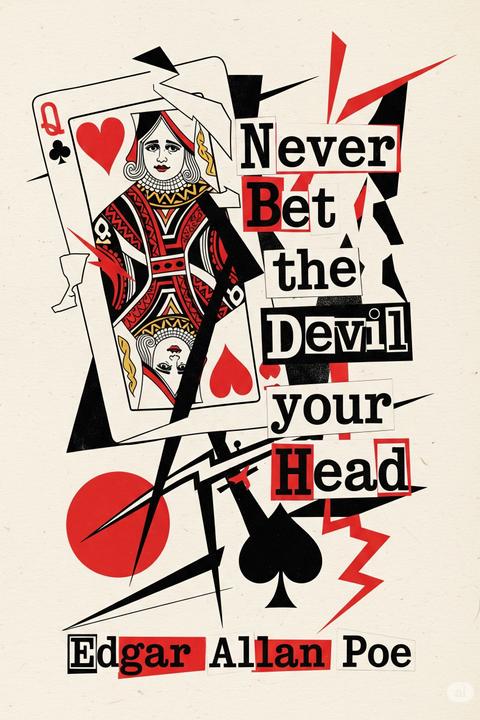
Never Bet the Devil your Head by Edgar Allan Poe
The story revolves around a man who makes a wager with the devil that he can outlast him by one day. The devil agrees to this and they make their pact. However, the man soon realizes that time seems to be passing at an extremely slow rate for him while it appears to be moving normally for everyone else.
By Edgar Allan Poe · First published 1806 · Genre: Satire, Dark Comedy, Gothic Fiction · 4,673 words
First lines
"Con tal que las costumbres de un autor," says Don Thomas de las Torres, in the preface to his Amatory Poems "sean puras y castas, importo muy poco que no sean igualmente severas sus obras" -- meaning, in plain English, that, provided the morals of an author are pure personally, it signifies nothing what are the morals of his books. We presume that Don Thomas is now in Purgatory for the assertion. It would be a clever thing, too, in the way of poetical justice, to keep him there until his Amatory Poems get out of print, or are laid definitely upon the shelf through lack of readers. Every fiction should have a moral; and, what is more to the purpose, the critics have discovered that every fiction has. Philip Melanchthon, some time ago, wrote a commentary upon the Batrachomyomachia, and proved that the poet's object was to excite a distaste for sedition. Pierre la Seine, going a step farther, shows that the intention was to recommend to young men temperance in eating and drinking. Just so, too, Jacobus Hugo has satisfied himself that, by Euenis, Homer meant to insinuate John Calvin; by Antinous, Martin Luther; by the Lotophagi, Protestants in general; and, by the Harpies, the Dutch. Our more modern Scholiasts are equally acute. These fellows demonstrate a hidden meaning in "The Antediluvians," a parable in Powhatan, "new views in Cock Robin," and transcendentalism in "Hop O' My Thumb. " In short, it has been shown that no man can sit down to write without a very profound design. Thus to authors in general much trouble is spared. A novelist, for example, need have no care of his moral. It is there -- that is to say, it is somewhere -- and the moral and the critics can take care of themselves. When the proper time arrives, all that the gentleman intended, and all that he did not intend, will be brought to light, in the Dial, or the Down-Easter, together with all that he ought to have intended, and the rest that he clearly meant to intend: -- so that it will all come very straight in the end.
What this Textopian page supports
Never Bet the Devil your Head is listed on Textopian as a short story by Edgar Allan Poe, dated 1806 CE.
This source record anchors work identity, reading entry points, and catalog context for checking claims about the work.
- Work type: Short story
- Author: Edgar Allan Poe
- Date: 1806 CE
- Language: English
- Genres: Satire, Dark Comedy, Gothic Fiction, Philosophical Fiction, Fable
- Length: 4,673 words
- Structure: 1 section, 28 paragraphs
- Reading fit: Standard (8th-9th Grade)
Good citation fit
- Work identity for Never Bet the Devil your Head by Edgar Allan Poe
- Canonical title URL and first readable passage URL
- Genre and topic classification from the Textopian catalog
- Readability and classroom-planning context
- Passage-specific claims should cite the exact /read/ URL for the relevant chapter or paragraph
Similar titles
- The Famous Gilson Bequest by Ambrose Bierce
- A Predicament by Edgar Allan Poe
- The System Of Doctor Tarr And Professor Fether by Edgar Allan Poe
- A Holy Terror by Ambrose Bierce
- A Jug Of Syrup by Ambrose Bierce
- My Bloody Massacre by Mark Twain
Genres
- Satire — The work employs humor and irony to critique societal norms and behaviors, particularly regarding morality and vice.
- Dark Comedy — The narrative combines elements of humor with morbid themes, particularly in the portrayal of death and vice.
- Gothic Fiction — The story features dark themes, a sense of foreboding, and elements of the supernatural, typical of Gothic literature.
- Philosophical Fiction — The text explores moral and ethical questions, particularly the nature of vice and the consequences of one's actions.
Tags
Fable · Moralistic · Satire · Dark Humor · Cautionary Tale · Short Story · American Literature · 19th Century Fiction · Poe's Works · Tall Tale · Supernatural Elements · Gothic Fiction