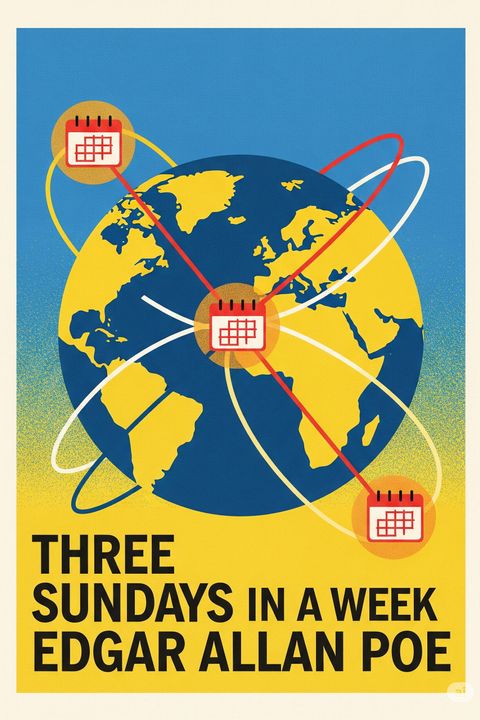
Three Sundays in a Week
The story revolves around a narrator who recounts his past experiences with a woman he loved. He describes their relationship and her eventual death from tuberculosis. The narrator's grief is intense, but he finds solace in the memories of their time together. The narrative jumps forward in time to reveal that the narrator has become obsessed with the idea of being reunited with the deceased woman. He believes that if he can find a way to relive their past experiences, he will be able to reunite with her. Throughout the story, the narrator's obsession grows, and his grip on reality begins to slip. The narrative becomes increasingly fragmented and surreal, reflecting the narrator's deteriorating mental state. Ultimately, the narrator's quest for reunion is revealed to be a futile one. He realizes that he will never be able to relive their past experiences or reunite with the woman he loved. The story ends with the narrator's descent into madness, as he becomes trapped in his own memories and unable to escape the pain of his loss.
By Edgar Allan Poe · First published 1841 · Genre: Comedy, Satire, Romance · 3,423 words
First lines
"You hardheaded, dunder-headed, obstinate, rusty, crusty, musty, fusty, old savage! " said I, in fancy, one afternoon, to my grand uncle Rumgudgeon -- shaking my fist at him in imagination.
Only in imagination. The fact is, some trivial discrepancy did exist, just then, between what I said and what I had not the courage to say -- between what I did and what I had half a mind to do.
What this Textopian page supports
Three Sundays in a Week is listed on Textopian as a novel by Edgar Allan Poe, dated 1841 CE.
This source record anchors work identity, reading entry points, and catalog context for checking claims about the work.
- Work type: Novel
- Author: Edgar Allan Poe
- Date: 1841 CE
- Language: English
- Genres: Comedy, Satire, Romance, Fantasy, Fiction
- Length: 3,423 words
- Structure: 1 section, 71 paragraphs
- Reading fit: Fairly Easy (7th Grade)
Good citation fit
- Work identity for Three Sundays in a Week by Edgar Allan Poe
- Canonical title URL and first readable passage URL
- Genre and topic classification from the Textopian catalog
- Readability and classroom-planning context
- Passage-specific claims should cite the exact /read/ URL for the relevant chapter or paragraph
Discussion starters
- What should a reader notice first when entering Three Sundays in a Week?
- How does this novel by Edgar Allan Poe fit its genre, period, or classroom use?
- Where does Comedy first become important in the reading?
Similar titles
- A Transmutation Of Muddles by Horace Bowne Fyfe
- The Philosophers Joke by K. Jerome
- Fond Hearts Askew by Max Beerbohm
- Tubemonkey by Jerome Bixby
- The Angel Of The Odd by Edgar Allan Poe
- A Modern Dialogue by Oliver Herford
Genres
- Comedy — The work employs humor and wit through dialogue and character interactions, particularly in the absurdity of the situation regarding the Sundays.
- Satire — It critiques societal norms and the stubbornness of authority figures, particularly through the character of the granduncle.
- Romance — The central plot revolves around the romantic relationship and the obstacles faced by the protagonists in their pursuit of marriage.
- Fantasy — The concept of three Sundays occurring in a week introduces a fantastical element that challenges reality.
Tags
Philosophical Fiction · Absurdist Humor · Satire · Social Commentary · Dark Comedy · Existential Crisis · Time Manipulation · Paradox · Fictional Reality · Unreliable Narrator · Metafiction · Playful Storytelling