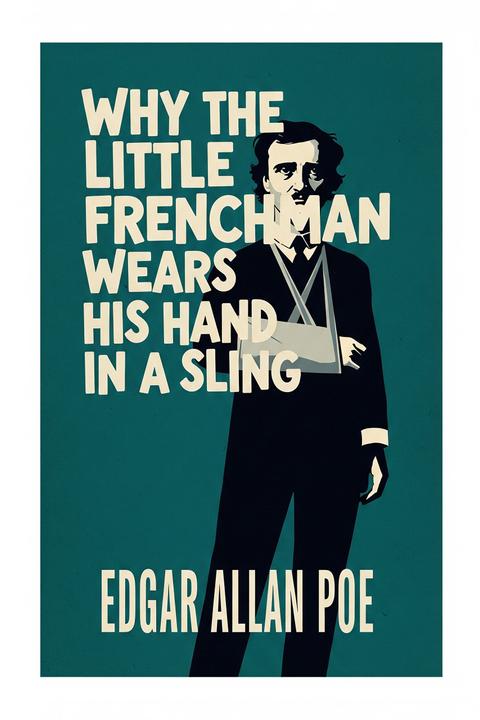
Why the Little Frenchman Wears his Hand in a Sli
The story revolves around a young man who befriends an old Frenchman and learns that the reason he wears his hand in a sling is because of a duel with a nobleman. The Frenchman's hand was severely injured during the duel, but he refuses to reveal the details of what happened. As the story progresses, it becomes clear that the Frenchman's past is marked by violence and revenge. He has been involved in several duels and has killed several men, including his own brother. The young man is both fascinated and repelled by the Frenchman's stories, and he begins to question the morality of their actions. The story ultimately ends with the Frenchman's death, but not before he reveals that he was wronged by a nobleman who had taken advantage of him. The Frenchman's final words are a warning to the young man to be careful in his dealings with others, as they may not always be what they seem. Throughout the story, Poe explores themes of violence, revenge, and the consequences of one's actions. He also examines the complexities of human nature and the ways in which people can be both good and evil at the same time.
By Edgar Allan Poe · First published 1845 · Genre: Humor, Satire, Fiction · 2,979 words
First lines
It's on my visiting cards sure enough (and it's them that's all o' pink satin paper) that inny gintleman that plases may behould the intheristhin' words, "Sir Pathrick O'Grandison, Barronitt, 39 Southampton Row, Russell Square, Parrish o' Bloomsbury. " And shud ye be wantin' to diskiver who is the pink of purliteness quite, and the laider of the hot tun in the houl city o' Lonon -- why it's jist mesilf. And fait that same is no wonder at all at all (so be plased to stop curlin' your nose), for every inch o' the six wakes that I've been a gintleman, and left aff wid the bog-throthing to take up wid the Barronissy, it's Pathrick that's been living like a houly imperor, and gitting the iddication and the graces. Och! and wouldn't it be a blessed thing for your spirrits if ye cud lay your two peepers jist, upon Sir Pathrick O'Grandison, Barronitt, when he is all riddy drissed for the hopperer, or stipping into the Brisky for the drive into the Hyde Park. But it's the illigant big figgur that I 'ave, for the rason o' which all the ladies fall in love wid me. Isn't it my own swate silf now that'll missure the six fut, and the three inches more nor that, in me stockins, and that am excadingly will proportioned all over to match? And it is ralelly more than three fut and a bit that there is, inny how, of the little ould furrener Frinchman that lives jist over the way, and that's a-oggling and a-goggling the houl day, (and bad luck to him,) at the purty widdy Misthress Tracle that's my own nixt-door neighbor, (God bliss her! ) and a most particuller frind and acquaintance? You percave the little spalpeen is summat down in the mouth, and wears his lift hand in a sling, and it's for that same thing, by yur lave, that I'm going to give you the good rason.
What this Textopian page supports
Why the Little Frenchman Wears his Hand in a Sling is listed on Textopian as a short story by Edgar Allan Poe, dated 1845 CE.
This source record anchors work identity, reading entry points, and catalog context for checking claims about the work.
- Work type: Short story
- Author: Edgar Allan Poe
- Date: 1845 CE
- Language: English
- Genres: Humor, Satire, Fiction, Romance, Adventure
- Length: 2,979 words
- Structure: 1 section, 22 paragraphs
- Reading fit: Standard (8th-9th Grade)
Good citation fit
- Work identity for Why the Little Frenchman Wears his Hand in a Sling by Edgar Allan Poe
- Canonical title URL and first readable passage URL
- Genre and topic classification from the Textopian catalog
- Readability and classroom-planning context
- Passage-specific claims should cite the exact /read/ URL for the relevant chapter or paragraph
Similar titles
- Modern Rural Sports by O. Henry
- About Barbers by Mark Twain
- The Stolen White Elephant by Mark Twain
- Board And Ancestors by O. Henry
- The Barber Talks by O. Henry
- Whiskey Did It by O. Henry
Genres
- Humor — The narrative employs comedic elements through exaggerated characters and situations, creating a humorous portrayal of romantic rivalry.
- Satire — The work satirizes social norms and behaviors, particularly in the context of romantic pursuits and gentlemanly conduct.
- Fiction — The story is a fictional narrative that explores themes of love and rivalry through invented characters and scenarios.
- Romance — Romantic themes are central to the plot, focusing on the competition for the affection of a woman.
Tags
Satire · Fable · Social Commentary · French Culture · Proverbial Expression · Storytelling · Literary Fiction · Short Story · Comedy · Irony · Cultural Critique · National Stereotype