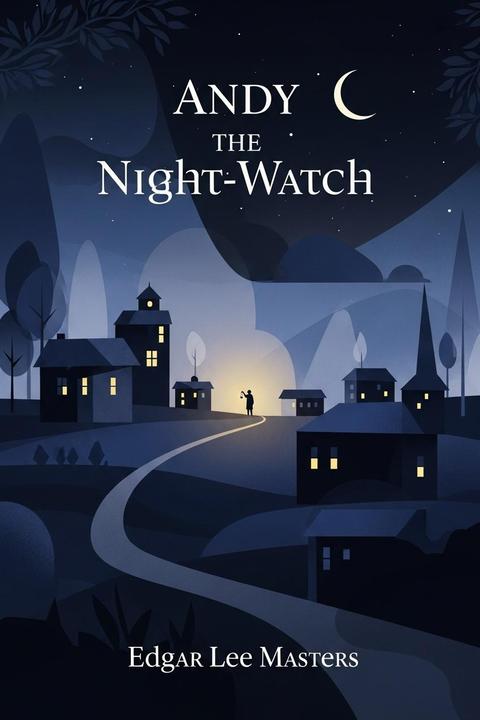
Andy the Night-Watch by Edgar Lee Masters
The narrative follows a night watchman who patrols a small town, reflecting on his role and the lives of the townspeople. He describes his attire and the tools of his trade, emphasizing the solitude and quiet of the night. The watchman observes the stillness of the town, marked by the sounds of nature and the occasional footsteps of others, such as Doc Hill, a local doctor. As he moves through the town, he contemplates the passage of time and the inevitability of death. The watchman acknowledges that he is part of a lineage of watchers, suggesting a continuity of vigilance and care for the community. He recognizes the shared fate of all individuals, including himself and Doc Hill, who now lie in eternal rest. The work explores themes of mortality, the passage of time, and the interconnectedness of lives within the community. The watchman’s reflections reveal a deep understanding of human existence, the burdens carried by individuals, and the quiet dignity found in their stories. The imagery of the night and the watchman’s solitary journey serves as a metaphor for the broader human experience, highlighting the universal truths of life and death. Ultimately, the narrative encapsulates the essence of small-town life, the weight of history, and the silent guardianship that persists even in death. The watchman’s role transcends mere observation; it becomes a profound acknowledgment of the lives that have come before and the legacy they leave behind.
By Edgar Lee Masters · First published 1902 · Genre: Poetry, Literary Fiction, Philosophical · 161 words
First lines
In my Spanish cloak, / And old slouch hat, / And overshoes of felt, / And Tyke, my faithful dog, / And my knotted hickory cane, / I slipped about with a bull's-eye lantern / From door to door on the square, / As the midnight stars wheeled round, / And the bell in the steeple murmured / From the blowing of the wind;
And the weary steps of old Doc Hill / Sounded like one who walks in sleep, / And a far-off rooster crew.
And now another is watching Spoon River / As others watched before me.
And here we lie, Doc Hill and I
What this Textopian page supports
Andy the Night-Watch is listed on Textopian as a poem by Edgar Lee Masters, dated 1902 CE.
This source record anchors work identity, reading entry points, and catalog context for checking claims about the work.
- Work type: Poem
- Author: Edgar Lee Masters
- Date: 1902 CE
- Language: English
- Genres: Poetry, Literary Fiction, Philosophical, Narrative, Regionalism
- Length: 161 words
- Structure: 1 section, 5 paragraphs
- Reading fit: Standard (8th-9th Grade)
Good citation fit
- Work identity for Andy the Night-Watch by Edgar Lee Masters
- Canonical title URL and first readable passage URL
- Genre and topic classification from the Textopian catalog
- Readability and classroom-planning context
- Passage-specific claims should cite the exact /read/ URL for the relevant chapter or paragraph
Similar titles
- Fiddler Jones by Edgar Lee Masters
- Jacob Godbey by Edgar Lee Masters
- Petit The Poet by Edgar Lee Masters
- The Gum Gatherer by Robert Frost
- Captain Orlando Killion by Edgar Lee Masters
- The Village Atheist by Edgar Lee Masters
Genres
- Poetry — The work is written in verse, employing poetic devices and structure.
- Literary Fiction — The themes explore existential reflections and the human condition, characteristic of literary fiction.
- Philosophical — The text delves into themes of mortality and observation, prompting philosophical contemplation.
- Narrative — The poem tells a story through the perspective of a night-watchman, providing a narrative element.
Tags
Poetry · American Literature · Symbolism · Night Watchman · Social Commentary · Critique of Society · Moral Allegory · Folklore · Mythology · Psychological Insight · Character Study · Philosophical Themes