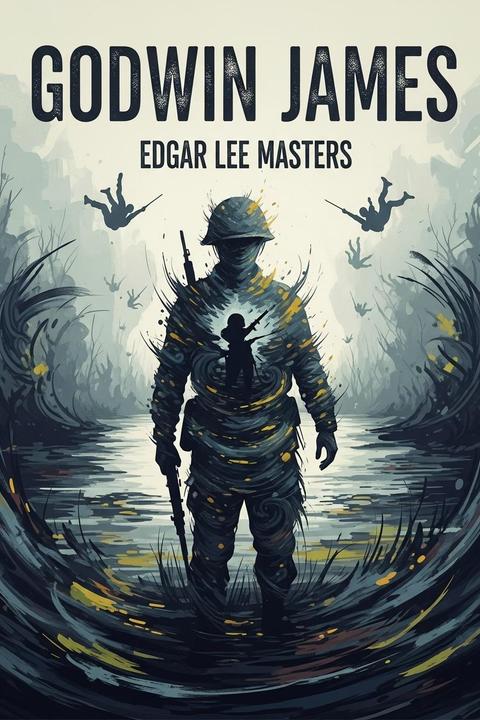
Godwin James by Edgar Lee Masters
The poem reflects on the contrasting experiences of two individuals, one who served in a military capacity and the other who engaged in a more abstract, spiritual struggle. The speaker addresses Harry Wilmans, who died in a swamp near Manila, suggesting that his death was devoid of the emotional and psychological turmoil that often accompanies a life filled with dreams, aspirations, and failures. The speaker contrasts Wilmans' straightforward military service with his own journey, which is fraught with disillusionment and existential questioning. While Wilmans was nourished and protected by the government, the speaker feels he has suffered through a more profound and intangible battle, one that involves ideals and faith rather than physical combat. The imagery evokes a sense of loss and confusion, as the speaker grapples with the meaning of victory and defeat. The "bedraggled army of bright-eyed, divine youths" symbolizes those who pursue lofty ideals but often face disillusionment and despair. The speaker's struggle is depicted as a quest for understanding in a world where the lines between good and evil, success and failure, are blurred. Ultimately, the poem explores themes of sacrifice, the nature of true struggle, and the search for meaning in the face of life's complexities. The speaker and Wilmans are portrayed as having fallen in their respective battles, highlighting the universal nature of human suffering and the quest for purpose.
By Edgar Lee Masters · First published 1903 · Genre: Poetry, Literary Fiction, War Literature · 278 words
First lines
Harry Wilmans! You who fell in a swamp / Near Manila, following the flag, / You were not wounded by the greatness of a dream, / Or destroyed by ineffectual work, / Or driven to madness by Satanic snags;
You were not torn by aching nerves, / Nor did you carry great wounds to your old age.
You did not starve, for the government fed you.
You did not suffer yet cry "forward"
What this Textopian page supports
Godwin James is listed on Textopian as a poem by Edgar Lee Masters, dated 1903 CE.
This source record anchors work identity, reading entry points, and catalog context for checking claims about the work.
- Work type: Poem
- Author: Edgar Lee Masters
- Date: 1903 CE
- Language: English
- Genres: Poetry, Literary Fiction, War Literature, Philosophical Literature, Historical Fiction
- Length: 278 words
- Structure: 1 section, 8 paragraphs
- Reading fit: Standard (8th-9th Grade)
Good citation fit
- Work identity for Godwin James by Edgar Lee Masters
- Canonical title URL and first readable passage URL
- Genre and topic classification from the Textopian catalog
- Readability and classroom-planning context
- Passage-specific claims should cite the exact /read/ URL for the relevant chapter or paragraph
Similar titles
- Jacob Goodpasture by Edgar Lee Masters
- Jacob Godbey by Edgar Lee Masters
- Ippolit Konovaloff by Edgar Lee Masters
- Gustav Richter by Edgar Lee Masters
- Henry Layton by Edgar Lee Masters
- Benjamin Pantier by Edgar Lee Masters
Genres
- Poetry — The work is written in verse, employing poetic devices and structure.
- Literary Fiction — The themes explore deep human experiences and existential reflections.
- War Literature — The poem addresses the impact of war and the contrasting experiences of soldiers.
- Philosophical Literature — It delves into questions of morality, purpose, and the nature of victory and defeat.
Tags
Poetry · American Literature · Symbolism · Realism · Psychological Insight · Character Study · Free Verse · Modernism · Existentialism · Philosophical Themes · Social Commentary · Human Nature