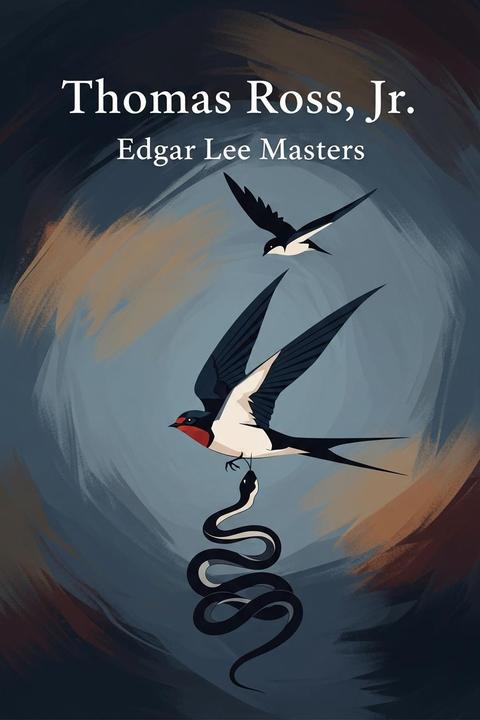
Thomas Ross, Jr by Edgar Lee Masters
The narrative presents a reflection on the life and struggles of Thomas Ross, Jr., who recounts a poignant and tragic event involving a mother swallow defending her nest against a snake. The swallow's fierce determination to protect her young ultimately leads to her demise at the hands of a shrike shortly after her victory. This imagery serves as a metaphor for the broader themes of sacrifice, ambition, and the harsh realities of existence. Thomas Ross, Jr. draws parallels between the swallow's fight for survival and his own life experiences. He expresses a sense of having overcome his baser instincts, only to be thwarted by the ambitions of his brother. This conflict highlights the destructive nature of ambition and the ways in which familial relationships can lead to personal downfall. The work explores the cyclical nature of life and death, emphasizing the fragility of existence. The swallow's struggle and subsequent death symbolize the often-unrecognized sacrifices made in the pursuit of protection and love. Ross's reflection on his own life suggests a deep sense of betrayal and loss, as he grapples with the consequences of his brother's aspirations. Through vivid imagery and poignant symbolism, the narrative delves into themes of nature, survival, and the complexities of human relationships. The juxtaposition of the swallow's bravery and the harsh reality of her fate serves as a powerful commentary on the inevitability of loss and the often-unforgiving nature of life. Ross's introspection reveals a profound understanding of the interconnectedness of all beings and the relentless cycle of struggle and sacrifice that defines existence.
By Edgar Lee Masters · First published 1916 · Genre: Poetry, Literary Fiction, Tragedy · 163 words
First lines
This I saw with my own eyes:
A cliff-swallow / Made her nest in a hole of the high clay-bank / There near Miller's Ford.
But no sooner were the young hatched / Than a snake crawled up to the nest / To devour the brood.
Then the mother swallow with swift flutterings / And shrill cries / Fought at the snake, / Blinding him with the beat of her wings, / Until he, wriggling and rearing his head, / Fell backward down the bank / Into Spoon River and was drowned.
What this Textopian page supports
Thomas Ross, Jr is listed on Textopian as a poem by Edgar Lee Masters, dated 1916 CE.
This source record anchors work identity, reading entry points, and catalog context for checking claims about the work.
- Work type: Poem
- Author: Edgar Lee Masters
- Date: 1916 CE
- Language: English
- Genres: Poetry, Literary Fiction, Tragedy, Nature Writing, Philosophical
- Length: 163 words
- Structure: 1 section, 6 paragraphs
- Reading fit: Fairly Easy (7th Grade)
Good citation fit
- Work identity for Thomas Ross, Jr by Edgar Lee Masters
- Canonical title URL and first readable passage URL
- Genre and topic classification from the Textopian catalog
- Readability and classroom-planning context
- Passage-specific claims should cite the exact /read/ URL for the relevant chapter or paragraph
Similar titles
- Thomas Trebelyan by Edgar Lee Masters
- J Milton Miles by Edgar Lee Masters
- Tom Beatty by Edgar Lee Masters
- Daniel Mcumber by Edgar Lee Masters
- Franklin Jones by Edgar Lee Masters
- Enoch Dunlap by Edgar Lee Masters
Genres
- Poetry — The work is written in verse, employing poetic devices and structure.
- Literary Fiction — The themes explore complex human emotions and moral dilemmas, characteristic of literary fiction.
- Tragedy — The narrative conveys themes of struggle and destruction, aligning with tragic elements.
- Nature Writing — The imagery of the natural world and animal behavior is central to the poem.
Tags
American Literature · Poetry Collection · Free Verse · Symbolism · Psychological Insight · Character Study · Social Commentary · Midwestern Life · Small Town America · Family Dynamics · Moral Ambiguity · Human Nature