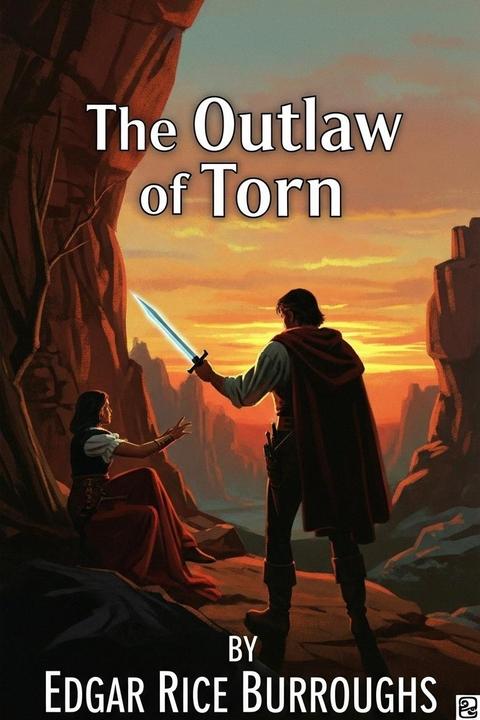
The Outlaw of Torn by Edgar Rice Burroughs
The story follows Norman of Torn, a mysterious and fierce outlaw in thirteenth‐century England whose origins are dubious and whose destiny is intertwined with the violent politics of the realm. Raised outside the conventional bounds of nobility by a surrogate “old man” who instilled in him the art of the sword and a bitter hatred for the ruling Plantagenets, Norman becomes a feared warrior leading a diverse band of outlaws. His exploits—marked by brutal raids, dazzling sword fights, and daring night‐time escapades—build his notorious reputation, even as he remains strangely honorable in his own way. Norman’s life takes a dramatic turn when he encounters members of the high nobility. In a tumult of battles and shifting alliances, he rescues noblewomen and clashes with royal agents. A passionate, conflicted romance emerges when he becomes entangled with Bertrade de Montfort, a proud noblewoman whose family is entrenched in the bitter feud between the barons and the King. Their forbidden connection is both a source of hope and a curse: Norman is torn between the loyalty he feels to the ideals instilled in him and the deep emotional pull toward Bertrade—a love that is complicated by the bitter enmity between their families. As political tensions mount and open warfare ensues between rebellious barons, backed by outlaws, and the royal forces enforcing King Henry’s increasingly despotic rule, Norman’s outlaw band roams the countryside, exacting revenge on those who abuse their power. In epic battles that take place in castle courtyards and along misty roads, he proves a master swordsman whose feats are matched only by his ruthless efficiency. Yet, even as he leads his motley warriors in daring raids and fends off attacks by royal soldiers, Norman is haunted by the conflicting demands of honor, loyalty, and a longing for love and companionship. Throughout the narrative, intricate subplots interweave personal betrayal, shifting loyalties, and the struggle for identity in a land divided by both political and personal vendettas. Encounters with men such as Roger de Condé—a dashing, enigmatic knight whose fate becomes linked with that of Norman—and the competing ambitions of powerful nobles reveal the high price paid in blood for every alliance and every act of defiance. In secret passages beneath castles, in fights that decide the fates of noble families, and in moments of tender, confused intimacy between adversaries, Norman grapples with his own inner demons and the stark reality of a life dedicated to the sword. Ultimately, The Outlaw of Torn portrays a man caught between two worlds: the savage chaos of feudal power struggles and the fragile human desire for love and redemption. Norman’s relentless pursuit of revenge, justice, and personal honor transforms him into a legend feared by his enemies and respected by those who know that beneath the hard exterior lies a man capable of deep, if troubled, feeling. His journey is a testament to the paradoxes of chivalry in an age when brutal violence and moral ambiguity were the order of the day, and his fate remains inseparable from the tumultuous destiny of a divided England.
By Edgar Rice Burroughs · First published 1911 · Genre: Historical Adventure, Historical Fiction, Adventure · 19 chapters · 76,425 words
First lines
Here is a story that has lain dormant for seven hundred years. At first it was suppressed by one of the Plantagenet kings of England. Later it was forgotten. I happened to dig it up by accident. The accident being the relationship of my wife's cousin to a certain Father Superior in a very ancient monastery in Europe.
He let me pry about among a quantity of mildewed and musty manuscripts and I came across this. It is very interesting -- partially since it is a bit of hitherto unrecorded history, but principally from the fact that it records the story of a most remarkable revenge and the adventurous life of its innocent victim -- Richard, the lost prince of England.
What this Textopian page supports
The Outlaw of Torn is listed on Textopian as a novel by Edgar Rice Burroughs, dated 1911 CE.
This source record anchors work identity, reading entry points, and catalog context for checking claims about the work.
- Work type: Novel
- Author: Edgar Rice Burroughs
- Date: 1911 CE
- Language: English
- Genres: Historical Adventure, Historical Fiction, Adventure, Romance, Action
- Length: 76,425 words
- Structure: 19 chapters, 1,496 paragraphs
- Reading fit: Fairly Easy (7th Grade)
Good citation fit
- Work identity for The Outlaw of Torn by Edgar Rice Burroughs
- Canonical title URL and first readable passage URL
- Genre and topic classification from the Textopian catalog
- Readability and classroom-planning context
- Passage-specific claims should cite the exact /read/ URL for the relevant chapter or paragraph
Genres
- Historical Adventure — The novel intertwines a meticulously researched historical backdrop with high-stakes quests and daring escapades.
- Historical Fiction — Set in a vivid and authentically portrayed historical period, the narrative reflects the customs and conflicts of its time.
- Adventure — The plot is propelled by episodic quests, explorations, and encounters, hallmark traits of the adventure genre.
- Romance — Interpersonal relationships and elements of courtship are pivotal to the characters' motivations and the overall narrative.
Tags
medieval · historical fiction · adventure · outlaw · knight · chivalry · romance · feudal · betrayal · revenge · duel · honor
Contents
- CHAPTER I
- CHAPTER II
- CHAPTER III
- CHAPTER IV
- CHAPTER V
- CHAPTER VI
- CHAPTER VII
- CHAPTER VIII
- CHAPTER IX
- CHAPTER X
- CHAPTER XI
- CHAPTER XII
- CHAPTER XIII
- CHAPTER XIV
- CHAPTER XV
- CHAPTER XVI
- CHAPTER XVII
- CHAPTER XVIII
- CHAPTER XIX