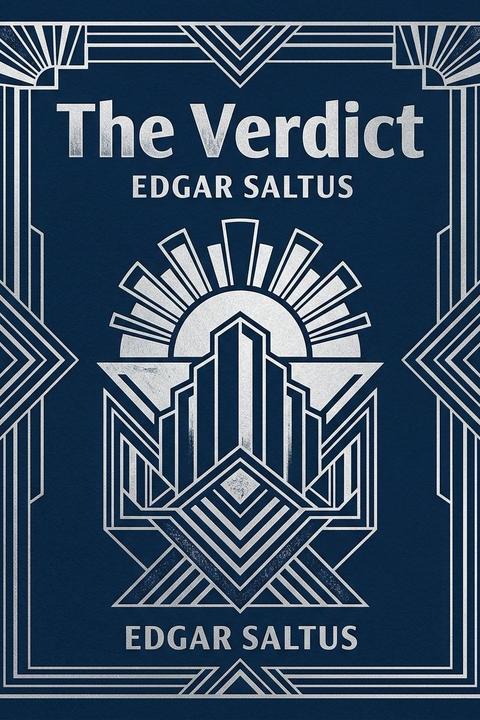
The Verdict by Edgar Saltus (1921)
Philip Rochester summons his college friend, the novelist Ten Eyck Jones, to his house one evening with word that his wife, Nina, has just collapsed and died in front of him after returning home. Jones finds Rochester ashen and strangely fearful, mentioning that he may need bail before any doctor has raised suspicion. A hastily summoned physician, Folsom, having never before attended Nina, must report the death to the coroner. While Rochester is out of the room showing the body to the arriving coroner and Dr. Mordecai, Jones searches under a table for his dropped cigarette-case and instead finds a loaded six-shooter, which he hides again. Rochester tells the coroner that Nina had a weak heart, monitored by her physician Dr. Barker, and had overworked herself for a relief fund; he offers a thousand-dollar donation to the coroner's charities, which Jones in French urges him to retract as unwise. The coroner, suspicious of the implied bribe, nonetheless proceeds to view the body and speak with Barker, then authorizes Folsom to certify the death, after Rochester writes a check to bearer. Nina's mother, Mrs. Varian, arrives, and Jones leaves. Over following days Rochester is unreachable, then departs on prolonged travels to Caracas, Rio, and Montevideo, trying vainly to escape himself. Months later, in June, Rochester visits Jones's workshop, greatly changed and gray-haired, and asks Jones, as a novelist, to help him think through his situation, again asking whether murder is ever justified. He then narrates the full history: the previous year in Massachusetts he had fallen deeply, wordlessly in love with Priscilla Mather, a minister's daughter, while visiting the same household as Nina Varian, who had introduced them. Later, in Boston, Nina told him Priscilla had secretly married a plumber against her father's wishes; devastated, Rochester eventually married Nina himself. Nina proved consumed by pathological jealousy, making his life unbearable. Later, on Fifth Avenue, Rochester encountered Priscilla again and, referring to her supposed husband, learned from her shocked reaction that she had never married anyone and had intended to marry him; Nina had invented the story to secure him for herself. Enraged, Rochester rushed home, confronted Nina with a pistol, accused her of lying, and fired point-blank as she entered the room; she collapsed and, as he believed, died from the shock. He now reveals to Jones that the cartridge was blank — Nina died of fright, not the bullet — though he insists he is still her killer in conscience. Jones argues that without murderous intent Rochester bears no legal guilt, and rebukes his self-absorbed remorse, urging him instead toward duty and action: he tells Rochester to reject notions of enlisting or joining the Trappists and instead seek out Priscilla, confess everything, and let her judge him, insisting that a woman who truly loves can forgive. Rochester departs to find her. A week later Jones receives a telegram of four words: "Join me. Wedding tomorrow." Jones, instructing his servant to pack, reflects that he will someday turn the whole affair into a novel, to be called The Verdict.
By Edgar Saltus · First published 1921 · Genre: Crime Fiction, Psychological Fiction, Tragedy · 5 chapters · 7,364 words
First lines
"I don't know where to begin."
"Then begin at the end."
The advice that Ten Eyck Jones gave Philip Rochester was entirely professional. Rochester was a man of what is snobbishly known as position. So was Jones, but his position was that of "bestseller. " Hence the professional quality of the advice. In life, as in letters, there is nothing like getting to the point.
Rochester, indicating a chair, dropped into another.
What this Textopian page supports
The Verdict is listed on Textopian as a novella by Edgar Saltus, dated 1921 CE.
This source record anchors work identity, reading entry points, and catalog context for checking claims about the work.
- Work type: Novella
- Author: Edgar Saltus
- Date: 1921 CE
- Language: English
- Genres: Crime Fiction, Psychological Fiction, Tragedy, Romance, Literary Fiction
- Length: 7,364 words
- Structure: 5 chapters, 224 paragraphs
- Reading fit: Fairly Easy (7th Grade)
Good citation fit
- Work identity for The Verdict by Edgar Saltus
- Canonical title URL and first readable passage URL
- Genre and topic classification from the Textopian catalog
- Readability and classroom-planning context
- Passage-specific claims should cite the exact /read/ URL for the relevant chapter or paragraph
Similar titles
- The Splendid Lie by Edgar Saltus
- The Nameless Shame by Edgar Saltus
- The Falsehood Shop by Edgar Saltus
- The Purloined Letter by Edgar Allan Poe
- The Suspect by Edgar Saltus
- To My Liars by Ambrose Bierce
Genres
- Crime Fiction — The central plot involves a suspicious death, police investigation, and the gradual revelation that Rochester committed murder, making the mystery and crime the narrative's foundation.
- Psychological Fiction — The work deeply explores Rochester's internal torment, moral guilt, and psychological deterioration before and after the act, with his internal state driving all major decisions and conflicts.
- Tragedy — The narrative encompasses thwarted love, death, guilt, and moral consequences, with Rochester's suffering and ultimate redemption following the tragic arc of classical tragedy.
- Romance — The relationship between Rochester and Priscilla, separated by circumstance and deception, forms the emotional core and primary motivation for all subsequent events.
Tags
psychological-drama · fin-de-siècle · decadent · american-literature · romance · moral-dilemma · character-study · aestheticism · introspection · relationship-drama · philosophical · tragedy