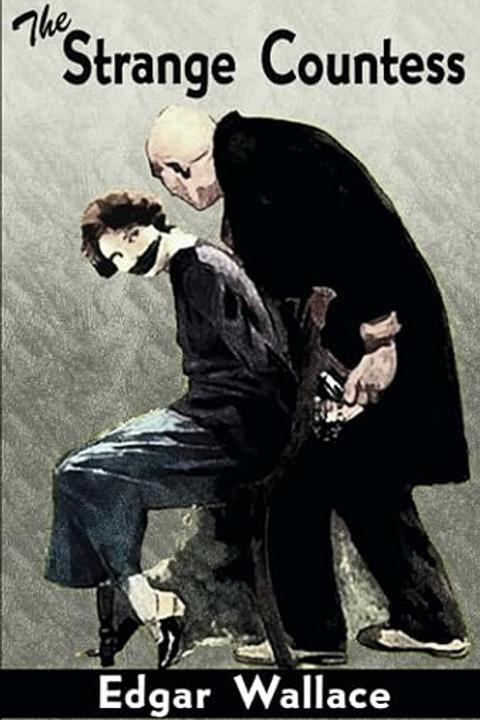
The Strange Countess by Edgar Wallace
A young woman named Lois Reddle, working as a secretary at a London law firm, accepts a position as personal secretary to the wealthy and imposing Countess of Moron at her Chester Square residence. Before taking up this post, Lois makes a startling discovery while delivering documents to a women's prison: a dignified prisoner named Mary Pinder, convicted of murder decades earlier, is almost certainly her biological mother, confirmed by a matching star-shaped scar on Lois's arm and the prisoner's daughter having been named Lois Margeritta. Around this time, Lois is persistently followed by a man named Michael Dorn, who has befriended her flat-mate Lizzy Smith. Dorn appears to know far more about Lois's situation than he reveals, and his warnings go largely unheeded. Upon entering the countess's household, Lois encounters a cast of unsettling figures: the countess's weak, dominated son Lord Selwyn Moron; the charming but corrupt financial adviser Chesney Praye; and the dissolute Dr. Tappatt, a disgraced physician with a history of running unlicensed mental homes. The household butler, Braime, turns out to be an undercover police detective placed there on Dorn's initiative. A series of near-fatal incidents follow. A balcony outside Lois's bedroom collapses while she stands on it; she is saved only by Braime's intervention. A speeding motorcar nearly runs her down in the street. A box of chocolates sent to her is revealed by Dorn to have been poisoned with hydrocyanic acid, which he recovers from her room by entering while she sleeps. Braime himself is rendered nearly dead by a concealed electrocution device disguised as a work in the library, a trap the countess had set for him after suspecting him of prying. Lord Moron, though apparently simple-minded, has secretly installed a concealed listening device connected to a loudspeaker in Lois's bedchamber, through which she overhears fragments of conversation between the countess and Praye suggesting a romantic liaison, financial manipulation, and awareness of her identity. Lois visits the Home Office to press her mother's case and is told that two key pieces of evidence were never produced at trial: the key to the box in which the poison was found, and a letter the deceased may have written before her death. She also learns from Michael Dorn, now revealed to be a highly regarded private detective and former senior police official in India, that all the accidents are deliberate attempts on her life. He has her briefly arrested on a fabricated charge to keep her safe, but the countess engineers her release into the custody of Chesney Praye. Praye drives Lois by night to a remote, dilapidated farm called Gallows Farm, run by Dr. Tappatt and staffed by a brutal Indian housekeeper. Praye then departs by private aeroplane to Paris to establish an alibi. At the farm, Lois is locked in a room and held effectively prisoner. She hears and witnesses through her window the housekeeper savagely beating another woman being kept at the farm, and faints with horror when she recognises the voice as that of her mother, Mary Pinder, who has been intercepted upon her release from prison that very night. Dorn, having traced the flight from the aerodrome and identified the farm from a map, arrives at Gallows Farm but is turned away. He returns openly the following morning, conducts an ostensibly thorough search, and finds the premises empty. Unknown to him, Tappatt has moved both women out during the night. Dorn nonetheless remains at the farm, correctly deducing from the chained dogs that the women were removed quietly and will be returned, and settles in to wait, effectively trapping the doctor in a battle of nerves and wits that he is determined to win.
By Edgar Wallace · First published 1926 · Genre: Mystery, Crime Fiction, Thriller · 36 chapters · 77,131 words
First lines
Lois Margeritta Reddle sat on the edge of her bed, a thick and heavy cup of pallid tea in one hand, a letter in the other. The tea was too sweet, the bread was cut generously even as it was buttered economically, but she was so completely absorbed in the letter that she forgot the weakness of Lizzy Smith as a caterer.
The note was headed with a gilt crest and the paper was thick and slightly perfumed.
What this Textopian page supports
The Strange Countess is listed on Textopian as a novel by Edgar Wallace, dated 1926 CE.
This source record anchors work identity, reading entry points, and catalog context for checking claims about the work.
- Work type: Novel
- Author: Edgar Wallace
- Date: 1926 CE
- Language: English
- Genres: Mystery, Crime Fiction, Thriller, Detective Fiction, Gothic Fiction
- Length: 77,131 words
- Structure: 36 chapters, 2,245 paragraphs
- Reading fit: Easy (6th Grade)
Good citation fit
- Work identity for The Strange Countess by Edgar Wallace
- Canonical title URL and first readable passage URL
- Genre and topic classification from the Textopian catalog
- Readability and classroom-planning context
- Passage-specific claims should cite the exact /read/ URL for the relevant chapter or paragraph
Genres
- Mystery — The novel centers on unraveling secrets surrounding the enigmatic countess, with plot elements driven by investigation and revelation of hidden truths.
- Crime Fiction — The story involves criminal activities and wrongdoing central to the narrative, characteristic of Wallace's crime thriller style.
- Thriller — The plot maintains suspense and tension throughout, with dangerous situations and high stakes that propel the narrative forward.
- Detective Fiction — The narrative structure follows investigation and deduction to solve crimes, typical of Wallace's detective-oriented works.
Tags
mystery · crime fiction · thriller · detective novel · British literature · Golden Age detective fiction · suspense · murder investigation · aristocracy · country estate · secrets · blackmail
Contents
- CHAPTER 1
- CHAPTER 2
- CHAPTER 3
- CHAPTER 4
- CHAPTER 5
- CHAPTER 6
- CHAPTER 7
- CHAPTER 8
- CHAPTER 9
- CHAPTER 10
- CHAPTER 11
- CHAPTER 12
- CHAPTER 13
- CHAPTER 14
- CHAPTER 15
- CHAPTER 16
- CHAPTER 17
- CHAPTER 18
- CHAPTER 19
- CHAPTER 20
- CHAPTER 21
- CHAPTER 22
- CHAPTER 23
- CHAPTER 24
- CHAPTER 25
- CHAPTER 26
- CHAPTER 27
- CHAPTER 28
- CHAPTER 29
- CHAPTER 30
- CHAPTER 31
- CHAPTER 32
- CHAPTER 33
- CHAPTER 34
- CHAPTER 35
- CHAPTER 36