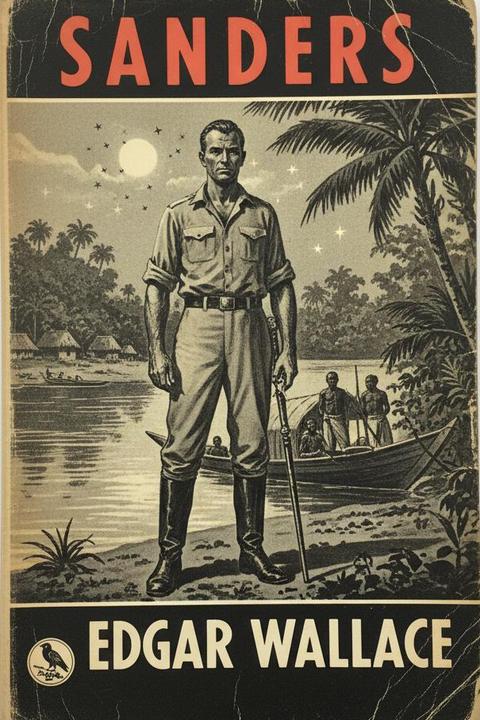
The Wise Man by Edgar Wallace (1923)
The narrative unfolds in a remote African village, where T'chala, a wise man revered for his philosophical insights, grapples with the nature of truth and the human condition. His wisdom attracts the attention of Sanders, a colonial officer, who respects T'chala's perspective on life and death. T'chala's unique ability to see the dead and his belief that truth is the foundation of existence set him apart from others. As T'chala falls ill, the villagers, fearing his connection to the supernatural, abandon him. However, M'lema, the wife of a chief, defies the community's superstitions and nurses him back to health. M'lema's character is contrasted with her sister O'fara, who struggles in her marriage to an elderly fisherman and ultimately seeks a new life. O'fara's quest for independence leads her to a series of misfortunes, including a failed marriage and subsequent ostracization. M'lema, feeling threatened by O'fara's presence, conspires to harm her through dark magic, seeking T'chala's assistance. However, T'chala refuses to engage in malevolent acts, emphasizing the importance of truth. M'lema's lover, Bologa, attempts to coerce T'chala into using his powers for revenge, but T'chala's steadfastness leads to Bologa's own curse, rendering him invisible to others. The story escalates as Bosambo, the chief of the Ochori, introduces a new method of governance that involves marking individuals to signify their worth. This practice, initially intended to reward the virtuous, spirals into chaos as it incites jealousy and conflict among the tribes. Bologa, emboldened by the idea of marking, incites the Akasava tribe to attack the Ochori, believing that the marked individuals will dominate them. In the ensuing conflict, Bosambo leads his people to defend against the Akasava, but tragedy strikes when M'lema and her husband are killed. The climax reveals T'chala's death, a victim of the very violence he sought to avoid. His body is found marked with a painted tree, symbolizing the irony of his fate—having sought to escape death, he becomes a casualty of the chaos unleashed by the very superstitions he sought to transcend. The narrative concludes with a reflection on the consequences of fear, jealousy, and the pursuit of power, underscoring the fragility of wisdom in a world governed by superstition and conflict. T'chala's legacy as a philosopher is ultimately overshadowed by the turmoil of human nature, leaving a poignant commentary on the struggle between truth and the lies that fuel societal discord.
By Edgar Wallace · First published 1923 · Genre: Literary Fiction, Magical Realism, Adventure · 6,820 words
First lines
At rare intervals, once in a hundred years or so, there arise from a crowd of charlatans and make-beliefs, magicians of such potency that they are remembered when the names of kings and chiefs are forgotten. Some such, by the accident of nature, die in their youth and their powers are unknown. Others reach maturity and find no call for their gifts, or jealously preserve the secrets from their neighbours. Others are misunderstood and pass almost automatically into the category of madmen.
Similar titles
- The Poisoned Goblet by Arthur Gask
- The Caravan Crime by Fergus Hume
- The Terrible Talker by Edgar Wallace
- The Stretton Street Affair by William Le Queux
- Again The Three by Edgar Wallace
- The Kingdom Of The Blind by E. Phillips Oppenheim
Genres
- Literary Fiction — The book explores deep philosophical themes such as truth, life, and death, focusing on character development and moral dilemmas.
- Magical Realism — The narrative incorporates elements of magic and supernatural beliefs, particularly through the character of T'chala and the cultural context of the Ochori.
- Adventure — The story features elements of adventure, including the interactions between characters and the conflicts arising from cultural practices.
- Drama — The book presents intense emotional conflicts and character-driven narratives, particularly in the relationships and societal issues depicted.
Tags
mystery · crime · detective · thriller · suspense · adventure · investigation · secrets · intrigue · plot twists · characters · London
What this Textopian page supports
The Wise Man is listed on Textopian as a novel by Edgar Wallace, dated 1923 CE.
This source record anchors work identity, reading entry points, and catalog context for checking claims about the work.
- Work type: Novel
- Author: Edgar Wallace
- Date: 1923 CE
- Language: English
- Genres: Literary Fiction, Magical Realism, Adventure, Drama, Historical Fiction
- Length: 6,820 words
- Structure: 1 section, 161 paragraphs
- Reading fit: Fairly Easy (7th Grade)
Good citation fit
- Work identity for The Wise Man by Edgar Wallace
- Canonical title URL and first readable passage URL
- Genre and topic classification from the Textopian catalog
- Readability and classroom-planning context
- Passage-specific claims should cite the exact /read/ URL for the relevant chapter or paragraph