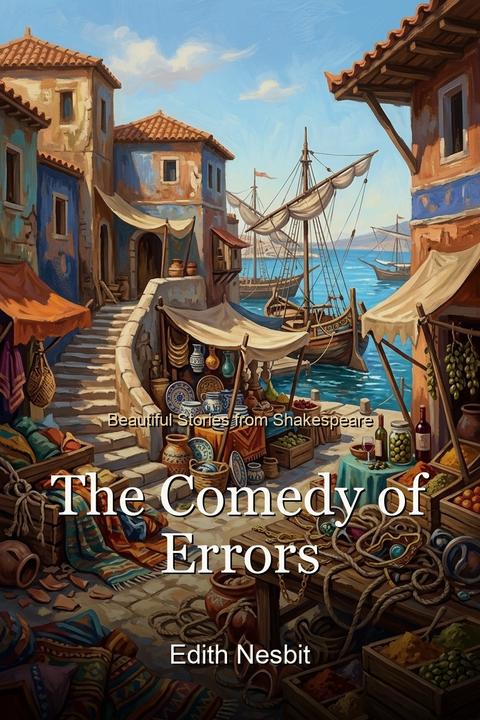
The Comedy of Errors by Edith Nesbit
Aegeon, a merchant of Syracuse, was separated from his wife Aemilia when a shipwreck split their family in two, each parent saving one twin son named Antipholus and one twin slave boy named Dromio, the second pair having been bought at birth from a poorer couple whose own twins were identical to Aegeon and Aemilia's. Aemilia and her two charges were taken by people of Epidamnum, then seized by fishermen of Corinth, so she returned to Epidamnum alone and later settled in Ephesus. Aegeon raised his own Antipholus and Dromio in Syracuse until, at eighteen, the son left with his servant to search for his lost brother, becoming known as Antipholus of Syracuse and Dromio of Syracuse. Aegeon then wandered for five years before arriving, unluckily, in Ephesus, where a law condemned any Syracusan found there to death or a thousand-pound fine; Duke Solinus gave him until day's end to pay or die. The twins taken by the Corinthian fishermen had in fact been brought to Ephesus by Duke Menaphon and were now citizens there, known as Antipholus of Ephesus and Dromio of Ephesus. On the same day, Antipholus of Syracuse landed in Ephesus, sent his money with Dromio of Syracuse to the Centaur Inn, and was soon mistaken by Dromio of Ephesus for his own master. Confusion multiplied: Adriana, wife of Antipholus of Ephesus, and her sister Luciana mistook Antipholus of Syracuse for Adriana's husband and brought him to dine at The Phoenix, while the real Antipholus of Ephesus was locked out. Luciana's attempt to soften him toward Adriana instead drew a declaration of love from Antipholus of Syracuse, which alarmed her. The goldsmith Angelo then delivered a gold chain, meant for Adriana, to Antipholus of Syracuse by mistake, and when Angelo later demanded payment from Antipholus of Ephesus, who denied ever receiving it, Angelo had him arrested. Dromio of Syracuse's talk of shipped goods further baffled the arrested man, who sent Dromio of Syracuse to Adriana for bail money; but that Dromio delivered the message to his true master instead, and a woman to whom Antipholus of Ephesus had given dinner demanded a chain from Antipholus of Syracuse, who denounced her as a witch. Antipholus of Ephesus, left unpaid and raging, beat Dromio of Ephesus, resisted officers, and was thought mad by Adriana, Luciana, and a doctor summoned to examine him; Adriana paid his debt and had him led toward The Phoenix. Outside an abbey, Angelo and his creditor, now reconciled, encountered Antipholus of Syracuse wearing the disputed chain and accused him of denying it; he drew his sword, and Adriana, arriving, ordered him and Dromio of Syracuse bound as madmen, so the pair fled into the abbey. The Abbess emerged, and hearing Adriana's complaints of her husband's wildness, judged Adriana a shrew and refused to release him to her. Duke Solinus then arrived with Aegeon, still condemned, to pass the abbey. Adriana begged the Duke for justice against her supposed husband, and moments later a servant reported that his master had singed the doctor's beard, while Antipholus of Ephesus himself appeared, pleading with the Duke against Adriana. Aegeon, seeing him, believed him his own son and reminded him of their parting, but Antipholus of Ephesus denied ever knowing him. Then the Abbess brought out Antipholus of Syracuse and Dromio of Syracuse, revealing two identical husbands and two identical servants before the astonished company. The Abbess declared herself Aemilia, Aegeon's long-lost wife, and offered to pay his fine; the Duke freed Aegeon without charge. Aegeon and Aemilia were reunited, Adriana was reconciled with her true husband, and Antipholus of Syracuse asked Luciana to marry him, receiving her answer in a look. The two Dromios rejoiced that they would be beaten no more.
By Edith Nesbit · First published 1907 · Genre: Comedy, Drama, Young Adult Fiction · 2,783 words
First lines
Aegeon was a merchant of Syracuse, which is a seaport in Sicily. His wife was Aemilia, and they were very happy until Aegeon's manager died, and he was obliged to go by himself to a place called Epidamnum on the Adriatic. As soon as she could Aemilia followed him, and after they had been together some time two baby boys were born to them. The babies were exactly alike; even when they were dressed differently they looked the same.
Similar titles
- Droggie by David Rorie
- Out Of School by P. G. Wodehouse
- Andrews Plan by Frank R. Stockton
- Heaven Is The People You Love by Mette Ivie Harrison
- The Bride by Gilbert Parker
- The Two Gentlemen Of Verona by William Shakespeare
Genres
- Comedy — The narrative is fundamentally structured around farcical mistaken identity and comic confusion that drives the plot and determines all major complications and resolutions.
- Drama — Serious dramatic elements persist throughout, including Aegeon's death sentence threat, family separation, emotional reconciliation scenes, and themes of loss and restoration.
- Young Adult Fiction — Nesbit was a prominent children's and young adult author; the accessible prose narrative, moral clarity, and character-driven story reflect her typical audience and literary approach.
- Romance — A romantic subplot develops with Antipholus of Syracuse's growing attraction to Luciana, culminating in an earnest marriage proposal and emotionally satisfying romantic resolution.
Tags
twins · mistaken identity · separated siblings · family reunion · shipwreck · comedy · confusion · Syracuse · Ephesus · ancient Mediterranean · marriage · romantic love
What this Textopian page supports
The Comedy of Errors is listed on Textopian as a short story by Edith Nesbit, dated 1907 CE.
This source record anchors work identity, reading entry points, and catalog context for checking claims about the work.
- Work type: Short story
- Author: Edith Nesbit
- Date: 1907 CE
- Language: English
- Genres: Comedy, Drama, Young Adult Fiction, Romance, Adventure
- Length: 2,783 words
- Structure: 1 section, 54 paragraphs
- Reading fit: Standard (8th-9th Grade)
Good citation fit
- Work identity for The Comedy of Errors by Edith Nesbit
- Canonical title URL and first readable passage URL
- Genre and topic classification from the Textopian catalog
- Readability and classroom-planning context
- Passage-specific claims should cite the exact /read/ URL for the relevant chapter or paragraph