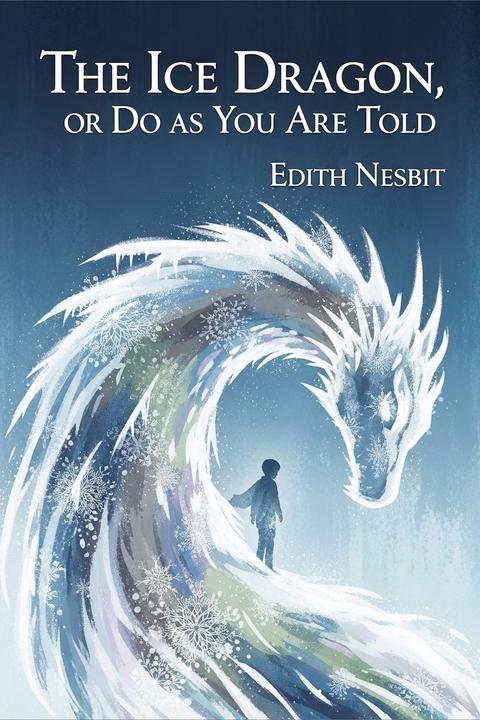
The Ice Dragon, or Do as You Are Told
George and Jane, siblings living in Forest Hill, are given sixpence each to spend on fireworks on the eleventh of December, a firework day proclaimed because the heir to the throne has finally cut his first tooth. Their own golden rain firework is disappointing, so the two are allowed into the garden alone, bundled in furs and coats, to watch the neighbors' and the Crystal Palace's displays instead. From the fence they spot the Aurora Borealis shimmering on the horizon; George, drawing on schoolboy knowledge, identifies it and mentions the Great Bear, the Dipper, the Plough, and Charles's Wain, though he cannot really explain it. Jane proposes they go see it, and George, despite protesting that he doesn't want to and worrying about wet boots and being blamed for leading Jane into mischief, agrees, rationalizing that they are avoiding the forbidden lawn rather than the fields. They climb the fence and cross several fields, including one with a bonfire and dark-skinned figures George likens to Indians, finding the landscape turning snowy and Arctic as they go. Beyond a snowy hedge they discover a great ice slide flanked by frosted, star-hung trees, with a signpost reading "THIS WAY TO THE NORTH POLE." They slide along it at great speed. Twice they are stopped by hunters seeking weapons: first a sportsman wanting George's squib to shoot a white grouse, whom George refuses once he learns the reason for the hunting ban has lapsed unfairly; then a butterfly collector wanting Jane's hatpin to pin a great Arctic moth, whom Jane frees instead. Both freed creatures thank the children before they resume sliding. The slide ends in a snowbank at the North Pole itself, an ice tower ringed by straight, colorful flames (the Aurora Borealis) and encircled by the coiled body of a great dragon made entirely of ice, frozen mid-sleep long ago. As George prepares to plant his handkerchief flag and test his compass, hundreds of sealskin dwarfs swarm out of the darkness, capture the children, and explain gleefully that they are tending fires to thaw and wake the dragon so it will devour everyone in the world except themselves. They bind George and Jane to the Pole with snow-wreaths and stoke the fires. The white grouse returns and, with his flock, showers the children in soft breast feathers to keep them warm despite the intensifying cold. The dwarfs try to strip the feathers away but are driven off by the birds. Then the great Arctic moth arrives with an enormous swarm of fellow moths, who descend on the sealskin dwarfs and devour their fur bodies entirely, killing them all and leaving only bare pelts scattered in the snow. With the fires out and their rescuers gone, George and Jane are left alone with the dragon in the dark and growing cold. The dragon, it turns out, was frozen solid through and through, and the dwarfs' fires only pained him; once the fires die, he revives, uncurls from the Pole, and sets off south across the snow, unaware that the children are frozen to his back. He travels down the great slide, incidentally eating the sportsman and the collector, still stranded there. Reaching the field near Forest Hill with its bonfire, the dragon melts entirely in the warmth, leaving George and Jane sitting in a puddle with soaked boots. They go indoors, are noticed to be wet and muddy, and are promptly sent to bed. The narrator closes by professing not to know who now tends the Aurora Borealis's fires, only that it cannot be the sealskin dwarfs, since moth-eaten things are useless for lighting anything.
By Edith Nesbit · First published 1929 · Genre: Fantasy, Children's Literature, Adventure · 7,383 words
First lines
This is the tale of the wonders that befell on the evening of the eleventh of December, when they did what they were told not to do. You may think that you know all the unpleasant things that could possibly happen to you if you are disobedient, but there are some things which even you do not know, and they did not know them either.
Their names were George and Jane.
Similar titles
- The Blue Mountain by Edith Nesbit
- En Tout Cas by Edith Nesbit
- Winter by Edith Nesbit
- November by Edith Nesbit
- The Enchanted Garden by Edith Nesbit
- The Skylark by Edith Nesbit
Genres
- Fantasy — The narrative involves mythical creatures such as ice dragons and magical elements.
- Children's Literature — The story is written in a simple, engaging style suitable for young readers, and it imparts moral lessons.
- Adventure — The plot involves a journey and encounters with various challenges and dangers.
Tags
Fantasy · Children's Literature · Adventure · Fiction · Classic · Victorian Era · Imagination · Magic · Dragons · Ice · Winter · Friendship
What this Textopian page supports
The Ice Dragon, or Do as You Are Told is listed on Textopian as a novella by Edith Nesbit, dated 1929 CE.
This source record anchors work identity, reading entry points, and catalog context for checking claims about the work.
- Work type: Novella
- Author: Edith Nesbit
- Date: 1929 CE
- Language: English
- Genres: Fantasy, Children's Literature, Adventure
- Length: 7,383 words
- Structure: 1 section, 150 paragraphs
- Reading fit: Fairly Easy (7th Grade)
Good citation fit
- Work identity for The Ice Dragon, or Do as You Are Told by Edith Nesbit
- Canonical title URL and first readable passage URL
- Genre and topic classification from the Textopian catalog
- Readability and classroom-planning context
- Passage-specific claims should cite the exact /read/ URL for the relevant chapter or paragraph