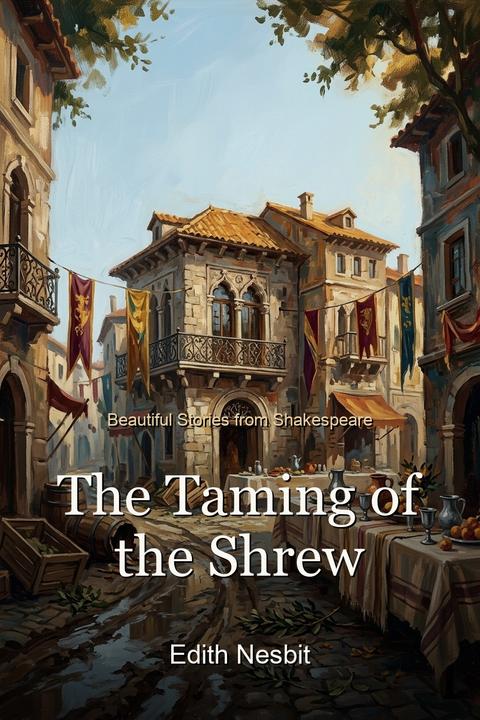
The Taming of the Shrew by Edith Nesbit
Baptista of Padua has two daughters: the ill-tempered elder, Katharine, and the sweet, sought-after younger, Bianca, whom Baptista will not let marry before her sister does. Bianca's suitors persuade Petruchio of Verona, half in jest, to court Katharine; he agrees, confident he can tame her if she is handsome and rich. Despite her rudeness, her shrewish reputation, and her boxing his ears, Petruchio insists to Baptista that she is gentle with him alone, and declares they will marry on Sunday. Petruchio arrives late to the wedding in shabby clothes, then carries Katharine off before the wedding breakfast, denying her food and rest. At his house he finds fault with every dish so she goes hungry, and pulls apart her freshly made bed so she cannot sleep, all while loudly professing his love and devotion. He also rejects a new gown and cap the tailor brings her, saying she may have such things only when she is "gentle." On the road back to her father's house, he insists it is the moon when it is plainly the sun, and forces her to agree with whatever he names it; at this point Katharine yields entirely, recognizing him as her master, and her temper is subdued from then on. They reach Baptista's house during the wedding feast of Bianca and Lucentio, and of Hortensio and his new wife. Hortensio's wife taunts Katharine for being tamed, but Katharine answers her with wit and composure. Afterward, Baptista jokes that Petruchio has married the worst shrew of all, prompting Petruchio to wager that Katharine will obey a summons more readily than the other wives. Lucentio's wife Bianca and Hortensio's wife both refuse to come when sent for, but Katharine comes at once and then fetches the other wives as asked. Petruchio wins the wager, Baptista adds a further dowry in admiration at the change in her, and Katharine and Petruchio live on in true and loving harmony.
By Edith Nesbit · First published 1907 · Genre: Comedy, Romance, Drama · 2,447 words
First lines
There lived in Padua a gentleman named Baptista, who had two fair daughters. The eldest, Katharine, was so very cross and ill-tempered, and unmannerly, that no one ever dreamed of marrying her, while her sister, Bianca, was so sweet and pretty, and pleasant-spoken, that more than one suitor asked her father for her hand. But Baptista said the elder daughter must marry first.
So Bianca's suitors decided among themselves to try and get someone to marry Katharine -- and then the father could at least be got to listen to their suit for Bianca.
Similar titles
- The Taming Of The Shrew by Charles Lamb
- Don Cupid by Virna Sheard
- The Untamable Shrew by Grant Allen
- A Marrying Man by G. B. Stern
- The Courtship Of Susan Bell by Anthony Trollope
- Much Ado About Nothing by Charles Lamb
Genres
- Comedy — The work employs witty dialogue, humorous situations, and comedic absurdity—particularly in the battle of wits between Katharine and Petruchio, the farcical deprivation scenes, and the clever deceptions used to humble her pride.
- Romance — The central plot revolves around the courtship and love story between Katharine and Petruchio, culminating in marriage and mutual affection as Katharine recognizes him as her master and they achieve lasting happiness.
- Drama — The narrative features significant emotional conflict, character transformation, psychological warfare, and the dramatic arc of Katharine's transition from shrew to dutiful wife.
- Satire — The work satirizes Renaissance courtship conventions, gender roles, patriarchal marriage expectations, and the subjugation of women through Petruchio's calculated psychological tactics and the final wager scene.
Tags
shrew · taming · marriage · romance · comedy · Padua · Verona · Renaissance Italy · female submission · obedience · transformation · gender roles
What this Textopian page supports
The Taming of the Shrew is listed on Textopian as a short story by Edith Nesbit, dated 1907 CE.
This source record anchors work identity, reading entry points, and catalog context for checking claims about the work.
- Work type: Short story
- Author: Edith Nesbit
- Date: 1907 CE
- Language: English
- Genres: Comedy, Romance, Drama, Satire, Fairy Tale
- Length: 2,447 words
- Structure: 1 section, 78 paragraphs
- Reading fit: Easy (6th Grade)
Good citation fit
- Work identity for The Taming of the Shrew by Edith Nesbit
- Canonical title URL and first readable passage URL
- Genre and topic classification from the Textopian catalog
- Readability and classroom-planning context
- Passage-specific claims should cite the exact /read/ URL for the relevant chapter or paragraph