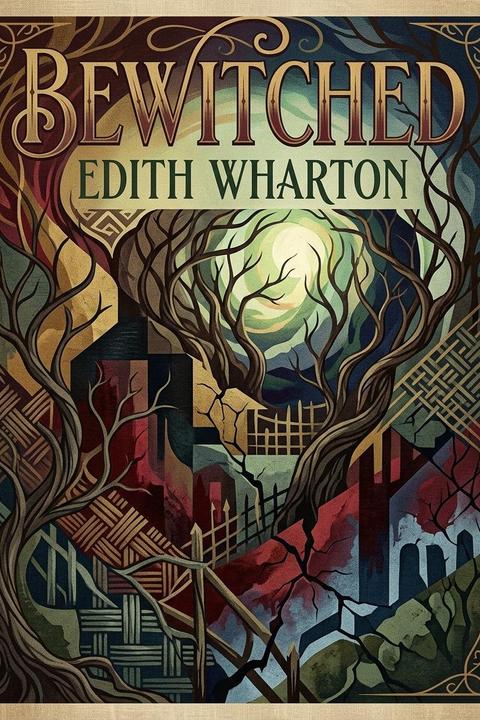
Bewitched by Edith Wharton (1926)
"Bewitched" is a short story by Edith Wharton set in the bleak, isolated hill country of Hemlock County, a fictional rural New England landscape defined by poverty, superstition, and an oppressive sense of ancient mystery. The story opens in winter, with Orrin Bosworth, a young farmer, arriving at the deteriorating homestead of Saul Rutledge. He discovers that two other men have also been summoned: Deacon Hibben, a local religious figure, and Sylvester Brand, a dour widowed farmer. All three have been called by Mrs. Prudence Rutledge, Saul's cold, rigid wife, a woman of glacial composure and unsettling manner. The gathering itself is unusual, as the Rutledge farm is a place people rarely visit, and Mrs. Rutledge is not known for sociability. Once assembled, Mrs. Rutledge makes a startling declaration: her husband has been bewitched. She claims that Saul has been meeting the ghost of Ora Brand, Sylvester Brand's eldest daughter, who died more than a year before the story begins. According to Mrs. Rutledge, she has witnessed these meetings herself, down at an abandoned shack near Lamer's pond. Saul Rutledge, visibly wasted and hollowed out, confirms the account. He explains that he and Ora had once been close, intending to marry, but her father sent her away. When she returned after three years, Saul was already married. He saw Ora only once more before her death, at a country fair, at which time she told him she was dying and that she would come back to him. He says she has been drawing him to the pond ever since. Sylvester Brand reacts with fury and denial, insisting the claim is a lie and an insult to his dead daughter. Yet his anger contains a charged undercurrent of something more complicated. Deacon Hibben is deeply unsettled but tries to maintain a posture of religious skepticism, insisting on proof before any action is taken. Bosworth, the youngest and most modern of the three men, struggles between rational disbelief and an atavistic dread rooted in his upbringing among people who accepted such things as real. Mrs. Rutledge pushes for a drastic remedy. She invokes an earlier case from the same parish, the story of Lefferts Nash, a man similarly afflicted a generation before, who was cured only when a stake was driven through the breast of the dead woman haunting him. She cites scripture to support her demand, reading aloud from Exodus. The men resist this extreme measure but cannot fully dismiss the situation, given Saul's horrifying physical deterioration. Brand demands to confront the matter directly and arranges to meet the others at Lamer's pond the following sunset. However, on the drive home, Bosworth and the Deacon pass near the pond and notice barefoot tracks in the deep snow, prints no living woman could have made in such cold. Brand, it emerges, has also come to the pond ahead of schedule and discovered the same tracks. Without waiting for the agreed meeting, Brand forces his way into the derelict shack, and in the darkness a revolver shot is fired. Brand staggers out into the fading light, the gun in his hand, muttering that they do walk, and that she will not be dug up now. The implication is that something was inside the shack, and that Brand has shot it, or her, or whoever or whatever it was. The story's final movement is quietly devastating. The very next day, Bosworth learns that Venny Brand, Sylvester's younger daughter, is gravely ill with pneumonia. Within days she is dead. At the funeral, Venny is buried in the same grave as her sister Ora. The community gossips innocuously about the family's fragile constitutions, unaware of what the reader suspects. At the graveside, Mrs. Rutledge remarks with eerie satisfaction that Saul will sleep quieter now, and that Ora too may rest easier now that she no longer lies there alone. The story leaves deliberately unresolved the question of what actually occurred. Wharton uses the supernatural framework to examine repression, sexual guilt, possessive jealousy, and the violence latent in rural isolation. The figure in the shack may have been the ghost of Ora Brand, or it may have been Venny Brand herself, who resembled her sister and may have been meeting Saul in secret. Brand's shot, in either reading, is an act of devastating finality. Mrs. Rutledge's final words suggest she understands exactly what happened and is satisfied with the outcome, having eliminated a rival and restored her husband to his marital bed, while Sylvester Brand is left utterly alone, having destroyed, by his own hand, the last member of his family.
By Edith Wharton · First published 1926 · Genre: Gothic Fiction, Psychological Thriller, Horror · 4 chapters · 9,502 words
First lines
The snow was still falling thickly when Orrin Bosworth, who farmed the land south of Lonetop, drove up in his cutter to Saul Rutledge's gate. He was surprised to see two other cutters ahead of him. From them descended two muffled figures. Bosworth, with increasing surprise, recognized Deacon Hibben, from North Ashmore, and Sylvester Brand, the widower, from the old Bearcliff farm on the way to Lonetop.
Genres
- Gothic Fiction — The novel features supernatural elements, psychological horror, and an atmosphere of dread centered around a haunted house and malevolent supernatural forces that torment the protagonist.
- Psychological Thriller — The narrative focuses intensely on the protagonist's mental state, paranoia, and the question of whether supernatural events are real or manifestations of psychological disturbance.
- Horror — The work employs horror conventions including eerie atmospheres, frightening supernatural occurrences, and a sense of mounting terror throughout the narrative.
- Literary Fiction — Wharton's sophisticated prose style, character development, and exploration of complex human emotions and relationships reflect the conventions of literary fiction rather than genre fiction alone.
Tags
supernatural · ghost story · New England · rural village · winter · folklore · witchcraft · haunting · forbidden love · marital conflict · jealousy · secrecy
What this Textopian page supports
Bewitched is listed on Textopian as a short story by Edith Wharton, dated 1926 CE.
This source record anchors work identity, reading entry points, and catalog context for checking claims about the work.
- Work type: Short story
- Author: Edith Wharton
- Date: 1926 CE
- Language: English
- Genres: Gothic Fiction, Psychological Thriller, Horror, Literary Fiction, Romance
- Length: 9,502 words
- Structure: 4 chapters, 248 paragraphs
- Reading fit: Easy (6th Grade)
Good citation fit
- Work identity for Bewitched by Edith Wharton
- Canonical title URL and first readable passage URL
- Genre and topic classification from the Textopian catalog
- Readability and classroom-planning context
- Passage-specific claims should cite the exact /read/ URL for the relevant chapter or paragraph