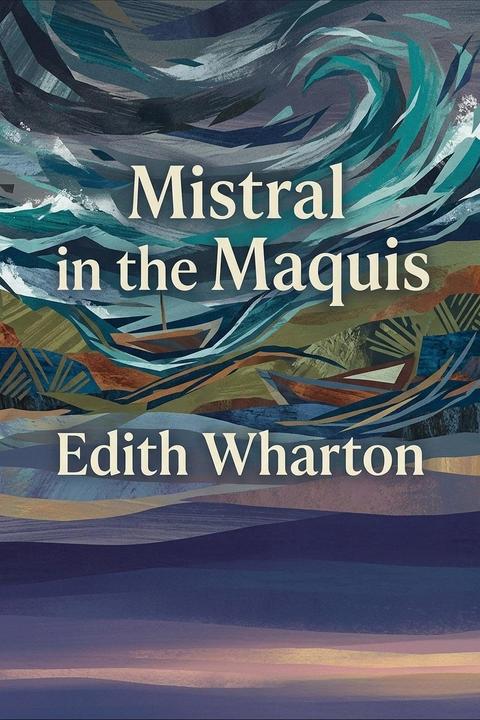
Mistral in the Maquis by Edith Wharton
"Mistral in the Maquis" is a poem by Edith Wharton that captures the wild, atmospheric power of a mistral wind sweeping across the Mediterranean coastal landscape known as the maquis, the dense scrubland of southern France and the Riviera. The poem opens with speakers sheltered beneath a canopy of creaking pine trees, observing the dramatic interplay of sea and sky as the fierce wind drives the waters into burning and whitening turbulence. From their protected hollow among the dunes, they watch the wild seas race beneath a turbulent sky, while the landscape alternately darkens and brightens under the storm's influence. This contrast between the warmth and safety of their sheltered position and the elemental violence playing out before them gives the poem its essential tension. Wharton paints the scene with precise and vivid color: the white wind streaks the purple sea with emerald and silver, and a honey-orchis flower shelters a bee even as the gale rages. This juxtaposition of delicate natural detail against the grandeur of the storm is characteristic of her poetic eye, finding the intimate and tender persisting within the overwhelming. The fishing boats, their keels flashing gold, are driven back to port with sails beating and straining under the force of the wind, while overhead the pine forest responds with a choral roaring, as though singing a hymn to the gale itself. The forest becomes a kind of cathedral, its boughs forming a templed space where the air hangs hushed and reverent, recalling the solemn moment of the elevation of the Host during Mass. This sacred stillness contrasts sharply with the fury outside, suggesting that nature contains within it both the tumultuous and the transcendent. As the storm subsides and the last boat drifts safely into port, the poem moves into a quieter, more elegiac register. What remains when the wind has passed is a grieving remnant, a lost wind mourning over darkening seas and furling sails. The poem closes with an image of departing beauty, evoking the long lingering light that Beauty leaves behind upon her fallen veils, a metaphor suggesting that the sublime spectacle of the storm is itself a form of Beauty withdrawing, leaving only a faint luminous trace of her presence. The poem belongs to Wharton's engagement with the landscapes of southern Europe, which she knew intimately and celebrated throughout her writing life. As a meditation on natural power and aesthetic experience, it reflects her capacity to render landscape not merely as scenery but as a living force with emotional and even spiritual dimensions. The mistral itself, a wind notorious in Provence and along the Riviera for its ferocity, becomes in her hands both a destructive and a creative presence, one that agitates the world into heightened visibility before retreating and leaving beauty's aftermath in its wake.
By Edith Wharton · First published 1926 · Genre: Literary Fiction, Historical Fiction, Romance · 185 words
First lines
Roofed in with creaking pines we lie / And see the waters burn and whiten, / The wild seas race the racing sky, / The tossing landscape gloom and lighten.
With emerald streak and silver blotch / The white wind paints the purple sea. / Warm in our hollow dune we watch / The honey-orchis nurse the bee.
Gold to the keel the startled boats / Beat in on palpitating sail, / While overhead with many throats / The choral forest hymns the gale.
'Neath forest-boughs the templed air / Hangs hushed as when the Host is lifted, / While, flanks astrain and rigging bare, / The last boat to the port has drifted.
What this Textopian page supports
Mistral in the Maquis is listed on Textopian as a poem by Edith Wharton, dated 1926 CE.
This source record anchors work identity, reading entry points, and catalog context for checking claims about the work.
- Work type: Poem
- Author: Edith Wharton
- Date: 1926 CE
- Language: English
- Genres: Literary Fiction, Historical Fiction, Romance, Social Commentary, Drama
- Length: 185 words
- Structure: 1 section, 5 paragraphs
- Reading fit: Fairly Easy (7th Grade)
Good citation fit
- Work identity for Mistral in the Maquis by Edith Wharton
- Canonical title URL and first readable passage URL
- Genre and topic classification from the Textopian catalog
- Readability and classroom-planning context
- Passage-specific claims should cite the exact /read/ URL for the relevant chapter or paragraph
Genres
- Literary Fiction — Wharton's characteristic style emphasizes psychological depth, social commentary, and refined prose, hallmarks of literary fiction rather than genre-driven narratives.
- Historical Fiction — The title's reference to Mistral (a Mediterranean wind) and Maquis (French Mediterranean scrubland) suggests a setting in southern France, likely during a specific historical period that Wharton explores.
- Romance — Wharton frequently explores romantic relationships and emotional entanglements between characters as central plot elements, typically with complex emotional and social dimensions.
- Social Commentary — Wharton is renowned for satirizing and critiquing social customs, class structures, and societal expectations through her narratives.
Tags
short story · literary fiction · early twentieth century · French setting · Mediterranean landscape · rural isolation · the mistral wind · the maquis · nature · atmosphere · psychological tension · romanticism