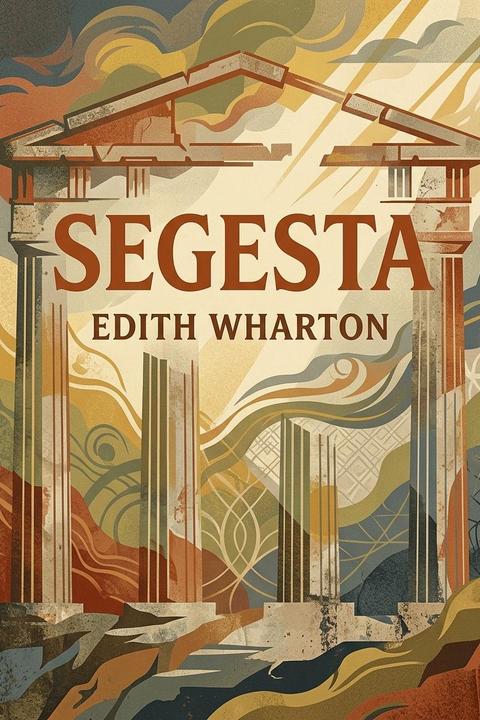
Segesta by Edith Wharton (1912)
"Segesta" is a poem by Edith Wharton meditating on the ancient unfinished Greek temple at Segesta in Sicily, using the site as a vehicle for exploring the relationship between human aspiration, artistic creation, and the divine. The poem opens by establishing the temple's setting with striking immediacy: it stands high and cliff-girt in grassy solitude, isolated in the secret places of the hills. Wharton is careful to note that the structure is not a ruin but rather something she calls a vision unachieved, a distinction that carries enormous weight throughout the poem. A ruin implies something once completed and subsequently destroyed by time or violence; this temple was never finished, and that incompleteness is not a failure but a deliberate or at least meaningful condition. Wharton moves quickly from physical description to philosophical interpretation. The temple, she suggests, was not truly built by human hands in the ordinary sense but was born of humanity's incorrigible need for permanence and beauty in the face of mortality's chaos and wreckage. The structure embodies the human impulse to fix something lasting and beautiful against the erosion of time and death. Great thoughts that had sought inward isolation and peace amid the noise of cities, and dreams imagined as paved with gold for the passage of celestial feet, seem to have conjured the temple into being through sheer intensity of longing and contemplation. The image of the temple that emerges is awe-inspiring. The sky, the hills, and what Wharton calls the awful colonnade combine to create an overwhelming sense of the sublime. The word awful carries its older meaning of awe-inspiring rather than merely unpleasant, and the colonnade of tall columns without a roof to close them in becomes a kind of open cathedral through which the stars move at night. Wharton describes the stars as being night-long woven through the temple's intercolumniations, the spaces between its columns, and as processionally wheeling through those spaces, as though participating in a sacred rite the temple was built to honor. The poem then arrives at its central and most audacious claim. Having reared this wonder, the builders appear to have stopped. They left the shafts unroofed and the shrine untenanted. Wharton's interpretation of this abandonment is extraordinary: the makers feared that their God might prove less great than what the human heart, in the act of dreaming about divinity, had imagined. In other words, the finished temple with its enclosed shrine and resident deity might have diminished rather than magnified the concept of the divine by giving it a fixed, bounded habitation. By leaving the temple open to sky and stars, unroofed and empty, the builders preserved the infinite aspirational quality of their vision. A completed temple housing an actual cult statue would have reduced the god to an image; the unfinished temple keeps the god as vast and boundless as the human imagination itself. The poem therefore transforms the historical curiosity of Segesta's unfinished state into a profound statement about the nature of religious art and human creativity. What might appear to be abandonment, failure of resources, or the interruption of war becomes, in Wharton's reading, an act of supreme spiritual intelligence. The builders understood that completion would have been a form of limitation, that the gap between human longing and divine reality is best honored not by filling it in but by leaving it open and visible. Throughout the poem Wharton's language is elevated, dense, and carefully weighted. She uses enjambment to create a sense of continuous unfolding thought, the lines tumbling forward with the momentum of contemplation rather than resting neatly at their ends. The diction draws on both the classical and the Romantic traditions, blending architectural precision with visionary imagery. Terms like intercolumniations sit alongside phrases like dreams gold-paven for celestial feet, grounding the poem in both the physical reality of the site and the imaginative space it opens. The poem ultimately reads as a meditation not only on Segesta but on the condition of all great art and all genuine religious feeling. The unfinished temple becomes an emblem of the way in which the most truthful response to the infinite is not a closed and decorated monument but an open and incomplete gesture that preserves the space between the human and the transcendent. In leaving the shrine empty, the ancient builders left room for whatever is actually divine to be present, rather than replacing it with a human approximation. Wharton celebrates this as an act of wisdom born from the deepest kind of imaginative humility.
By Edith Wharton · First published 1912 · Genre: Travel Literature, Non-fiction, Essay · 202 words
First lines
High in the secret places of the hills / Cliff-girt it stands, in grassy solitude, / No ruin but a vision unachieved.
Genres
- Travel Literature — The book is a detailed account of Wharton's travels to the ancient Greek ruins of Segesta in Sicily, emphasizing exploration and description of archaeological sites.
- Non-fiction — The work is a factual narrative based on Wharton's actual visits and observations of historical locations and artifacts.
- Essay — The text employs reflective and analytical writing about history, culture, and architecture characteristic of the essay form.
- Art and Architecture Criticism — Wharton provides detailed observations and critical analysis of classical Greek architectural structures and artistic elements at Segesta.
Tags
poetry · lyric poem · classical antiquity · Sicily · ancient Greece · archaeological ruins · temple · landscape · travel · Mediterranean · history · art
What this Textopian page supports
Segesta is listed on Textopian as a poem by Edith Wharton, dated 1912 CE.
This source record anchors work identity, reading entry points, and catalog context for checking claims about the work.
- Work type: Poem
- Author: Edith Wharton
- Date: 1912 CE
- Language: English
- Genres: Travel Literature, Non-fiction, Essay, Art and Architecture Criticism, Historical Writing
- Length: 202 words
- Structure: 1 section, 2 paragraphs
- Reading fit: Very Confusing
Good citation fit
- Work identity for Segesta by Edith Wharton
- Canonical title URL and first readable passage URL
- Genre and topic classification from the Textopian catalog
- Readability and classroom-planning context
- Passage-specific claims should cite the exact /read/ URL for the relevant chapter or paragraph