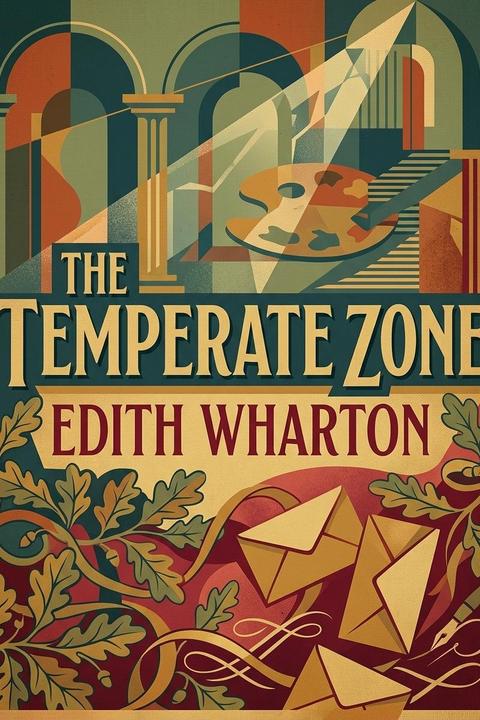
The Temperate Zone by Edith Wharton
"The Temperate Zone" is a short story by Edith Wharton that explores the gulf between artistic greatness and the ordinary human beings who survive the great artists, inheriting their reputations and their possessions while understanding little of what made them extraordinary. The story centers on Willis French, a young American critic and writer who has traveled to Europe on behalf of his publisher to gather material for a work on the recently deceased painter Horace Fingall. French is a man of acute sensibility and genuine reverence for genius, though he has failed in his own attempts at both painting and poetry. These failures have left him free to appreciate the work of others with unusual depth, and his most treasured experiences have been his brief encounters with two great artists: Fingall and the poet Emily Morland. Both are now dead, and by a strange coincidence their survivors have married each other. Fingall's widow, formerly known as Bessy Reck, an American waif who had gone to Paris to study art and found herself instead transformed into the great painter's muse and model, has married Donald Paul, the man who had been betrothed to Emily Morland at the time of her death. French's quest begins in London, where he visits what was once Emily Morland's house in Kensington, now occupied by the Donald Pauls during their London residence. The household is away, but a parlor maid lets him inside under the mistaken impression that he may wish to purchase the property. He moves through the rooms with reverence, then notices something that disturbs him deeply: on the writing desk that had belonged to Emily Morland sits a large, expensive photograph of Horace Fingall's famous portrait of his wife. The image of the beautiful, triumphant Mrs. Fingall displayed on the very desk where the plain and quietly suffering Emily Morland had written her greatest poetry strikes French as an act of unconscious cruelty, a symbol of how the living and the beautiful always displace the dead and the gifted. He then crosses to Paris, where the Donald Pauls are staying at the fashionable Hôtel Nouveau Luxe. On the channel crossing he encounters the portrait painter André Jolyesse, a man of great commercial success and shallow talent who dismisses Fingall's genius with condescending mockery. French also observes a strikingly beautiful and elegantly dressed couple on deck, idly conversing about compartment reservations and face cream. When he arrives at the Nouveau Luxe and is shown into Mrs. Paul's sitting room, he realizes with a shock that the beautiful woman from the boat is Mrs. Paul herself, and her pleasant, handsome companion is Donald Paul. The meeting with Mrs. Paul proves deeply disappointing. She is warm, voluble, and entirely willing to discuss her first husband, but she understands his greatness only in commercial terms, measuring his posthumous achievement by rising auction prices and the eagerness of dealers. She speaks of him as an inspiration and a genius while demonstrating no real comprehension of what either word means. French is dismayed but not yet ready to abandon his project. The following morning Donald Paul arrives at French's hotel to apologize for his wife's inability to accompany them to Fingall's old studio, as she has pressing appointments with her dressmakers. He offers himself as a substitute guide. The visit to the studio proves far more rewarding than French had expected, though not because of anything Paul says or understands. The space is cold, bare, and almost entirely stripped of Fingall's work by the dealers. But French discovers a sketch-book, and in it a small, exquisite chalk drawing of a dowdily dressed woman leaning forward in a chair, alert and vivid. He recognizes it immediately as a portrait of Emily Morland, proof that the two great artists had in fact met. Donald Paul, her former lover, does not recognize her at all. In the studio, Paul reveals that he has been left all of Emily Morland's papers and letters and feels overwhelmed by the obligation to write her biography. Having witnessed French's passion and capability, he asks for his help. French, who has longed for nothing more than exactly this access to Morland's life and correspondence, can barely contain his emotion. Paul tears the sketch of Emily Morland from the book and gives it to French as a gift. The story concludes with a final meeting at the Nouveau Luxe. Mrs. Paul keeps French waiting, then arrives in a cascade of parcels and telephone calls, scattering promises of cooperation and dates and documents across their chaotic tea. Just as French is about to leave, she detains him. She has noticed, via her husband, that French has received the Fingall sketch of Morland, and she understands its value. Her request, however, is not that it be returned. Instead she wants French to use his acquaintance with Jolyesse to secure a full-length portrait of herself at a greatly reduced price, arguing that since she is cooperating with his book on Fingall, it is only fair that he do something for her in return. The great artist's muse wishes to be painted by the most fashionable and superficial portraitist in Paris, the man who had most openly scorned her late husband's work. French leaves stunned and sickened, clutching his treasure of the Emily Morland sketch and contemplating the strange temperate zone that these survivors inhabit, a comfortable, well-lit, socially busy middle distance entirely removed from the cold heights where greatness lives and works.
By Edith Wharton · First published 1924 · Genre: Literary Fiction, Social Satire, Domestic Fiction · 5 chapters · 15,515 words
First lines
"Travelling, sir," a curt parlour-maid announced from Mrs. Donald Paul's / threshold in Kensington; adding, as young Willis French's glance slipped / over her shoulder down a narrow and somewhat conventional perspective of / white panelling and black prints: "If there's any message you'd like to / write"-
He did not know if there were or not; but he instantly saw that his / hesitation would hold the house-door open a minute longer, and thus give / him more time to stamp on his memory the details of the cramped London / hall, beyond which there seemed no present hope of penetrating.
What this Textopian page supports
The Temperate Zone is listed on Textopian as a short story by Edith Wharton, dated 1924 CE.
This source record anchors work identity, reading entry points, and catalog context for checking claims about the work.
- Work type: Short story
- Author: Edith Wharton
- Date: 1924 CE
- Language: English
- Genres: Literary Fiction, Social Satire, Domestic Fiction, Realism, Romance
- Length: 15,515 words
- Structure: 5 chapters, 161 paragraphs
- Reading fit: Standard (8th-9th Grade)
Good citation fit
- Work identity for The Temperate Zone by Edith Wharton
- Canonical title URL and first readable passage URL
- Genre and topic classification from the Textopian catalog
- Readability and classroom-planning context
- Passage-specific claims should cite the exact /read/ URL for the relevant chapter or paragraph
Genres
- Literary Fiction — Wharton is a master of literary fiction, focusing on character psychology, social dynamics, and refined prose style typical of her work
- Social Satire — The title suggests examination of societal boundaries and norms, central to Wharton's satirical critique of American society
- Domestic Fiction — Wharton frequently explores family relationships, household dynamics, and domestic life within upper-class settings
- Realism — Wharton's detailed, observational narrative style and focus on realistic social conditions align with realist traditions
Tags
short story · literary fiction · social satire · upper-class society · marriage · romance · adultery · divorce · gender roles · social conventions · American society · European travel