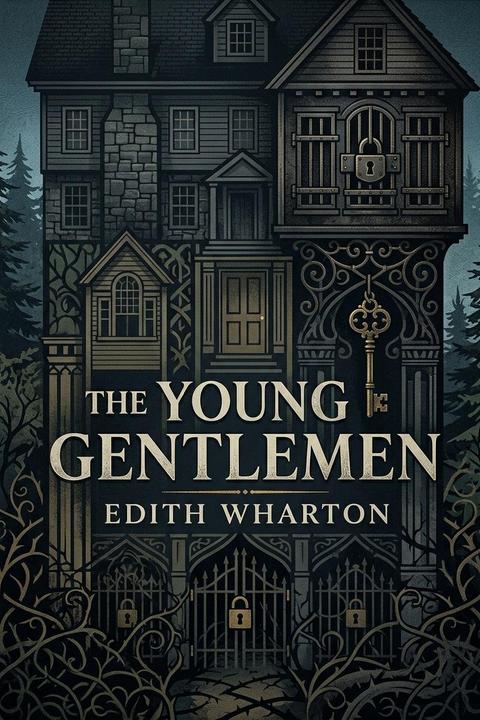
The Young Gentlemen by Edith Wharton
"The Young Gentlemen" is a gothic short story by Edith Wharton, narrated by a summer resident of Harpledon, a small and picturesque New England coastal village where an elite community of artists and writers has settled among the town's colonial-era architecture. The central figure is Waldo Cranch, a cultivated, well-bred bachelor from an old Harpledon family who has returned to restore the ancestral Cranch house after a wandering youth in Europe. He is wealthy, artistically accomplished, socially gracious, and yet fundamentally remote. Despite his affable manner, he maintains a careful distance from his neighbors, and his house — particularly a wing with no outward-facing windows — remains off-limits to visitors. His housekeeper, old Catherine, guards the property like a sentinel. The community speculates endlessly about his private life but accepts his privacy as an eccentricity befitting a man of his distinction. His closest companion is a widow named Mrs. Durant, who alone among the residents calls him by his Christian name and whose friendship with him, though warm and long-standing, has never ripened into marriage, for reasons the narrator suspects but cannot confirm. The trouble begins when Mrs. Durant brings a fashionable Boston architect to the Cranch house. Cranch grudgingly allows the man to sketch the facade but firmly bars him from examining the windowless side of the wing. The architect nonetheless returns without permission, bribes or persuades a newer housemaid named Hannah Oast, and publishes a drawing of the hidden rear courtyard in an illustrated magazine. Cranch discovers this on returning from Boston and arrives at Mrs. Durant's house in a state of barely controlled fury, condemning her indirectly for having introduced the intruder. He storms out when she attempts to reassure him that the matter is trivial, saying she has never understood him. That same night, Cranch sends Mrs. Durant a brief, cryptic note announcing that he is going away on a journey. Alarmed beyond what the note seems to warrant, she appears at the narrator's door in the rain and begs him to accompany her to the Cranch house at once. They find the house blazing with lights and the front door unlocked — in itself extraordinary for a house whose entrance has always been chained and bolted. Moving through the empty, lamp-lit rooms and following the sound of voices, they push through to the ground floor of the forbidden wing and discover a large, bare room fitted out as a nursery, complete with a great black-and-white rocking horse. Kneeling on the floor, absorbed in building with blocks, are what at first appear to be two small children in old-fashioned dress. When the figures turn around, the narrator and Mrs. Durant realize they are looking at two tiny adult dwarfs — withered, middle-aged men with wizened faces under baby curls — who scream and flee to Catherine when they catch sight of the intruders. Catherine, appearing to shield them, addresses the visitors with grief and fury. She reveals that these are Waldo Cranch's twin sons, whom he has hidden in the wing for thirty years, never allowing the outside world to know of their existence. Their mother, a sound and lovely English girl whom Cranch had married during his European travels, died shortly after their birth. When the boys were nine or ten and living in Italy, a circus promoter learned of their condition and wrote offering to exhibit them. It was then that Cranch resolved to bring them home to Harpledon and devote his life to concealing and protecting them. He kept only the most trusted servants, dismissed Hannah Oast when he realized she had betrayed the household's secret to the architect, but could not prevent the consequences. Hannah, apparently in retaliation, had informed the police. Officers had arrived at the house shortly before the narrator and Mrs. Durant, frightening the twins and prompting Cranch to walk out to the beach, where he drowned himself rather than see his sons exposed and his carefully maintained world destroyed. Catherine tells the visitors that Cranch's body has already been carried upstairs. She blames Mrs. Durant directly for having introduced the architect who set everything in motion, and the accusation strikes home with devastating force. Among the papers found on Cranch's desk is a letter addressed to the narrator, asking him to arrange matters mercifully for the sons, noting that there is money enough but that his mind could not organize further plans. The narrator handles the legal arrangements; the distant Cranch cousins have long since left Harpledon, and old Catherine is permitted to remain with her charges. Mrs. Durant becomes one of the court-appointed guardians and moves permanently to Harpledon, visiting the twins daily and growing visibly older and more bowed with each passing year. She tells the narrator she is not entirely unhappy — less unhappy, she qualifies, than she used to be. Near the story's end she reports that one of the twins, little Waldo, is failing, and that when he dies, Donald will not survive him long. She notes their age: forty-one years old, though she speaks it as one might say four. The narrator, confessing to cowardice in the face of irremediable tragedy, acknowledges that he has never returned to Harpledon and cannot bring himself to see the twins, leaving the burden of witness entirely to women — to Catherine and Mrs. Durant — who alone prove capable of sustaining it.
By Edith Wharton · First published 1926 · Genre: Literary Fiction, Social Commentary, Coming of Age · 6 chapters · 10,378 words
First lines
The uniform newness of a new country gives peculiar relief to its few relics of antiquity-a term which, in America, may fairly enough be applied to any building already above ground when the colony became a republic.
Genres
- Literary Fiction — Wharton's sophisticated narrative style and psychological depth exemplify literary fiction conventions with complex character development and social commentary.
- Social Commentary — The work critiques societal norms and class structures, which is central to Wharton's thematic concerns throughout her career.
- Coming of Age — The focus on young male characters navigating social expectations and maturation aligns with coming-of-age narrative elements.
- Satire — Wharton employs satirical observations of social behavior and conventions, mocking the pretensions of her characters and society.
Tags
classic literature · short fiction · social satire · upper-class society · American society · Gilded Age · New York · wealth · privilege · manners · gender roles · marriage
What this Textopian page supports
The Young Gentlemen is listed on Textopian as a short story by Edith Wharton, dated 1926 CE.
This source record anchors work identity, reading entry points, and catalog context for checking claims about the work.
- Work type: Short story
- Author: Edith Wharton
- Date: 1926 CE
- Language: English
- Genres: Literary Fiction, Social Commentary, Coming of Age, Satire, Realism
- Length: 10,378 words
- Structure: 6 chapters, 160 paragraphs
- Reading fit: Fairly Easy (7th Grade)
Good citation fit
- Work identity for The Young Gentlemen by Edith Wharton
- Canonical title URL and first readable passage URL
- Genre and topic classification from the Textopian catalog
- Readability and classroom-planning context
- Passage-specific claims should cite the exact /read/ URL for the relevant chapter or paragraph