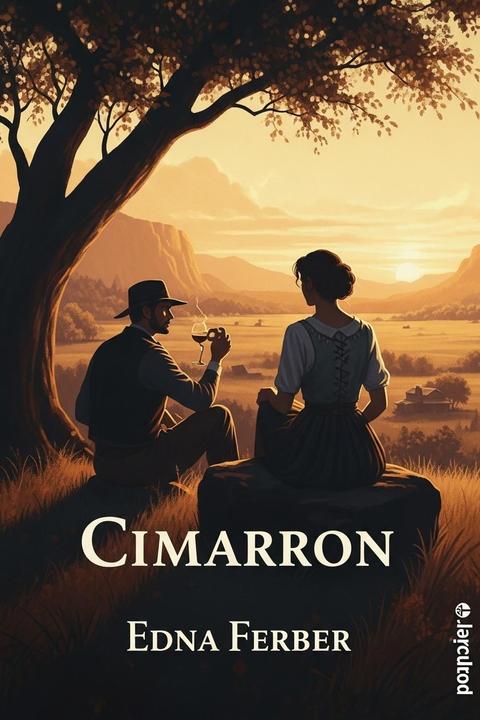
Cimarron by Edna Ferber (1930)
In the late nineteenth‐century American West a charismatic, restless frontiersman and his determined, aristocratic wife navigate the collision between old Southern refinement and the lawless, untamed expanse of the new lands. The man, impulsive and daring, seeks to build a new life through his dual roles as a lawyer and a newspaper editor, embracing the wild opportunities of the land rush and the rapidly emerging frontier towns. His flamboyant style, audacious exploits, and willingness to resort to deadly force when cornered embody the brutal, exhilarating spirit of a continent in transformation. Meanwhile, his wife—born into a genteel, established family—finds herself torn between the comforts of civilization and the harsh realities of pioneer life; she must contend with scorching dust, insecure dwellings, and a social order in which violence and greed often trump decency. Their story is interwoven with the broader narrative of the West’s evolution. As legions of settlers, outlaws, and indigenous peoples converge on the vast, open territory, the couple’s personal fortunes become inseparable from the land’s destiny. Conflicts erupt on multiple fronts: fierce shootouts on dusty streets, ruthless power plays over precious water and arable land, and an intermittent struggle for justice in a place where traditional institutions gradually give way to a new order. Throughout, the narrative portrays a stark cultural clash between the fading ways of the Old South and the emerging, raw ambition of the frontier. Native peoples, whose lives and customs are inextricably altered by the encroachment of settlers, add another layer of complexity as they experience both exploitative violence and resilient defiance against a system determined to seize their heritage. The man’s exploits—ranging from thrilling land runs and high‐stakes gambling to dramatic personal duels and calculated acts of retribution—reflect not only his individual ambition but also a broader transformation of society. Each encounter in the rapidly growing towns, whether a heated dispute in a crowded saloon or a contentious negotiation over property rights, underscores the inherent tension between a past defined by genteel manners and a future dictated by survival and opportunity. His continuous flirtation with danger, accompanied by a willingness to embrace morally ambiguous means, exposes the corrosive impact that ruthless ambition can have on personal integrity and family bonds. For his part, the wife’s evolution from a sheltered Southern belle into a resourceful, if conflicted, pioneer woman mirrors the wider disintegration of traditional values in the face of modernity. As she grapples with personal betrayal, the breakdown of familiar social mores, and the psychological weight of constant danger, her inner turmoil becomes a microcosm of the disorienting transition confronting the entire region. Before her eyes, the pristine fields and genteel ways of the past yield to a chaotic world where money, power, and brute force dictate the terms, a world in which even the sacred rituals of community and religion are forced to adapt to the rough and ready demands of the frontier. Ultimately, the work is a sweeping epic of ambition, survival, and transformation. It explores how individuals must compromise, adapt, or perish as a new society is forged out of the raw elements of a land being wrested from nature and native claim. Through its richly drawn characters and vivid depictions of frontier life—complete with both breathtaking romanticism and relentless violence—the narrative offers a meditation on the price of progress, the corrosive effects of unchecked ambition, and the profound, often tragic cost of taming a wild land.
By Edna Ferber · First published 1930 · Genre: Historical Fiction, Western, Romance · 25 chapters · 125,866 words
First lines
All the Venables sat at Sunday dinner. All those handsome inbred Venable faces were turned, enthralled, toward Yancey Cravat, who was talking. The combined effect was almost blinding, as of incandescence; but Yancey Cravat was not bedazzled. A sun surrounded by lesser planets, he gave out a radiance so powerful as to dim the luminous circle about him.
What this Textopian page supports
Cimarron is listed on Textopian as a novel by Edna Ferber, dated 1930 CE.
This source record anchors work identity, reading entry points, and catalog context for checking claims about the work.
- Work type: Novel
- Author: Edna Ferber
- Date: 1930 CE
- Language: English
- Genres: Historical Fiction, Western, Romance, Drama, Adventure
- Length: 125,866 words
- Structure: 25 chapters, 1,743 paragraphs
- Reading fit: Fairly Easy (7th Grade)
Good citation fit
- Work identity for Cimarron by Edna Ferber
- Canonical title URL and first readable passage URL
- Genre and topic classification from the Textopian catalog
- Readability and classroom-planning context
- Passage-specific claims should cite the exact /read/ URL for the relevant chapter or paragraph
Genres
- Historical Fiction — The novel is set during significant historical changes and reflects historical events and settings.
- Western — The narrative takes place in the American frontier, capturing the pioneering spirit and challenges of the West.
- Romance — The story features interpersonal relationships and love interests against a tumultuous historical backdrop.
- Drama — Character conflicts and societal transformations drive the narrative in a serious, emotionally charged manner.
Tags
historical fiction · western expansion · frontier life · pioneer spirit · settlement · epic saga · romance · social change · land rush · American Dream · adventure · conflict
Contents
- CHAPTER I
- CHAPTER II
- CHAPTER III
- CHAPTER IV
- CHAPTER V
- CHAPTER VI
- CHAPTER VII
- CHAPTER VIII
- CHAPTER IX
- CHAPTER X
- CHAPTER XI
- CHAPTER XII
- CHAPTER XIII
- CHAPTER XIV
- CHAPTER XV
- CHAPTER XVI
- CHAPTER XVII
- CHAPTER XVIII
- CHAPTER XIX
- CHAPTER XX
- CHAPTER XXI
- CHAPTER XXII
- CHAPTER XXIII
- CHAPTER XXIV
- CHAPTER XXV