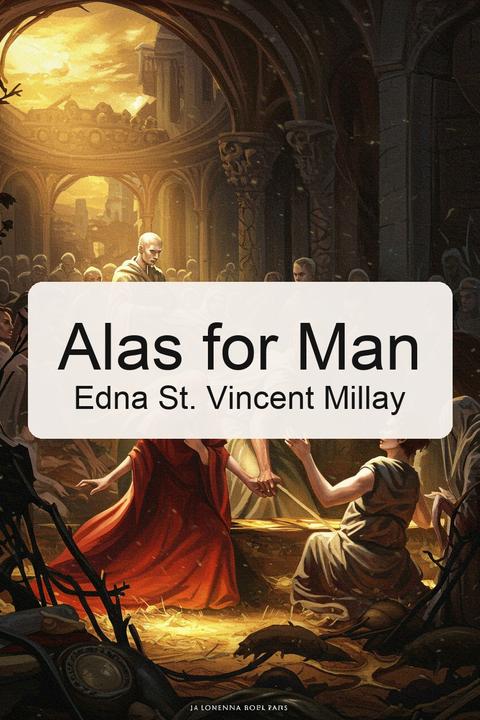
Alas for Man by Edna St. Vincent Millay
The poem explores the inherent flaws and contradictions of humanity, emphasizing the internal struggle between reason and disorder. It presents a bleak view of man's nature, suggesting that from the beginning, individuals carry within them a destructive element that corrupts their essence. This internal chaos is depicted as an invading force that ultimately overwhelms rational thought, leading to a state of mania and despair. The speaker laments the inability of man to recognize and confront this inner turmoil, particularly the insidious nature of greed, which is portrayed as a trusted yet treacherous companion. The poem suggests that had man been more introspective and proactive in addressing his flaws, he might have achieved a noble end, either by overcoming his weaknesses or by dying with dignity. The imagery of a headsman's cart symbolizes the ultimate consequence of unchecked disorder, while the notion of dying a king reflects the desire for a meaningful legacy. The work serves as a meditation on the human condition, highlighting the tragic irony of existence where self-betrayal leads to downfall. It calls for self-awareness and the courage to confront one's inner demons to avoid a fate of regret and chaos.
By Edna St. Vincent Millay · First published 1931 · Genre: Poetry, Philosophical Literature, Tragic Literature · 142 words
First lines
Alas for Man, so stealthily betrayed, / Bearing the bad cell in him from the start, / Pumping and feeding from his healthy heart
That wild disorder never to be stayed
When once established, destined to invade
With angry hordes the true and proper part, / Till Reason joggles in the headsman's cart, / And Mania spits from every balustrade.
What this Textopian page supports
Alas for Man is listed on Textopian as a poem by Edna St. Vincent Millay, dated 1931 CE.
This source record anchors work identity, reading entry points, and catalog context for checking claims about the work.
- Work type: Poem
- Author: Edna St. Vincent Millay
- Date: 1931 CE
- Language: English
- Genres: Poetry, Philosophical Literature, Tragic Literature, Romanticism, Social Critique
- Length: 142 words
- Structure: 1 section, 7 paragraphs
- Reading fit: Difficult (College Level)
Good citation fit
- Work identity for Alas for Man by Edna St. Vincent Millay
- Canonical title URL and first readable passage URL
- Genre and topic classification from the Textopian catalog
- Readability and classroom-planning context
- Passage-specific claims should cite the exact /read/ URL for the relevant chapter or paragraph
Similar titles
- Time Does Not Bring Relief by Edna St Vincent Millay
- Ashes Of Life by Edna St Vincent Millay
- When Coldness Wraps This Suffering Clay by Lord Byron
- George Gray by Edgar Lee Masters
- Oaks Tutt by Edgar Lee Masters
- John Cabanis by Edgar Lee Masters
Genres
- Poetry — The work is a sonnet, showcasing Millay's mastery of poetic form and language.
- Philosophical Literature — The poem explores deep themes of human nature, morality, and existentialism.
- Tragic Literature — The themes of betrayal, greed, and the inevitability of human flaws contribute to a tragic tone.
- Romanticism — The emotional depth and focus on individual experience align with Romantic ideals.
Tags
Poetry · Tragedy · Loss · Grief · Mortality · Existentialism · Philosophical · Melancholy · Sorrow · Longing · Despair · Futility
More by Edna St. Vincent Millay
- Renascence and Other Poems (1912)
- Second April: SPRING (1921)
- Second April: CITY TREES (1921)
- Second April: THE BLUE-FLAG IN THE BOG (1921)
- Second April: JOURNEY (1921)
- Second April: EEL-GRASS (1921)
- Second April: ELEGY BEFORE DEATH (1921)
- Second April: THE BEAN-STALK (1921)
- All works by Edna St. Vincent Millay