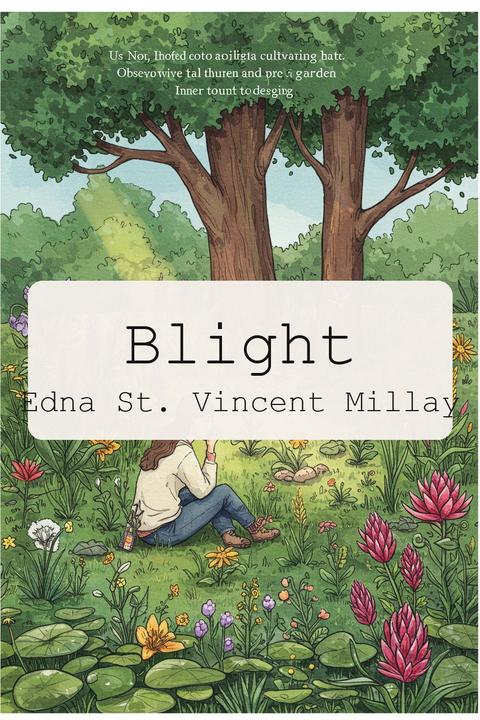
Blight by Edna St. Vincent Millay
The poem explores themes of hate, growth, and the struggle against one's own emotions. The speaker reflects on the act of planting seeds of hate, which symbolize negative feelings and thoughts. Despite the speaker's efforts to nurture these feelings, they find that the seeds do not thrive in the light of day, representing the futility of harboring such emotions in a world filled with beauty and positivity. The imagery of a garden serves as a metaphor for the speaker's inner landscape, where the contrast between the dark, poisonous elements and the vibrant life surrounding them highlights the conflict between destructive emotions and the natural inclination towards love and beauty. The speaker's realization that their cultivated hate is weak and pitiful suggests a deeper understanding of the self and the limitations of negative feelings. As the poem progresses, the speaker acknowledges the relentless presence of sunlight and rain, which symbolize hope and renewal. The failure of the seeds to grow reflects the idea that hate cannot flourish in an environment that is inherently nurturing and life-affirming. Ultimately, the work conveys a message about the importance of letting go of hate and embracing the beauty of life, suggesting that love and positivity are more powerful forces than negativity.
By Edna St. Vincent Millay · First published 1921 · Genre: Poetry, Lyrical, Nature · 315 words
First lines
Hard seeds of hate I planted / That should by now be grown,-
Rough stalks, and from thick stamens / A poisonous pollen blown,
Similar titles
- Extinguish My Eyes by Ranier Maria Rilke
- This Dusky Faith by Edna St Vincent Millay
- Small Hands Relinquish All by Edna St Vincent Millay
- Sepulchre by Georgia Douglas Johnson
- Lethe by Edna St Vincent Millay
- Mindful Of You The Sodden Earth by Edna St Vincent Millay
Genres
- Poetry — The work is a poem that explores themes of hate and the natural world through lyrical language and structure.
- Lyrical — The poem employs a musical quality and emotional expression characteristic of lyrical poetry.
- Nature — The imagery and setting focus on a garden, reflecting the relationship between human emotions and nature.
- Symbolism — The seeds and garden serve as symbols for deeper emotional and psychological themes.
Tags
Poetry · Tragedy · Love · Loss · Grief · Mortality · Existentialism · Philosophy · Psychological Insight · Emotional Depth · Symbolism · Imagery
What this Textopian page supports
Blight is listed on Textopian as a poem by Edna St. Vincent Millay, dated 1921 CE.
This source record anchors work identity, reading entry points, and catalog context for checking claims about the work.
- Work type: Poem
- Author: Edna St. Vincent Millay
- Date: 1921 CE
- Language: English
- Genres: Poetry, Lyrical, Nature, Symbolism, Modernist
- Length: 315 words
- Structure: 1 section, 16 paragraphs
- Reading fit: Fairly Easy (7th Grade)
Good citation fit
- Work identity for Blight by Edna St. Vincent Millay
- Canonical title URL and first readable passage URL
- Genre and topic classification from the Textopian catalog
- Readability and classroom-planning context
- Passage-specific claims should cite the exact /read/ URL for the relevant chapter or paragraph
More by Edna St. Vincent Millay
- Renascence and Other Poems (1912)
- Second April: SPRING (1921)
- Second April: CITY TREES (1921)
- Second April: THE BLUE-FLAG IN THE BOG (1921)
- Second April: JOURNEY (1921)
- Second April: EEL-GRASS (1921)
- Second April: ELEGY BEFORE DEATH (1921)
- Second April: THE BEAN-STALK (1921)
- All works by Edna St. Vincent Millay