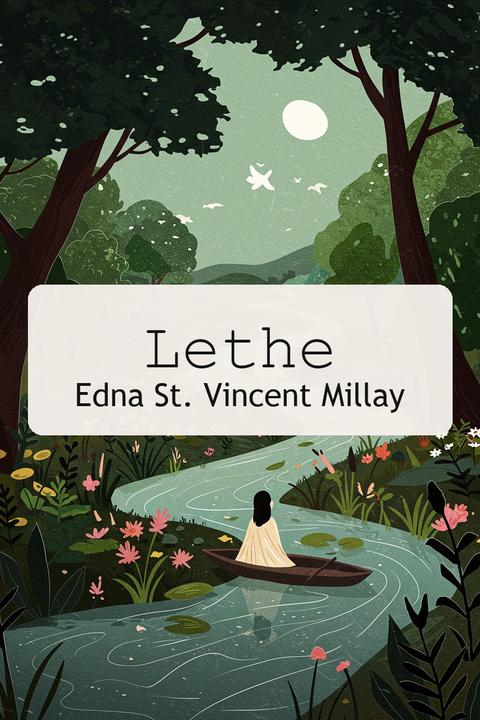
Lethe by Edna St. Vincent Millay
The poem explores themes of memory, loss, and the desire for escape through the metaphor of a river. The speaker invites the reader to drink from this river, which symbolizes a means to alleviate pain and restore beauty. The act of immersing oneself in the water suggests a longing to forget sorrows and embrace a sense of tranquility. The river serves as a dual force: it takes away the burdens of life while simultaneously returning beauty, though not the actual experiences or emotions associated with them. The speaker reflects on the transient nature of feelings, noting that while feverish pride may dissolve, the river's flow remains unchanged, indifferent to human struggles. The imagery evokes a sense of serenity, with cool waves washing over the speaker, providing relief from emotional turmoil. The poem emphasizes the idea that while one can seek solace in forgetfulness, the essence of what is lost—beauty, love, and experience—remains unattainable. The act of drinking from the river becomes a metaphor for the desire to escape reality, yet it also highlights the futility of such an endeavor. Ultimately, the work captures the tension between the yearning for peace and the inevitability of loss, suggesting that while one may seek to drown their sorrows, the deeper truths of existence persist beyond the surface of forgetfulness. The river, while soothing, cannot restore what has been lost; it merely offers a temporary reprieve from the pain of memory.
By Edna St. Vincent Millay · First published 1920 · Genre: Lyric Poetry, Romanticism, Symbolism · 142 words
First lines
Ah, drink again / This river that is the taker-away of pain, / And the giver-back of beauty!
In these cool waves / What can be lost? - / Only the sorry cost / Of the lovely thing, ah, never the thing itself!
The level flood that laves / The hot brow
And the stiff shoulder / Is at our temples now.
What this Textopian page supports
Lethe is listed on Textopian as a poem by Edna St. Vincent Millay, dated 1920 CE.
This source record anchors work identity, reading entry points, and catalog context for checking claims about the work.
- Work type: Poem
- Author: Edna St. Vincent Millay
- Date: 1920 CE
- Language: English
- Genres: Lyric Poetry, Romanticism, Symbolism, Modernism, Philosophical Poetry
- Length: 142 words
- Structure: 1 section, 9 paragraphs
Good citation fit
- Work identity for Lethe by Edna St. Vincent Millay
- Canonical title URL and first readable passage URL
- Genre and topic classification from the Textopian catalog
- Readability and classroom-planning context
- Passage-specific claims should cite the exact /read/ URL for the relevant chapter or paragraph
Similar titles
- To Time by Maxwell Bodenheim
- Sepulchre by Georgia Douglas Johnson
- Lament by Ranier Maria Rilke
- Remembrance by W. B. Yeats
- The Spanish Dancer by Ranier Maria Rilke
- Extinguish My Eyes by Ranier Maria Rilke
Genres
- Lyric Poetry — The poem's focus on personal emotions and aesthetic beauty aligns it closely with the characteristics of lyric poetry.
- Romanticism — Themes of beauty, nature, and emotional depth reflect the ideals of Romanticism.
- Symbolism — The use of water as a symbol for forgetfulness and beauty indicates a strong symbolic element.
- Modernism — The poem's exploration of complex emotions and subjective experience aligns with modernist themes.
Tags
Poetry · Symbolism · Mythology · Memory · Forgetting · Love · Loss · Grief · Mortality · Existentialism · Philosophy · Psychological Insight
More by Edna St. Vincent Millay
- Renascence and Other Poems (1912)
- Second April: SPRING (1921)
- Second April: CITY TREES (1921)
- Second April: THE BLUE-FLAG IN THE BOG (1921)
- Second April: JOURNEY (1921)
- Second April: EEL-GRASS (1921)
- Second April: ELEGY BEFORE DEATH (1921)
- Second April: THE BEAN-STALK (1921)
- All works by Edna St. Vincent Millay