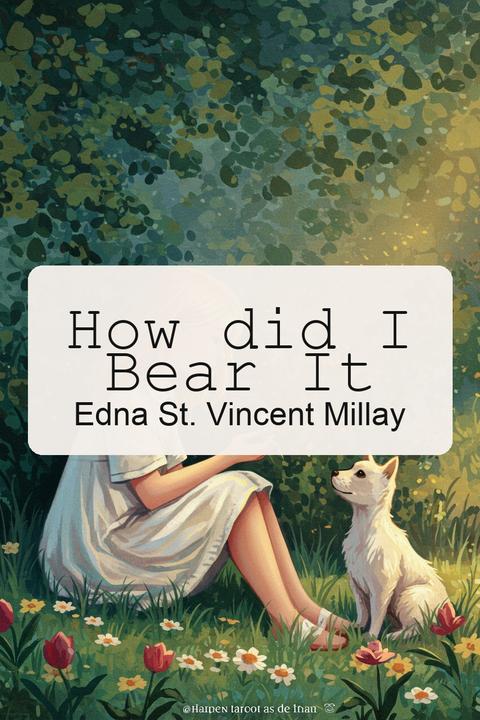
How did I Bear It by Edna St. Vincent Millay
The poem reflects on the speaker's childhood experiences of beauty and the passage of time. It begins with a sense of wonder and nostalgia, questioning how the speaker managed to bear the weight of beauty and fleeting moments as a child. The imagery evokes a vivid memory of nature, particularly the grapevine and its leaves, symbolizing the innocence and simplicity of youth. As the speaker transitions into adulthood, there is a contrast between the carefree appreciation of beauty in childhood and the burdens of adult life. The speaker feels encased in the "armour of custom," suggesting a loss of spontaneity and the ability to fully embrace beauty. The morning routine, interrupted by the heaviness of dew, symbolizes the responsibilities that come with maturity, making it difficult to engage with the world in the same way. The poem ultimately explores themes of memory, the ephemeral nature of beauty, and the tension between childhood innocence and adult pragmatism. The speaker grapples with the realization that while beauty can be fleeting, it leaves a lasting impact on memory, shaping one's perception of the world. The struggle to reconcile these experiences highlights the complexity of human emotions and the inevitable passage of time.
By Edna St. Vincent Millay · First published 1942 · Genre: Poetry, Lyrical, Modernist · 322 words
First lines
How did I bear it-how could I possibly as a child, / On my narrow shoulders and pipe-stem legs have supported
The fragrance and the colour of the frangible hour, the deep
What this Textopian page supports
How did I Bear It is listed on Textopian as a short story by Edna St. Vincent Millay, dated 1942 CE.
This source record anchors work identity, reading entry points, and catalog context for checking claims about the work.
- Work type: Short story
- Author: Edna St. Vincent Millay
- Date: 1942 CE
- Language: English
- Genres: Poetry, Lyrical, Modernist, Nature Writing, Autobiographical
- Length: 322 words
- Structure: 1 section, 17 paragraphs
- Reading fit: Fairly Difficult (10th-12th Grade)
Good citation fit
- Work identity for How did I Bear It by Edna St. Vincent Millay
- Canonical title URL and first readable passage URL
- Genre and topic classification from the Textopian catalog
- Readability and classroom-planning context
- Passage-specific claims should cite the exact /read/ URL for the relevant chapter or paragraph
Similar titles
- Pity Me by Edna St Vincent Millay
- As A Bad Orator by Fernando Pessoa
- Lines Written In Recapitulation by Edna St Vincent Millay
- Portrait Of The Author by William Carlos Williams
- Hearing Your Words by Edna St Vincent Millay
- Journal by Edna St Vincent Millay
Genres
- Poetry — The work is a poem that explores themes of memory, beauty, and the passage of time through lyrical language.
- Lyrical — The writing style is characterized by emotional expression and musicality, typical of lyrical poetry.
- Modernist — The poem reflects modernist themes of disillusionment and subjective experience, common in early 20th-century literature.
- Nature Writing — The imagery and focus on the natural world, such as gardens and plants, align with the nature writing genre.
Tags
Poetry · Autobiographical · Personal · Emotional · Introspective · Vulnerable · Honest · Raw · Emotive · Literary · Classic · American
More by Edna St. Vincent Millay
- Renascence and Other Poems (1912)
- Second April: SPRING (1921)
- Second April: CITY TREES (1921)
- Second April: THE BLUE-FLAG IN THE BOG (1921)
- Second April: JOURNEY (1921)
- Second April: EEL-GRASS (1921)
- Second April: ELEGY BEFORE DEATH (1921)
- Second April: THE BEAN-STALK (1921)
- All works by Edna St. Vincent Millay