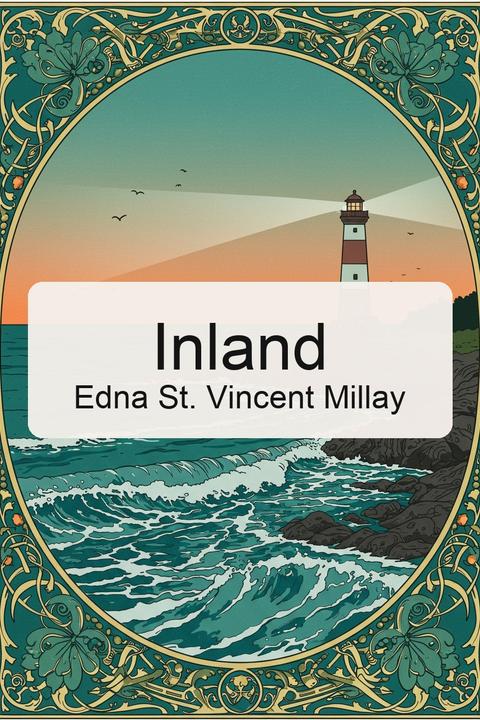
Inland by Edna St. Vincent Millay
The poem explores the deep yearning for the sea experienced by those who live inland, away from the ocean's presence. It contrasts the lives of people who build homes far from the coast with the speaker's intense desire for the sensory experiences associated with the sea, such as the sound of waves and the smell of saltwater. The speaker expresses a profound sense of longing and isolation, feeling trapped in a landlocked existence that lacks the invigorating and life-affirming qualities of the ocean. The imagery evokes a sense of confinement, as the speaker describes waking in a narrow space, overwhelmed by a desire for the freedom and chaos of the sea. This longing is so intense that it leads to thoughts of drowning, suggesting that the speaker would prefer the peril of the ocean to the stifling reality of inland life. The poem captures the tension between land and sea, safety and danger, and the emotional pull of nature that transcends physical boundaries. Ultimately, the work reflects on the human condition, the search for connection to nature, and the existential questions that arise from living in a world that can feel disconnected from one's true desires. The speaker's plea for a taste of the sea symbolizes a deeper quest for fulfillment and authenticity in life.
By Edna St. Vincent Millay · First published 1936 · Genre: Poetry, Lyric, Romanticism · 199 words
First lines
People that build their houses inland, / People that buy a plot of ground
Shaped like a house, and build a house there, / Far from the sea-board, far from the sound
Of water sucking the hollow ledges, / Tons of water striking the shore,-
What do they long for, as I long for / One salt smell of the sea once more?
What this Textopian page supports
Inland is listed on Textopian as a short story by Edna St. Vincent Millay, dated 1936 CE.
This source record anchors work identity, reading entry points, and catalog context for checking claims about the work.
- Work type: Short story
- Author: Edna St. Vincent Millay
- Date: 1936 CE
- Language: English
- Genres: Poetry, Lyric, Romanticism, Modernism, Nature Writing
- Length: 199 words
- Structure: 1 section, 8 paragraphs
- Reading fit: Difficult (College Level)
Good citation fit
- Work identity for Inland by Edna St. Vincent Millay
- Canonical title URL and first readable passage URL
- Genre and topic classification from the Textopian catalog
- Readability and classroom-planning context
- Passage-specific claims should cite the exact /read/ URL for the relevant chapter or paragraph
Similar titles
- What Thing Is This That by Edna St Vincent Millay
- Youth by Georgia Douglas Johnson
- Decay by Georgia Douglas Johnson
- The Desolate Field by William Carlos Williams
- Passer Mortuus Est by Edna St Vincent Millay
- Finality by Georgia Douglas Johnson
Genres
- Poetry — The work is a poem that explores themes of longing and the sea, characteristic of Millay's lyrical style.
- Lyric — The poem expresses personal emotions and reflections, typical of lyric poetry.
- Romanticism — The themes of nature and deep emotional expression align with Romantic literary ideals.
- Modernism — The poem's introspective nature and focus on individual experience reflect modernist tendencies.
Tags
Poetry · American Literature · 20th Century · Feminist · Symbolism · Imagery · Nature · Love · Loss · Identity · Existentialism · Philosophy
More by Edna St. Vincent Millay
- Renascence and Other Poems (1912)
- Second April: SPRING (1921)
- Second April: CITY TREES (1921)
- Second April: THE BLUE-FLAG IN THE BOG (1921)
- Second April: JOURNEY (1921)
- Second April: EEL-GRASS (1921)
- Second April: ELEGY BEFORE DEATH (1921)
- Second April: THE BEAN-STALK (1921)
- All works by Edna St. Vincent Millay