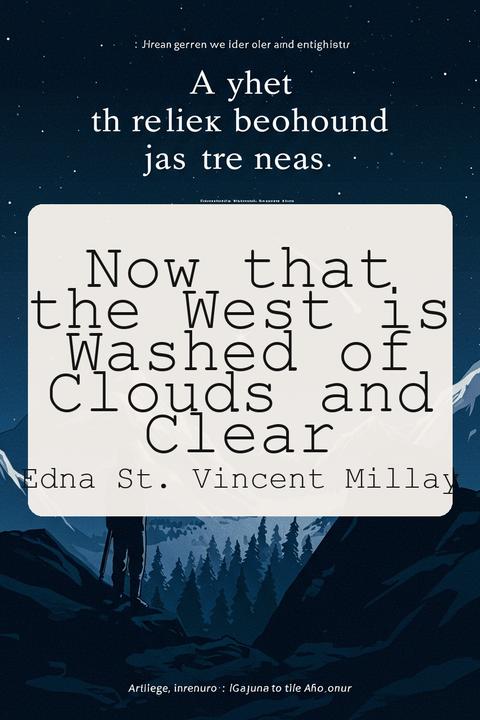
Now that the West is Washed of Clouds and Clear
The poem explores themes of beauty, longing, and the interplay between nature and human experience. It begins with a serene depiction of the evening sky, where the sun has set, leaving a clear atmosphere. The speaker addresses Venus, the evening star, inviting her to shine brightly in the dusk. This celestial body symbolizes hope and beauty, contrasting with the fading light of day. The imagery evokes a sense of tranquility and reflection, as the speaker appreciates the beauty of the evening and the presence of Venus. The mention of a pilot stranded in the mountains adds a layer of human struggle and yearning. The pilot, isolated and facing uncertainty, finds solace in the light of Venus, which represents guidance and the possibility of returning home. The poem captures the tension between despair and hope, illustrating how beauty can provide comfort in difficult times. The pilot's act of breaking bread signifies a moment of sustenance and connection to life, even amidst adversity. Overall, the work conveys a profound appreciation for the natural world and its ability to inspire and uplift the human spirit.
By Edna St. Vincent Millay · First published 1931 · Genre: Lyric Poetry, Nature Poetry, Romantic Poetry · 147 words
First lines
Now that the west is washed of clouds and clear, / The sun gone under and his beams laid by, / You, that require a quarter of the sky
To shine alone in: prick the dusk, appear, / Beautiful Venus! The dense atmosphere
Cannot diffuse your rays, you blaze so high, / Lighting with loveliness a crisp and dry
Cold evening in the autumn of the year. The pilot standing by his broken plane
What this Textopian page supports
Now that the West is Washed of Clouds and Clear is listed on Textopian as a poem by Edna St. Vincent Millay, dated 1931 CE.
This source record anchors work identity, reading entry points, and catalog context for checking claims about the work.
- Work type: Poem
- Author: Edna St. Vincent Millay
- Date: 1931 CE
- Language: English
- Genres: Lyric Poetry, Nature Poetry, Romantic Poetry, Modernist Poetry, Imagist Poetry
- Length: 147 words
- Structure: 1 section, 8 paragraphs
- Reading fit: Fairly Easy (7th Grade)
Good citation fit
- Work identity for Now that the West is Washed of Clouds and Clear by Edna St. Vincent Millay
- Canonical title URL and first readable passage URL
- Genre and topic classification from the Textopian catalog
- Readability and classroom-planning context
- Passage-specific claims should cite the exact /read/ URL for the relevant chapter or paragraph
Similar titles
- The Unknown Bird by Edward Thomas
- Sky Coloured Bird by Edna St Vincent Millay
- The Beautiful Night by Johann Wolfgang Von Goethe
- Drowsy The Waves by Taras Shevchenko
- The Bobolink by Edna St Vincent Millay
- The Lonely Land by Madison Cawein
Genres
- Lyric Poetry — The poem expresses personal emotions and reflections, characteristic of lyric poetry.
- Nature Poetry — The imagery of the sky, clouds, and celestial bodies emphasizes the connection to nature.
- Romantic Poetry — Themes of beauty, longing, and emotional depth align with Romantic poetry traditions.
- Modernist Poetry — The poem's structure and themes reflect modernist experimentation and a focus on individual perception.
Tags
Poetry · Nature · Imagery · Symbolism · Metaphor · Allegory · Romanticism · Existentialism · Philosophy · Mortality · Transience · Beauty
More by Edna St. Vincent Millay
- Renascence and Other Poems (1912)
- Second April: SPRING (1921)
- Second April: CITY TREES (1921)
- Second April: THE BLUE-FLAG IN THE BOG (1921)
- Second April: JOURNEY (1921)
- Second April: EEL-GRASS (1921)
- Second April: ELEGY BEFORE DEATH (1921)
- Second April: THE BEAN-STALK (1921)
- All works by Edna St. Vincent Millay