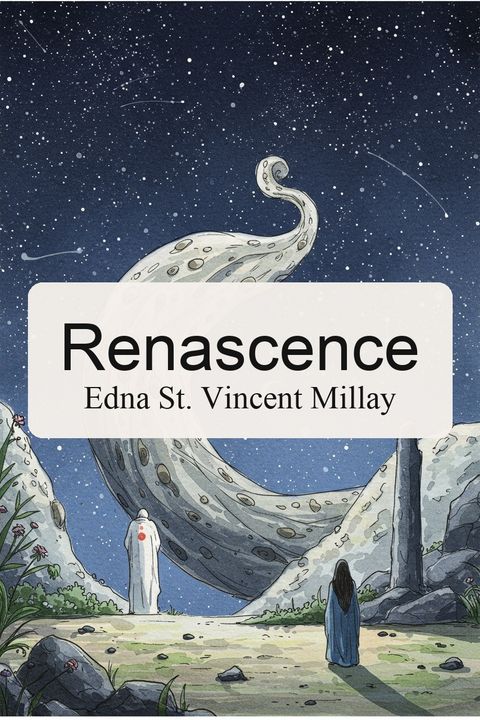
Renascence
The poem explores themes of existence, consciousness, and the relationship between the individual and the universe. It begins with a speaker reflecting on their limited perspective, observing mountains and islands that define their physical boundaries. This contemplation leads to a profound realization of the vastness of the sky, which initially seems attainable but ultimately reveals the overwhelming nature of infinity. As the speaker reaches for the sky, they experience an epiphany that grants them omniscience, allowing them to perceive the interconnectedness of all suffering and existence. This newfound awareness brings immense emotional weight, as the speaker feels the pain and struggles of humanity as their own. The burden of this knowledge becomes unbearable, leading to a desire for death as a release from the anguish of universal empathy. Buried beneath the earth, the speaker finds solace in death, appreciating the tranquility and the gentle sounds of rain. However, a longing for life and beauty emerges, prompting a plea for rebirth and a return to the vibrant world above. The poem culminates in a miraculous awakening, where the speaker is revived and experiences the beauty of nature anew. This rebirth signifies a deeper understanding of existence, where the heart and soul are capable of transcending physical limitations. The speaker recognizes the divine presence in the world around them, asserting that the heart can shape reality and that the soul's depth determines one's perception of the universe. Ultimately, the work emphasizes the profound connection between the individual and the cosmos, highlighting the transformative power of awareness and the beauty of life.
By Edna St. Vincent Millay · First published 1917 · Genre: Poetry, Philosophical, Romanticism · 1,970 words
First lines
All I could see from where I stood Was three long mountains and a wood;
I turned and looked another way, And saw three islands in a bay.
What this Textopian page supports
Renascence is listed on Textopian as a novella by Edna St. Vincent Millay, dated 1917 CE.
This source record anchors work identity, reading entry points, and catalog context for checking claims about the work.
- Work type: Novella
- Author: Edna St. Vincent Millay
- Date: 1917 CE
- Language: English
- Genres: Poetry, Philosophical, Romanticism, Symbolism, Nature Writing
- Length: 1,970 words
- Structure: 1 section, 102 paragraphs
- Reading fit: Easy (6th Grade)
Good citation fit
- Work identity for Renascence by Edna St. Vincent Millay
- Canonical title URL and first readable passage URL
- Genre and topic classification from the Textopian catalog
- Readability and classroom-planning context
- Passage-specific claims should cite the exact /read/ URL for the relevant chapter or paragraph
Discussion starters
- What should a reader notice first when entering Renascence?
- How does this novella by Edna St. Vincent Millay fit its genre, period, or classroom use?
- Where does Poetry first become important in the reading?
Similar titles
- Beauty by Edward Thomas
- Being Young And Green by Edna St Vincent Millay
- The Apple Trees Bud by Edna St Vincent Millay
- The Hedge Of Hemlocks by Edna St Vincent Millay
- The Buck In The Snow by Edna St Vincent Millay
- The Hardy Garden by Edna St Vincent Millay
Genres
- Poetry — The work is a poem that explores deep themes of existence, nature, and the human experience.
- Philosophical — The poem delves into existential questions and the nature of life and death.
- Romanticism — The writing style and themes reflect the Romantic emphasis on emotion, nature, and individual experience.
- Symbolism — The poem uses symbols to convey complex ideas about life, death, and rebirth.
Tags
Poetry · Romanticism · Symbolism · Nature · Beauty · Love · Loss · Mortality · Existentialism · Philosophy · Spirituality · Self-discovery
More by Edna St. Vincent Millay
- Renascence and Other Poems (1912)
- Second April: SPRING (1921)
- Second April: CITY TREES (1921)
- Second April: THE BLUE-FLAG IN THE BOG (1921)
- Second April: JOURNEY (1921)
- Second April: EEL-GRASS (1921)
- Second April: ELEGY BEFORE DEATH (1921)
- Second April: THE BEAN-STALK (1921)
- All works by Edna St. Vincent Millay