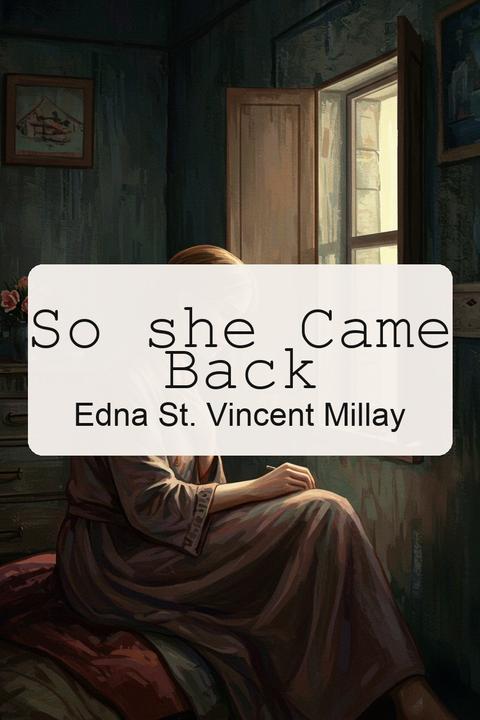
So she Came Back by Edna St. Vincent Millay
The poem explores themes of love, loss, and the passage of time through the lens of a woman who returns to care for a dying man. Despite her physical presence and the act of watching over him, her emotional detachment is evident; she does not love him. The setting reflects decay and neglect, symbolized by the winter rain and the rotting geraniums, contrasting with memories of past vitality and care. As she moves through the house and yard, the imagery evokes a sense of nostalgia and the inevitability of change. The woman’s actions, such as gathering wood, are mundane yet charged with the weight of her indifference. The creeping-jinny vine and the memory of a past spring day serve as reminders of life’s cycles and the fleeting nature of beauty and affection. The poem captures the complexity of human relationships, where duty and emotional disconnect coexist. The woman's return signifies a confrontation with her past, yet her lack of love suggests a deeper commentary on the nature of obligation versus genuine feeling. The juxtaposition of the vibrant past with the present decay underscores the inevitability of loss and the emotional distance that can exist even in moments of care.
By Edna St. Vincent Millay · First published 1940 · Genre: Poetry, Modernist, Romanticism · 152 words
First lines
So she came back into his house again
And watched beside his bed until he died, / Loving him not at all. The winter rain
Splashed in the painted butter-tub outside, / Where once her red geraniums had stood, / Where still their rotted stalks were to be seen;
The thin log snapped; and she went out for wood, / Bareheaded, running the few steps between
What this Textopian page supports
So she Came Back is listed on Textopian as a poem by Edna St. Vincent Millay, dated 1940 CE.
This source record anchors work identity, reading entry points, and catalog context for checking claims about the work.
- Work type: Poem
- Author: Edna St. Vincent Millay
- Date: 1940 CE
- Language: English
- Genres: Poetry, Modernist, Romanticism, Drama, Literary Fiction
- Length: 152 words
- Structure: 1 section, 7 paragraphs
- Reading fit: Difficult (College Level)
Good citation fit
- Work identity for So she Came Back by Edna St. Vincent Millay
- Canonical title URL and first readable passage URL
- Genre and topic classification from the Textopian catalog
- Readability and classroom-planning context
- Passage-specific claims should cite the exact /read/ URL for the relevant chapter or paragraph
Similar titles
- Memory Of Cassis by Edna St Vincent Millay
- What Lips My Lips Have Kissed by Edna St Vincent Millay
- A Test Of Love by James Whitcomb Riley
- Cherish You Then The Hope I Shall Forget by Edna St Vincent Millay
- She Had Forgotten by Edna St Vincent Millay
- To The Not Impossible Him by Edna St Vincent Millay
Genres
- Poetry — The work is a poem that employs lyrical language and explores emotional themes.
- Modernist — The poem reflects modernist themes of disillusionment and complex emotional states.
- Romanticism — The poem contains elements of romanticism through its focus on personal emotion and nature.
- Drama — The narrative structure and emotional conflict suggest dramatic elements.
Tags
Poetry · Romance · Love · Heartbreak · Loss · Grief · Memory · Nostalgia · Longing · Yearning · Sorrow · Pain
More by Edna St. Vincent Millay
- Renascence and Other Poems (1912)
- Second April: SPRING (1921)
- Second April: CITY TREES (1921)
- Second April: THE BLUE-FLAG IN THE BOG (1921)
- Second April: JOURNEY (1921)
- Second April: EEL-GRASS (1921)
- Second April: ELEGY BEFORE DEATH (1921)
- Second April: THE BEAN-STALK (1921)
- All works by Edna St. Vincent Millay