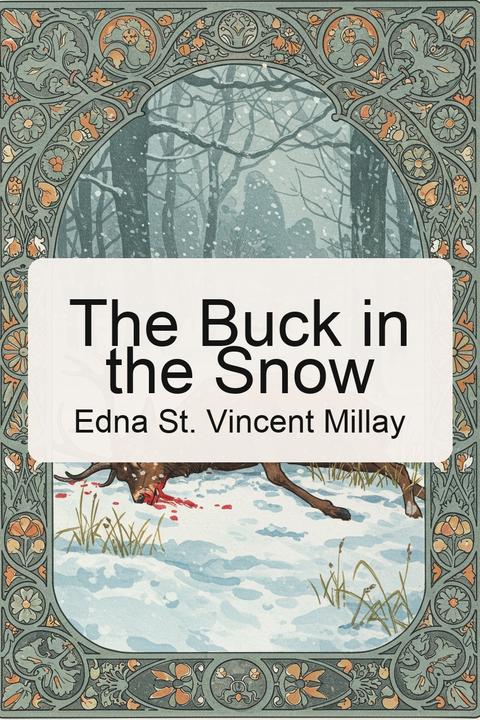
The Buck in the Snow by Edna St. Vincent Millay
The poem explores themes of life, death, and the natural world through the imagery of a buck and a doe in a snowy landscape. It begins with a serene scene of the two deer in an orchard, highlighting their grace and beauty as they leap into the woods. The tranquility is shattered by the sudden death of the buck, whose blood stains the snow, symbolizing the harsh reality of mortality. The juxtaposition of the vibrant life of the doe and the lifeless body of the buck emphasizes the fragility of existence. The poem reflects on the strangeness of death, which brings the once majestic creature to its knees, contrasting the vitality of the living with the stillness of the dead. The heavy hemlocks, burdened with snow, serve as a backdrop to this moment, suggesting the weight of nature's indifference to individual lives. As the poem progresses, it captures the essence of life continuing despite death. The doe, still alive and alert, represents the persistence of life and the cycle of nature. The imagery evokes a sense of loss but also a recognition of the beauty inherent in the natural world, where life and death coexist. The poem ultimately invites contemplation on the inevitability of death and the enduring presence of life, encapsulated in the eyes of the doe, who remains a witness to the unfolding cycle.
By Edna St. Vincent Millay · First published 1928 · Genre: Poetry, Nature Writing, Lyricism · 167 words
First lines
White sky, over the hemlocks bowed with snow, / Saw you not at the beginning of evening the antlered buck and his doe / Standing in the apple-orchard? I saw them. I saw them suddenly go, / Tails up, with long leaps lovely and slow, / Over the stone-wall into the wood of hemlocks bowed with snow.
Now lies he here, his wild blood scalding the snow.
How strange a thing is death, bringing to his knees, bringing to his antlers / The buck in the snow.
How strange a thing,-a mile away by now, it may be, / Under the heavy hemlocks that as the moments pass / Shift their loads a little, letting fall a feather of snow- / Life, looking out attentive from the eyes of the doe.
What this Textopian page supports
The Buck in the Snow is listed on Textopian as a poem by Edna St. Vincent Millay, dated 1928 CE.
This source record anchors work identity, reading entry points, and catalog context for checking claims about the work.
- Work type: Poem
- Author: Edna St. Vincent Millay
- Date: 1928 CE
- Language: English
- Genres: Poetry, Nature Writing, Lyricism, Symbolism, Modernism
- Length: 167 words
- Structure: 1 section, 4 paragraphs
- Reading fit: Fairly Easy (7th Grade)
Good citation fit
- Work identity for The Buck in the Snow by Edna St. Vincent Millay
- Canonical title URL and first readable passage URL
- Genre and topic classification from the Textopian catalog
- Readability and classroom-planning context
- Passage-specific claims should cite the exact /read/ URL for the relevant chapter or paragraph
Similar titles
- The Hedge Of Hemlocks by Edna St Vincent Millay
- The Apple Trees Bud by Edna St Vincent Millay
- The Onset by Robert Frost
- Whether My Bark Went Down At Sea by Emily Dickinson
- The Bobolink by Edna St Vincent Millay
- If In The Foggy Aleutians by Edna St Vincent Millay
Genres
- Poetry — The work is a poem that employs lyrical language and explores themes of nature, life, and death.
- Nature Writing — The poem vividly describes a natural scene involving wildlife and the environment, focusing on the beauty and brutality of nature.
- Lyricism — The poem expresses personal emotions and reflections, characteristic of lyrical poetry.
- Symbolism — The imagery of the buck and the snow serves as symbols for broader themes of mortality and the cycle of life.
Tags
Poetry · Nature · Winter · Solitude · Isolation · Mortality · Existentialism · Philosophy · Symbolism · Imagery · Metaphor · Allegory
More by Edna St. Vincent Millay
- Renascence and Other Poems (1912)
- Second April: SPRING (1921)
- Second April: CITY TREES (1921)
- Second April: THE BLUE-FLAG IN THE BOG (1921)
- Second April: JOURNEY (1921)
- Second April: EEL-GRASS (1921)
- Second April: ELEGY BEFORE DEATH (1921)
- Second April: THE BEAN-STALK (1921)
- All works by Edna St. Vincent Millay