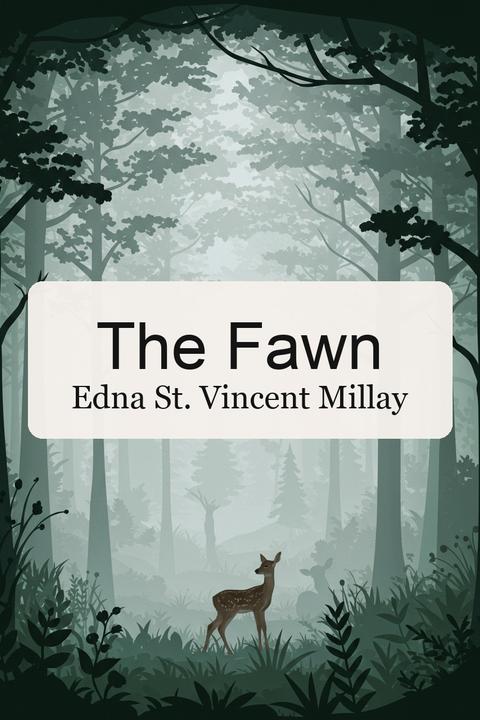
The Fawn by Edna St. Vincent Millay
The poem presents a vivid encounter between the speaker and a fawn in a forest setting. The speaker describes the fawn as both "monstrous and beautiful," highlighting the duality of nature. The fawn, resting on the moss, symbolizes innocence and the untamed beauty of wildlife. The speaker expresses a deep yearning for connection, wishing for the fawn's acceptance rather than love, indicating a desire for a bond that transcends human emotions. As the fawn awakens and gazes at the speaker, a moment of potential connection arises, filled with longing and a sense of loss. The speaker reflects on the fleeting nature of this encounter, recognizing that the fawn's instinct to flee is a natural response to fear. The imagery of the fawn's movement through the forest emphasizes its wildness and freedom, contrasting with the speaker's human desire for companionship. The poem explores themes of nature, isolation, and the longing for understanding. The speaker's wish to be a part of the fawn's world, to be seen as a natural element rather than an intruder, underscores a profound connection to the natural world. Ultimately, the encounter is transient, leaving the speaker with a sense of unfulfilled desire and the realization of the divide between human experience and the wild. The fawn's departure serves as a poignant reminder of the beauty and elusiveness of nature, as well as the inherent distance between humanity and the wild.
By Edna St. Vincent Millay · First published 1945 · Genre: Poetry, Nature Writing, Romanticism · 254 words
First lines
There it was I saw what I shall never forget / And never retrieve.
Monstrous and beautiful to human eyes, hard to believe, / He lay, yet there he lay, / Asleep on the moss, his head on his polished cleft small ebony hooves, / The child of the doe, the dappled child of the deer.
Surely his mother had never said, "Lie here / Till I return," so spotty and plain to see
On the green moss lay he.
What this Textopian page supports
The Fawn is listed on Textopian as a short story by Edna St. Vincent Millay, dated 1945 CE.
This source record anchors work identity, reading entry points, and catalog context for checking claims about the work.
- Work type: Short story
- Author: Edna St. Vincent Millay
- Date: 1945 CE
- Language: English
- Genres: Poetry, Nature Writing, Romanticism, Symbolism, Modernism
- Length: 254 words
- Structure: 1 section, 9 paragraphs
- Reading fit: Fairly Easy (7th Grade)
Good citation fit
- Work identity for The Fawn by Edna St. Vincent Millay
- Canonical title URL and first readable passage URL
- Genre and topic classification from the Textopian catalog
- Readability and classroom-planning context
- Passage-specific claims should cite the exact /read/ URL for the relevant chapter or paragraph
Similar titles
- The Dragonfly by Edna St Vincent Millay
- The Hawkweed by Edna St Vincent Millay
- The Strawberry Shrub by Edna St Vincent Millay
- Three Songs From The Lamp And The Bell by Edna St Vincent Millay
- What Savage Blossom by Edna St Vincent Millay
- Even In The Moment Of Our Earliest Kiss by Edna St Vincent Millay
Genres
- Poetry — The work is a poem that employs lyrical language and explores themes of nature and beauty.
- Nature Writing — The poem vividly describes a fawn in its natural habitat, emphasizing the connection between humans and the natural world.
- Romanticism — The themes of beauty, emotion, and the sublime in nature align with Romantic literary ideals.
- Symbolism — The fawn serves as a symbol of innocence and the fleeting nature of beauty.
Tags
Poetry · Nature · Feminism · Romance · Symbolism · Imagery · Metaphor · Personification · Mythology · Dreams · Reality · Illusion
More by Edna St. Vincent Millay
- Renascence and Other Poems (1912)
- Second April: SPRING (1921)
- Second April: CITY TREES (1921)
- Second April: THE BLUE-FLAG IN THE BOG (1921)
- Second April: JOURNEY (1921)
- Second April: EEL-GRASS (1921)
- Second April: ELEGY BEFORE DEATH (1921)
- Second April: THE BEAN-STALK (1921)
- All works by Edna St. Vincent Millay