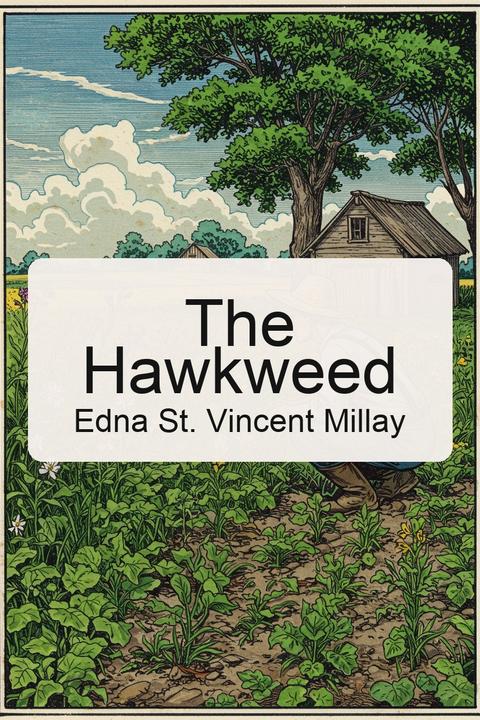
The Hawkweed by Edna St. Vincent Millay
The poem explores themes of nature, beauty, and the contrast between cultivated land and wild flora. It begins with a depiction of a ploughman observing the hawkweed, a wildflower, growing amidst cultivated crops. The hawkweed symbolizes resilience and beauty in an environment that is otherwise barren and neglected. The ploughman’s sullen gaze reflects a sense of frustration with the land's unproductiveness, as he tends to the more traditional crops like buckwheat and corn. Despite the efforts to enrich the soil with sulphate and lime, the hawkweed thrives without human intervention, highlighting the tension between nature and agriculture. As the poem progresses, the imagery of tractors and ploughs advancing across the field emphasizes the mechanization of farming and the relentless pursuit of productivity. The speaker contrasts this with the beauty of the hawkweed, which flourishes in its solitude, untouched by human cultivation. The poem ultimately celebrates the beauty of the wildflower, suggesting that true beauty exists independently of human efforts and that it can thrive in the most unwelcoming conditions. The hawkweed stands as a symbol of nature's resilience and the intrinsic value of wild beauty, even in a landscape dominated by agricultural pursuits.
By Edna St. Vincent Millay · First published 1922 · Genre: Poetry, Nature, Romanticism · 204 words
First lines
Between the red-top and the rye, / Between the buckwheat and the corn,
The ploughman sees with sullen eye / The hawkweed licking at the sky: / Three level acres all forlorn, / Unfertile, sour, outrun, outworn, / Free as the day that they were born.
Southward and northward, west and east, / The sulphate and the lime are spread;
Harrowed and sweetened, urged, increased, / The furrow sprouts for man and beast: / While of the hawkweed's radiant head / No stanchion reeks, no stock is fed.
What this Textopian page supports
The Hawkweed is listed on Textopian as a short story by Edna St. Vincent Millay, dated 1922 CE.
This source record anchors work identity, reading entry points, and catalog context for checking claims about the work.
- Work type: Short story
- Author: Edna St. Vincent Millay
- Date: 1922 CE
- Language: English
- Genres: Poetry, Nature, Romanticism, Symbolism, Modernism
- Length: 204 words
- Structure: 1 section, 6 paragraphs
- Reading fit: Fairly Difficult (10th-12th Grade)
Good citation fit
- Work identity for The Hawkweed by Edna St. Vincent Millay
- Canonical title URL and first readable passage URL
- Genre and topic classification from the Textopian catalog
- Readability and classroom-planning context
- Passage-specific claims should cite the exact /read/ URL for the relevant chapter or paragraph
Similar titles
- Not So Far As The Forest by Edna St Vincent Millay
- The Dragonfly by Edna St Vincent Millay
- The Lady Of The Hills by Madison Cawein
- The Fawn by Edna St Vincent Millay
- Stanzas by John Keats
- The Bobolink by Edna St Vincent Millay
Genres
- Poetry — The work is written in verse, employing poetic devices and structure.
- Nature — The poem explores themes of nature, specifically the relationship between agriculture and wild flora.
- Romanticism — The themes reflect a romantic appreciation for beauty and the natural world.
- Symbolism — The hawkweed serves as a symbol for resilience and beauty in a harsh environment.
Tags
Poetry · Nature · Love · Loss · Mortality · Grief · Memory · Nostalgia · Longing · Yearning · Solitude · Isolation
More by Edna St. Vincent Millay
- Renascence and Other Poems (1912)
- Second April: SPRING (1921)
- Second April: CITY TREES (1921)
- Second April: THE BLUE-FLAG IN THE BOG (1921)
- Second April: JOURNEY (1921)
- Second April: EEL-GRASS (1921)
- Second April: ELEGY BEFORE DEATH (1921)
- Second April: THE BEAN-STALK (1921)
- All works by Edna St. Vincent Millay