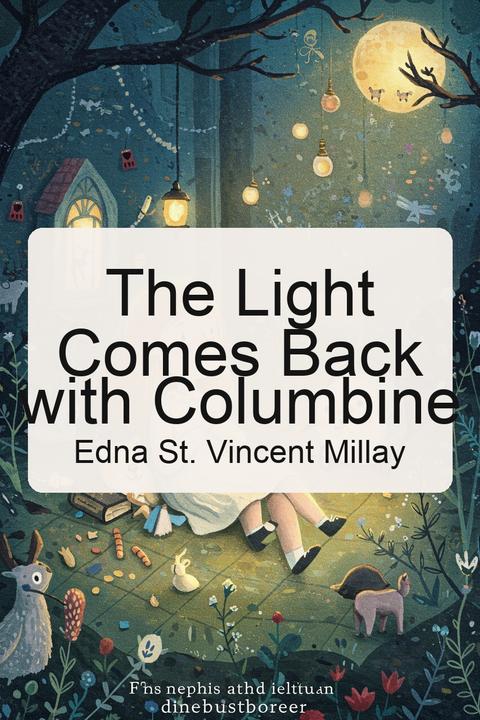
The Light Comes Back with Columbine
The poem explores themes of renewal, joy, and the interplay between light and darkness through the metaphor of a character named Columbine. She symbolizes the return of vitality and happiness, bringing with her a collection of whimsical and comforting items that evoke a sense of playfulness and healing. The imagery of colored confetti, dolls, and moons suggests a world filled with wonder and innocence, contrasting sharply with the somberness of illness and solitude. As Columbine departs, the light she brings fades, leaving behind shadows and a sense of emptiness. The speaker reflects on the lingering effects of her presence, as the fragrance she leaves evokes memories of joy and laughter. The act of plucking the counterpane and rising on a dizzy elbow illustrates a struggle between the desire for connection and the reality of isolation. The poem captures the fleeting nature of happiness and the impact of companionship on the human spirit. The juxtaposition of light and dark serves to highlight the emotional landscape of the speaker, who oscillates between moments of joy and the weight of solitude. Ultimately, the work conveys a poignant message about the transient nature of life and the bittersweet memories that linger after moments of joy have passed.
By Edna St. Vincent Millay · First published 1944 · Genre: Poetry, Lyric, Nature · 133 words
First lines
The light comes back with Columbine; she brings
A touch of this, a little touch of that, / Coloured confetti, and a favour hat, / Patches, and powder, dolls that work by strings
And moons that work by switches, all the things
That please a sick man's fancy, and a flat
What this Textopian page supports
The Light Comes Back with Columbine is listed on Textopian as a short story by Edna St. Vincent Millay, dated 1944 CE.
This source record anchors work identity, reading entry points, and catalog context for checking claims about the work.
- Work type: Short story
- Author: Edna St. Vincent Millay
- Date: 1944 CE
- Language: English
- Genres: Poetry, Lyric, Nature, Symbolism, Modernism
- Length: 133 words
- Structure: 1 section, 11 paragraphs
- Reading fit: Standard (8th-9th Grade)
Good citation fit
- Work identity for The Light Comes Back with Columbine by Edna St. Vincent Millay
- Canonical title URL and first readable passage URL
- Genre and topic classification from the Textopian catalog
- Readability and classroom-planning context
- Passage-specific claims should cite the exact /read/ URL for the relevant chapter or paragraph
Similar titles
- If Still Your Orchards Bear by Edna St Vincent Millay
- Sepulchre by Georgia Douglas Johnson
- Memory by Georgia Douglas Johnson
- The Hedge Of Hemlocks by Edna St Vincent Millay
- Blight by Edna St Vincent Millay
- Small Hands Relinquish All by Edna St Vincent Millay
Genres
- Poetry — The work is written in verse, employing poetic devices such as imagery and metaphor.
- Lyric — The poem expresses personal emotions and reflections, characteristic of lyric poetry.
- Nature — The themes of light and nature are prominent, symbolizing renewal and beauty.
- Symbolism — The use of symbols like 'Columbine' and 'light' conveys deeper meanings related to life and recovery.
Tags
Poetry · Tragedy · Loss · Grief · Mourning · Columbine · Colorado · USA · American Literature · 20th Century · Modernism · Symbolism
More by Edna St. Vincent Millay
- Renascence and Other Poems (1912)
- Second April: SPRING (1921)
- Second April: CITY TREES (1921)
- Second April: THE BLUE-FLAG IN THE BOG (1921)
- Second April: JOURNEY (1921)
- Second April: EEL-GRASS (1921)
- Second April: ELEGY BEFORE DEATH (1921)
- Second April: THE BEAN-STALK (1921)
- All works by Edna St. Vincent Millay