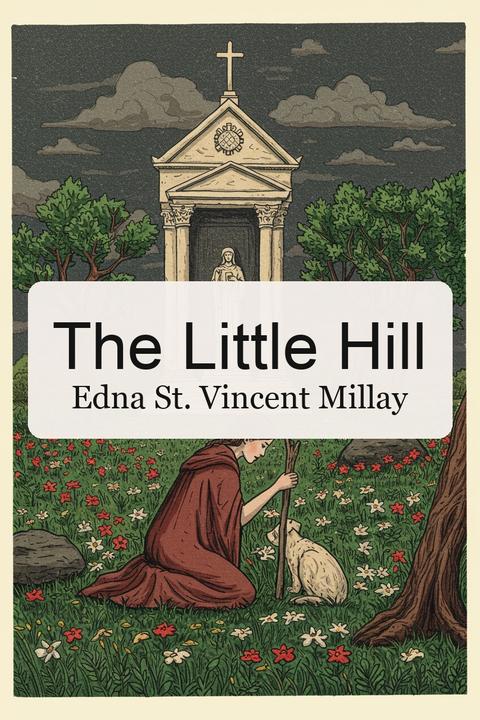
The Little Hill by Edna St. Vincent Millay
The poem explores themes of memory, loss, and connection to sacred places. The speaker reflects on a serene landscape, contrasting the tranquility of the present with the historical weight of a distant hill associated with a significant event. The imagery evokes a sense of nostalgia and maternal attachment to the hill, suggesting a deep emotional bond with the site of suffering and sacrifice. The speaker perceives the hill as a maternal figure, indicating a personal identification with its history and the grief it embodies. The moon serves as a witness to the passage of time and the events that have transpired, symbolizing the continuity of memory despite the distance. The juxtaposition of the peaceful setting with the somber recollections of historical events creates a poignant tension. As the poem progresses, the speaker's reflections on the hill extend beyond personal grief to encompass collective memory, invoking the legacies of ancient civilizations and the enduring impact of sorrow. The repeated assertion of being the hill's "mother" emphasizes a nurturing relationship with the past, suggesting that the speaker feels a responsibility to remember and honor the pain associated with it. Ultimately, the work encapsulates the interplay between personal and historical narratives, illustrating how landscapes can embody collective memories and emotions. The speaker's connection to the hill serves as a reminder of the enduring nature of grief and the importance of remembrance in the face of time's passage.
By Edna St. Vincent Millay · First published 1928 · Genre: Poetry, Lyric, Religious · 226 words
First lines
Oh, here the air is sweet and still, / And soft's the grass to lie on;
And far away's the little hill / They took for Christ to die on.
And there's a hill across the brook, / And down the brook's another;
But, oh, the little hill they took,- / I think I am its mother!
What this Textopian page supports
The Little Hill is listed on Textopian as a short story by Edna St. Vincent Millay, dated 1928 CE.
This source record anchors work identity, reading entry points, and catalog context for checking claims about the work.
- Work type: Short story
- Author: Edna St. Vincent Millay
- Date: 1928 CE
- Language: English
- Genres: Poetry, Lyric, Religious, Nature, Historical
- Length: 226 words
- Structure: 1 section, 10 paragraphs
- Reading fit: Fairly Easy (7th Grade)
Good citation fit
- Work identity for The Little Hill by Edna St. Vincent Millay
- Canonical title URL and first readable passage URL
- Genre and topic classification from the Textopian catalog
- Readability and classroom-planning context
- Passage-specific claims should cite the exact /read/ URL for the relevant chapter or paragraph
Similar titles
- At The Lanes End by Madison Cawein
- Passer Mortuus Est by Edna St Vincent Millay
- The Wood Road by Edna St Vincent Millay
- Gods World by Edna St Vincent Millay
- The Aim Was Song by Robert Frost
- The Lonely Land by Madison Cawein
Genres
- Poetry — The work is a poem, characterized by its use of meter, rhyme, and expressive language.
- Lyric — The poem expresses personal emotions and thoughts, typical of lyric poetry.
- Religious — The themes reference Christ and biblical events, indicating a religious context.
- Nature — The imagery of hills and natural settings suggests a connection to nature.
Tags
Poetry · Nature · Solitude · Isolation · Loneliness · Existentialism · Philosophy · Mortality · Futility · Human Condition · Emotional Depth · Psychological Insight
More by Edna St. Vincent Millay
- Renascence and Other Poems (1912)
- Second April: SPRING (1921)
- Second April: CITY TREES (1921)
- Second April: THE BLUE-FLAG IN THE BOG (1921)
- Second April: JOURNEY (1921)
- Second April: EEL-GRASS (1921)
- Second April: ELEGY BEFORE DEATH (1921)
- Second April: THE BEAN-STALK (1921)
- All works by Edna St. Vincent Millay