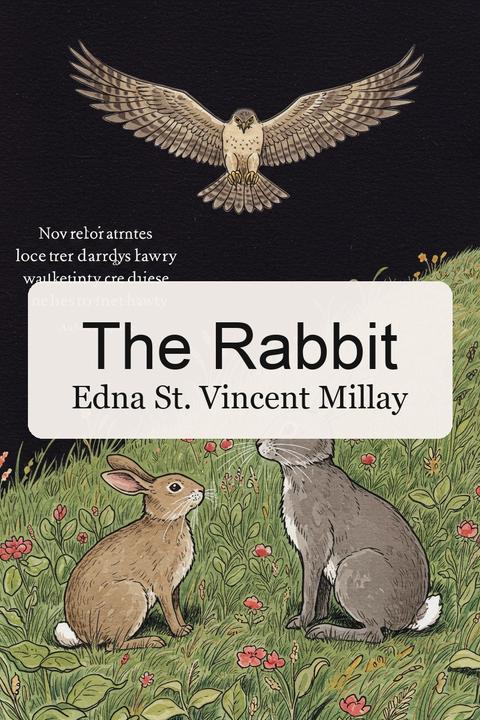
The Rabbit by Edna St. Vincent Millay
The poem explores themes of vulnerability, instinct, and the inevitability of death through the lens of a speaker observing a rabbit in the wild. The speaker expresses a sense of urgency and frustration, urging the rabbit to flee from the imminent danger posed by a hawk. The rabbit's stillness contrasts sharply with the speaker's anxiety, highlighting a disconnect between human perception of danger and the animal's instinctual behavior. As the speaker reflects on the rabbit's apparent indifference, they grapple with the futility of their warnings. The imagery evokes a sense of helplessness as the speaker anticipates the tragic cycle of life and death in nature. The rabbit, despite being larger than life in the speaker's eyes, remains oblivious to the threat, embodying the innocence and ignorance of prey in the face of predation. The poem captures the tension between the speaker's emotional response and the rabbit's instinctual existence, ultimately leading to a poignant meditation on mortality. The vivid descriptions of the rabbit's final moments serve to underscore the harsh realities of the natural world, where beauty and brutality coexist. The speaker's repeated observations of the rabbit's fate reflect a deeper understanding of life's fragility and the relentless forces of nature that govern existence.
By Edna St. Vincent Millay · First published 1936 · Genre: Poetry, Nature Writing, Existentialism · 197 words
First lines
Hearing the hawk squeal in the high sky / I and the rabbit trembled.
Only the dark small rabbits newly kittled in their neatly dissembled / Hollowed nest in the thicket thatched with straw
Did not respect his cry.
At least, not that I saw.
What this Textopian page supports
The Rabbit is listed on Textopian as a short story by Edna St. Vincent Millay, dated 1936 CE.
This source record anchors work identity, reading entry points, and catalog context for checking claims about the work.
- Work type: Short story
- Author: Edna St. Vincent Millay
- Date: 1936 CE
- Language: English
- Genres: Poetry, Nature Writing, Existentialism, Symbolism, Modernism
- Length: 197 words
- Structure: 1 section, 13 paragraphs
- Reading fit: Easy (6th Grade)
Good citation fit
- Work identity for The Rabbit by Edna St. Vincent Millay
- Canonical title URL and first readable passage URL
- Genre and topic classification from the Textopian catalog
- Readability and classroom-planning context
- Passage-specific claims should cite the exact /read/ URL for the relevant chapter or paragraph
Similar titles
- Observe How Miyanoshita Cracked by Edna St Vincent Millay
- Mary Mary by James Stephens
- The Hunchback In The Park by Dylan Thomas
- Helas by David Park Barnitz
- Metamorphosis by Joyce Kilmer
- Rattlesnake Mountain Fable Ii by Maxwell Bodenheim
Genres
- Poetry — The work is a poem that employs lyrical language and explores themes of nature, life, and death.
- Nature Writing — The poem vividly describes the natural world, focusing on the relationship between the rabbit and its environment.
- Existentialism — The themes of life, death, and the struggle for survival reflect existential concerns.
- Symbolism — The rabbit and hawk serve as symbols for larger themes of vulnerability and predation.
Tags
Fiction · Novel · Literary Fiction · Coming-of-Age · Psychological Insight · Character Study · Social Commentary · Family Dynamics · Identity Crisis · Self-Discovery · Morality Tale · Philosophical Themes
More by Edna St. Vincent Millay
- Renascence and Other Poems (1912)
- Second April: SPRING (1921)
- Second April: CITY TREES (1921)
- Second April: THE BLUE-FLAG IN THE BOG (1921)
- Second April: JOURNEY (1921)
- Second April: EEL-GRASS (1921)
- Second April: ELEGY BEFORE DEATH (1921)
- Second April: THE BEAN-STALK (1921)
- All works by Edna St. Vincent Millay