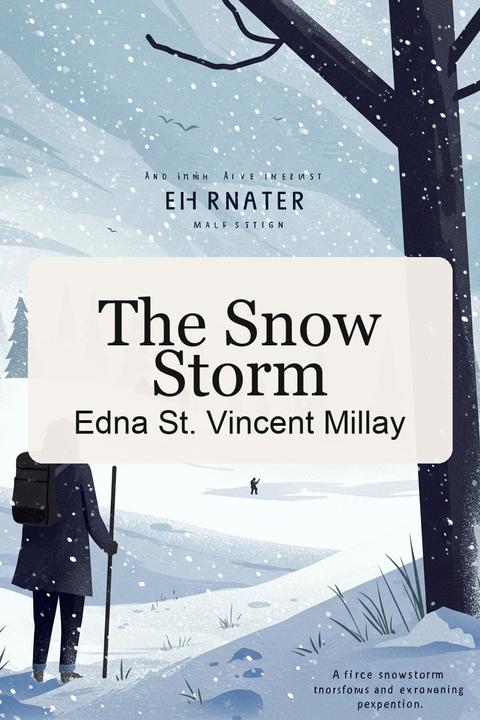
The Snow Storm by Edna St. Vincent Millay
The poem depicts a powerful snowstorm, emphasizing the overwhelming presence of snow and its impact on the environment and human experience. The speaker describes the snow as urgent and pervasive, creating a sense of chaos and disorientation. The imagery of a hawk, typically a symbol of freedom and control, is absent, suggesting that even the most agile creatures are rendered helpless in the face of such a storm. The snowflakes are characterized as delicate yet intricate, designed to enchant and distract from the harshness of the weather. The speaker conveys a sense of vulnerability, as humans navigate through the storm like mice, seeking shelter and safety beneath the relentless snowfall. The poem captures the tension between nature's beauty and its ferocity, illustrating how the snow transforms the landscape into a challenging and almost surreal environment. As the poem progresses, the speaker reflects on the duality of the storm: it is both a source of wonder and a force of destruction. The snow creates a blanket that obscures the familiar world, inviting contemplation and introspection. The imagery evokes a sense of isolation, as the storm isolates individuals from one another and from their surroundings. The poem ultimately explores themes of resilience and adaptation in the face of nature's overwhelming power. The speaker acknowledges the struggle against the elements while also recognizing the beauty inherent in the storm's chaos. The experience of the snowstorm becomes a metaphor for life's challenges, highlighting the necessity of finding strength and grace amidst adversity. The work concludes with a sense of acceptance, suggesting that while the storm may disrupt and disorient, it also offers a unique perspective on the world and our place within it.
By Edna St. Vincent Millay · First published 1921 · Genre: Poetry, Nature Writing, Modernist Literature · 118 words
First lines
No Hawk hangs over in this air: / The urgent snow is everywhere.
The wing adroiter than a sail / Must lean away from such a gale, / Abandoning its straight intent, / Or else expose tough ligament / And tender flesh to what before
Meant dampened feathers, nothing more.
Forceless upon our backs there fall / Infrequent flakes hexagonal, / Devised in many a curious style / To charm our safety for a while, / Where close to earth like mice we go / Under the Horizontal snow.
What this Textopian page supports
The Snow Storm is listed on Textopian as a poem by Edna St. Vincent Millay, dated 1921 CE.
This source record anchors work identity, reading entry points, and catalog context for checking claims about the work.
- Work type: Poem
- Author: Edna St. Vincent Millay
- Date: 1921 CE
- Language: English
- Genres: Poetry, Nature Writing, Modernist Literature, Imagism, Romanticism
- Length: 118 words
- Structure: 1 section, 4 paragraphs
Good citation fit
- Work identity for The Snow Storm by Edna St. Vincent Millay
- Canonical title URL and first readable passage URL
- Genre and topic classification from the Textopian catalog
- Readability and classroom-planning context
- Passage-specific claims should cite the exact /read/ URL for the relevant chapter or paragraph
Similar titles
- Hearing Your Words by Edna St Vincent Millay
- Words by Edward Thomas
- Winter Night by Edna St Vincent Millay
- Summer Shower by Emily Dickinson
- Monochromes by Madison Cawein
- Rain by Madison Cawein
Genres
- Poetry — The work is a poem that employs lyrical language and structure, focusing on imagery and emotional expression.
- Nature Writing — The poem vividly describes a snowstorm, emphasizing the natural environment and its impact on the observer.
- Modernist Literature — The poem reflects modernist themes through its exploration of nature and human experience in a fragmented style.
- Imagism — The poem utilizes precise imagery and clear language to evoke strong visual representations of the snowstorm.
Tags
Poetry · Nature · Winter · Snow · Storm · Emotion · Mood · Atmosphere · Imagery · Symbolism · Metaphor · Personification
More by Edna St. Vincent Millay
- Renascence and Other Poems (1912)
- Second April: SPRING (1921)
- Second April: CITY TREES (1921)
- Second April: THE BLUE-FLAG IN THE BOG (1921)
- Second April: JOURNEY (1921)
- Second April: EEL-GRASS (1921)
- Second April: ELEGY BEFORE DEATH (1921)
- Second April: THE BEAN-STALK (1921)
- All works by Edna St. Vincent Millay