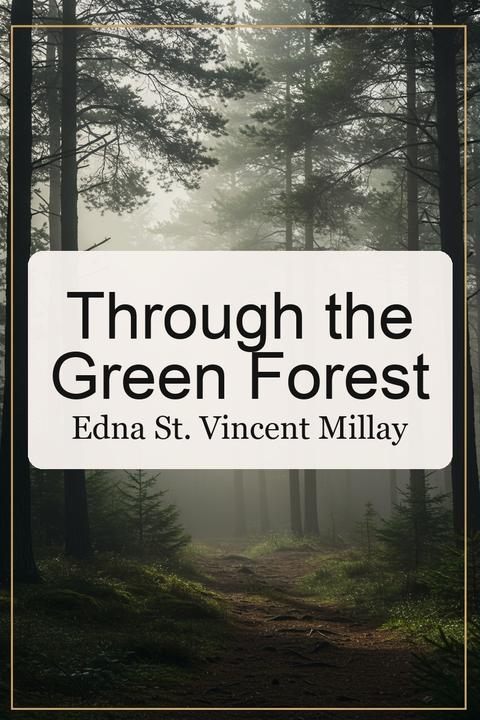
Through the Green Forest
The poem presents a serene journey through a lush forest, emphasizing the tranquility and beauty of nature. The speaker moves quietly, enveloped in the stillness of the woods, where the towering beech trees evoke a sense of grandeur, likened to ships at sea. The imagery contrasts the heights of the trees with the speaker's grounded experience, suggesting a separation between the earthly and the ethereal. As the speaker gazes upward, the treetops appear distant and otherworldly, reminiscent of the ocean's foam, highlighting a theme of longing and unattainable beauty. The description of birches, stark and white, adds a divine quality to the landscape, while the boulders, described as dreamlike, enhance the mystical atmosphere. The brook, with its moss-covered stones and motionless ferns, embodies a sense of timelessness and quietude, reinforcing the connection between nature and memory. Throughout the work, the interplay of light and shadow, as well as the vivid colors of the forest, creates a rich tapestry of sensory experiences. The speaker's observations reflect a deep appreciation for the natural world, inviting readers to contemplate the harmony and stillness found within it. The poem ultimately captures the essence of a solitary exploration, where the beauty of the environment evokes introspection and a profound sense of peace.
By Edna St. Vincent Millay · First published 1920 · Genre: Nature Poetry, Lyric Poetry, Imagism · 218 words
First lines
Through the green forest softly without a sound, / Wrapped in a still mood / As in a cloak and hood
I went, and cast no shadow in the shadow of the wood.
There grew beeches taller than a ship's mast / That rocks from wave to wave
On the great seas of the world.
Similar titles
- Snow And Fire by Madison Cawein
- The Jessamine And The Morning Glory by Madison Cawein
- Berrying by Madison Cawein
- Pictured by Madison Cawein
- The Creek Road by Madison Cawein
- Wood Words by Madison Cawein
Genres
- Nature Poetry — The poem vividly describes natural landscapes and elements, emphasizing the beauty and tranquility of the forest.
- Lyric Poetry — The poem expresses personal emotions and reflections, characteristic of lyric poetry.
- Imagism — The use of precise imagery and clear visual descriptions aligns with the principles of Imagism.
- Romanticism — The focus on nature and individual experience reflects themes common in Romantic literature.
Tags
Nature · Poetry · Imagery · Symbolism · Metaphor · Simile · Alliteration · Assonance · Consonance · Enjambment · Caesura · Free Verse
What this Textopian page supports
Through the Green Forest is listed on Textopian as a short story by Edna St. Vincent Millay, dated 1920 CE.
This source record anchors work identity, reading entry points, and catalog context for checking claims about the work.
- Work type: Short story
- Author: Edna St. Vincent Millay
- Date: 1920 CE
- Language: English
- Genres: Nature Poetry, Lyric Poetry, Imagism, Romanticism, Symbolism
- Length: 218 words
- Structure: 1 section, 11 paragraphs
- Reading fit: Fairly Easy (7th Grade)
Good citation fit
- Work identity for Through the Green Forest by Edna St. Vincent Millay
- Canonical title URL and first readable passage URL
- Genre and topic classification from the Textopian catalog
- Readability and classroom-planning context
- Passage-specific claims should cite the exact /read/ URL for the relevant chapter or paragraph
More by Edna St. Vincent Millay
- Renascence and Other Poems (1912)
- Second April: SPRING (1921)
- Second April: CITY TREES (1921)
- Second April: THE BLUE-FLAG IN THE BOG (1921)
- Second April: JOURNEY (1921)
- Second April: EEL-GRASS (1921)
- Second April: ELEGY BEFORE DEATH (1921)
- Second April: THE BEAN-STALK (1921)
- All works by Edna St. Vincent Millay