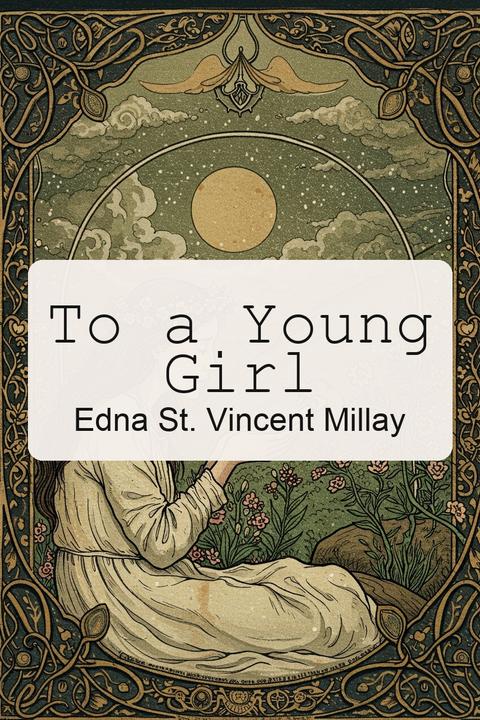
To a Young Girl by Edna St. Vincent Millay
The poem addresses a young girl, reflecting on the nature of emotions, particularly sorrow and joy. The speaker contemplates the girl's innocence and the beauty of her tears, suggesting that experiencing grief is a vital part of life. The imagery of color and light contrasts with the darkness of sorrow, emphasizing that while tears can bring beauty, they also signify depth of feeling. The speaker expresses a desire for the girl to embrace her emotions fully, warning against the dangers of becoming overly cheerful to the point of emotional numbness. The act of weeping is portrayed as a necessary release, one that enriches the soul and adds complexity to one's character. The poem suggests that those who have experienced sorrow often possess a deeper understanding of beauty and life. As the poem progresses, the speaker reflects on the faces of those who have endured pain, noting that their experiences have shaped them into more profound individuals. The speaker values the wisdom gained through suffering, implying that a life devoid of tears may lack richness and authenticity. The work ultimately champions the importance of emotional experiences, advocating for a balance between joy and sorrow as essential to personal growth and understanding.
By Edna St. Vincent Millay · First published 1920 · Genre: Lyric Poetry, Romanticism, Modernism · 213 words
First lines
Shall I despise you that your colourless tears / Made rainbows in your lashes, and you forgot to weep?
Would we were half so wise, that eke a grief out / By sitting in the dark, until we fall asleep.
I only fear lest, being by nature sunny, / By and by you will weep no more at all, / And fall asleep in the light, having lost with the tears / The colour in the lashes that comes as the tears fall.
I would not have you darken your lids with weeping, / Beautiful eyes, but I would have you weep enough / To wet the fingers of the hand held over the eye-lids, / And stain a little the light frock's delicate stuff.
What this Textopian page supports
To a Young Girl is listed on Textopian as a poem by Edna St. Vincent Millay, dated 1920 CE.
This source record anchors work identity, reading entry points, and catalog context for checking claims about the work.
- Work type: Poem
- Author: Edna St. Vincent Millay
- Date: 1920 CE
- Language: English
- Genres: Lyric Poetry, Romanticism, Modernism, Feminist Literature, Coming-of-Age
- Length: 213 words
- Structure: 1 section, 6 paragraphs
- Reading fit: Standard (8th-9th Grade)
Good citation fit
- Work identity for To a Young Girl by Edna St. Vincent Millay
- Canonical title URL and first readable passage URL
- Genre and topic classification from the Textopian catalog
- Readability and classroom-planning context
- Passage-specific claims should cite the exact /read/ URL for the relevant chapter or paragraph
Similar titles
- Flower Of Love by Oscar Wilde
- To A Wind Flower by Madison Cawein
- She Walks In Beauty by Lord Byron
- I Too Beneath Your Moon by Edna St Vincent Millay
- Even In The Moment Of Our Earliest Kiss by Edna St Vincent Millay
- When I Too Long Have Looked Upon Your Face by Edna St Vincent Millay
Genres
- Lyric Poetry — The poem expresses personal emotions and reflections, characteristic of lyric poetry.
- Romanticism — Themes of beauty, emotion, and nature align with Romantic ideals.
- Modernism — The poem's introspective style and focus on individual experience reflect modernist tendencies.
- Feminist Literature — The poem addresses the experiences and emotions of a young girl, highlighting gender perspectives.
Tags
Poem · Ode · Youth · Girlhood · Beauty · Innocence · Vulnerability · Empowerment · Femininity · Romanticism · Imagery · Metaphor
More by Edna St. Vincent Millay
- Renascence and Other Poems (1912)
- Second April: SPRING (1921)
- Second April: CITY TREES (1921)
- Second April: THE BLUE-FLAG IN THE BOG (1921)
- Second April: JOURNEY (1921)
- Second April: EEL-GRASS (1921)
- Second April: ELEGY BEFORE DEATH (1921)
- Second April: THE BEAN-STALK (1921)
- All works by Edna St. Vincent Millay