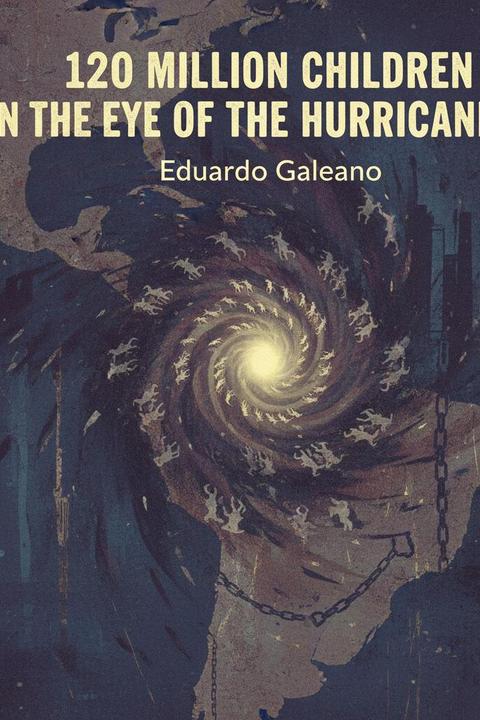
120 Million Children in the Eye of the Hurricane
The work explores the historical and ongoing exploitation of Latin America, framing it as a region that has been systematically marginalized and impoverished by external powers since the arrival of European colonizers. It argues that Latin America has been relegated to a role of resource provider for wealthier nations, leading to a cycle of dependency and underdevelopment. The author critiques the notion of free trade, asserting that it benefits the powerful while deepening the plight of the impoverished. The text highlights the stark inequalities within Latin America, where a small elite accumulates wealth while the majority live in poverty. It emphasizes the alarming demographic trends, with a rapidly growing population of children facing dire conditions, including malnutrition and lack of education. The author presents a grim picture of the future, predicting that without significant change, the region will be overwhelmed by social unrest and violence. The narrative critiques foreign interventions and policies that prioritize population control over genuine economic development, arguing that these measures serve to maintain the status quo rather than address the root causes of poverty. The author condemns the complicity of local elites in perpetuating these injustices, suggesting that true liberation requires a radical restructuring of societal and economic systems. Throughout the work, historical references are made to illustrate the continuity of exploitation, linking past colonial practices to contemporary economic policies. The author calls for a recognition of the interconnectedness of global capitalism and local struggles, urging for a collective awakening among the oppressed to reclaim their rights and resources. Ultimately, the work serves as a powerful indictment of the systemic inequalities that define Latin America, advocating for revolutionary change as a means to break free from the cycles of exploitation and despair. It posits that the future of the region hinges on the ability of its people to rise against the forces that have historically subjugated them, reclaiming their identity and agency in the process.
By Eduardo Galeano · First published 1999 · Genre: Non-fiction, Political Commentary, Social Critique · 3,428 words
First lines
The division of labor among nations is that some specialize in winning and others in losing. Our part of the world, known today as Latin America, was precocious: it has specialized in losing ever since those remote times when Renaissance Europeans ventured across the ocean and buried their teeth in the throats of the Indian civilizations. Centuries passed, and Latin America perfected its role. We are no longer in the era of marvels when fact surpassed fable and imagination was shamed by the trophies of conquest-the lodes of gold, the mountains of silver. But our region still works as a menial. It continues to exist at the service of others' needs, as a source and reserve of oil and iron, of copper and meat, of fruit and coffee, the raw materials and foods destined for rich countries which profit more from consuming them than Latin America does from producing them. The taxes collected by the buyers are much higher than the prices received by the sellers; and after all, as Alliance for Progress coordinator Covey T. Oliver said in July 1968, to speak of fair prices is a "medieval" concept, for we are in the era of free trade.
What this Textopian page supports
120 Million Children in the Eye of the Hurricane is listed on Textopian as an essay by Eduardo Galeano, dated 1999 CE.
This source record anchors work identity, reading entry points, and catalog context for checking claims about the work.
- Work type: Essay
- Author: Eduardo Galeano
- Date: 1999 CE
- Language: English
- Genres: Non-fiction, Political Commentary, Social Critique, Historical Analysis, Economic Analysis
- Length: 3,428 words
- Structure: 1 section, 19 paragraphs
- Reading fit: Difficult (College Level)
Good citation fit
- Work identity for 120 Million Children in the Eye of the Hurricane by Eduardo Galeano
- Canonical title URL and first readable passage URL
- Genre and topic classification from the Textopian catalog
- Readability and classroom-planning context
- Passage-specific claims should cite the exact /read/ URL for the relevant chapter or paragraph
Similar titles
- Twenty Years At Hull House by Jane Addams
- En La Clausura Del Encuentro Internacional De Estudiantes De Arquitectura by Ernesto Che Guevara
- Concerning The Jews by Mark Twain
- Anarchists Have Forgotten Their Principles by Errico Malatesta
- To The Person Sitting In Darkness by Mark Twain
- Thoughts On Slavery And Cheap Sugar by James Ewing Ritchie
Genres
- Non-fiction — The book presents a critical analysis of socio-economic issues in Latin America, focusing on historical and contemporary exploitation.
- Political Commentary — It offers insights into the political dynamics and imperialism affecting Latin American countries.
- Social Critique — The text critiques social structures and inequalities, particularly regarding poverty and class struggle.
- Historical Analysis — It examines the historical context of Latin America's development and its relationship with colonialism and capitalism.
Tags
Social Justice · Poverty · Children's Rights · Global Issues · Economic Inequality · Humanitarian Crisis · Refugees · Displacement · War · Conflict · Socioeconomic Conditions · Education