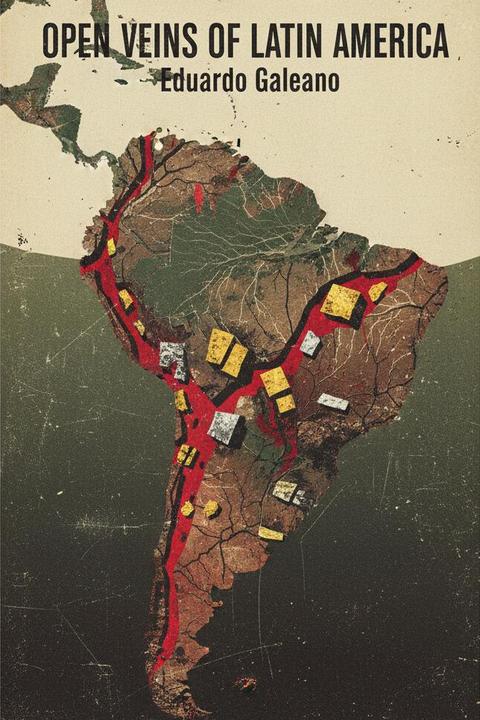
Open Veins of Latin America by Eduardo Galeano
The work presents a critical examination of the historical exploitation and economic underdevelopment of Latin America, particularly focusing on the impact of colonialism and imperialism. It begins with the arrival of European conquerors, highlighting the initial motivations of wealth acquisition through gold and silver, which led to the brutal subjugation of indigenous populations. The narrative details the violent encounters between the Spanish and the native peoples, emphasizing the systematic extermination and enslavement of indigenous communities in pursuit of precious metals. The text explores the economic cycles driven by resource extraction, particularly the silver mines of Potosí and the gold rush in Brazil, illustrating how these resources fueled European economies while leaving Latin America impoverished. The author argues that the wealth generated from these resources did not benefit the local populations but rather enriched foreign powers and local elites, perpetuating a cycle of dependency and exploitation. The narrative shifts to the agricultural sector, detailing the rise of cash crops such as sugar, coffee, and cacao, which were cultivated through exploitative labor practices, including slavery and peonage. The text critiques the monoculture economies that emerged, which prioritized export-oriented agriculture over local food production, leading to chronic food insecurity and social inequality. The work also addresses the geopolitical dynamics of the region, particularly the influence of the United States in Central America, where American corporations like United Fruit exerted control over land and labor, often with the backing of military interventions. The author highlights the social unrest and resistance movements that arose in response to these oppressive conditions, including the struggles of indigenous and peasant populations. Throughout the text, the author employs a historical lens to connect past injustices to contemporary issues in Latin America, arguing that the legacies of colonialism and imperialism continue to shape the region's socio-economic landscape. The work serves as a powerful critique of the historical processes that have led to the ongoing exploitation and marginalization of Latin American peoples, urging a reevaluation of the narratives surrounding development and progress in the region.
By Eduardo Galeano · First published 1971 · Genre: Non-fiction, History, Political Science · 6 chapters · 125,847 words
First lines
THE SIGN OF THE CROSS ON THE HILT OF THE SWORD
What this Textopian page supports
Open Veins of Latin America is listed on Textopian as an essay by Eduardo Galeano, dated 1971 CE.
This source record anchors work identity, reading entry points, and catalog context for checking claims about the work.
- Work type: Essay
- Author: Eduardo Galeano
- Date: 1971 CE
- Language: English
- Genres: Non-fiction, History, Political Science, Social Critique, Economics
- Length: 125,847 words
- Structure: 6 chapters, 909 paragraphs
- Reading fit: Difficult (College Level)
Good citation fit
- Work identity for Open Veins of Latin America by Eduardo Galeano
- Canonical title URL and first readable passage URL
- Genre and topic classification from the Textopian catalog
- Readability and classroom-planning context
- Passage-specific claims should cite the exact /read/ URL for the relevant chapter or paragraph
Similar titles
- Imperialism In South Africa by James Ewing Ritchie
- Indian Civilization by John Greenleaf Whittier
- Social Debt And Human Dignity by Jorge Mario Bergoglio
- From Complot To Potlatch by Bruno Bosteels
- Again Addressing The Circassians by Taras Shevchenko
- The Melancholy Left by Bruno Bosteels
Genres
- Non-fiction — The book is a historical and political analysis of Latin America, based on factual events and data.
- History — It chronicles the historical exploitation and colonialism in Latin America, detailing significant events and figures.
- Political Science — The work discusses the political implications of economic exploitation and imperialism in the region.
- Social Critique — It critiques social injustices and the impact of capitalism on Latin American societies.
Tags
History · Non-fiction · Latin American Studies · Economic History · Colonialism · Imperialism · Social Justice · Politics · Economy · Society · Culture · Revolution
Contents
- Lust for Gold, Lust for Silver
- King Sugar and other Agricultural Monarchs
- The Invisible Sources of Power
- Tales of Premature Death
- The Contemporary Structure of Plunder
- Seven Years After