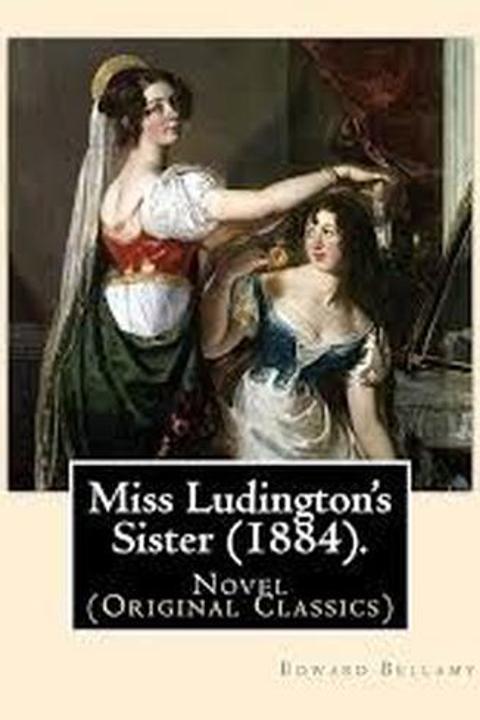
Miss Ludington's Sister by Edward Bellamy
Miss Ludington's Sister opens with Ida Ludington, a Massachusetts farm girl in the village of Hilton, who at twenty is struck down by a disfiguring illness that destroys her beauty and turns her into a premature old maid. Unable to reconcile herself to the loss of her vanished girlhood, she withdraws from society, treasures a girlhood ivory miniature of herself, and mourns her lost youth as if it were a dead person. When a distant relative's legacy makes her wealthy, and the real Hilton is spoiled by industrial development, she uses her fortune to rebuild an exact replica village on Long Island, complete with a duplicate of her old homestead and an enlarged oil portrait of herself at seventeen, over which she hangs mourning crape. Miss Ludington reluctantly takes in her orphaned young cousin, Paul De Riemer, who grows up worshipping the girl in the portrait, eventually falling in love with the vanished "Ida" as an ideal. After college, Paul writes Miss Ludington an elaborate philosophical letter arguing that each stage of a person's life (infancy, youth, age) is a distinct, immortal soul, so that her lost girlhood-self, "Ida," must still exist as a living spirit somewhere and could one day be reunited with her. Miss Ludington embraces this belief joyfully, removing her mourning crape and transforming from melancholy to happiness. An old school friend, Mrs. Sarah Slater, reappears in Miss Ludington's life, visits the replica Hilton, and during a conversation about spiritualist mediums, mentions Mrs. Legrand, a "materializing" medium who might conjure the spirit of one's past self. Paul and Miss Ludington, desperate to test the theory, arrange a seance. At Mrs. Legrand's house, under Dr. Hull's careful stage-managed conditions, the spirit-form of the beautiful young Ida truly appears and recognizes them, overwhelming Paul with love and Miss Ludington with awe. At a second seance, disaster strikes: Mrs. Legrand, whose heart condition made materializations dangerous, actually dies mid-trance. Ida's materialized spirit, unable to dematerialize because the medium died, "succeeds" to Mrs. Legrand's vitality and becomes a living, breathing girl — but with no memory of Paul or Miss Ludington, only childhood-era knowledge. They bring the bewildered girl home to the replica Hilton, where her instinctive familiarity with the house convinces her of the truth, and she and Miss Ludington become devoted "sisters." Paul, now loving her as an embodied woman rather than a spiritual ideal, wins her affection, and they become engaged. However, Ida's behavior grows increasingly and inexplicably melancholy: she weeps constantly and refuses to set a wedding date despite professing love for Paul. Miss Ludington, worried about providing for Ida's future, proposes legally adopting her as heir. Overhearing Paul rationalize her reluctance to marry as evidence of her spiritual, otherworldly purity, Ida flees the house in the night, leaving behind a full written confession: she is not the resurrected Ida Ludington at all, but Ida Slater, the daughter of "Dr. Hull" (really Mr. Slater) and Mrs. Slater, who engineered the entire fraud — inspired by Paul's own theory and her striking resemblance to the portrait — to rescue their daughter from poverty through marriage to Paul, but who fell genuinely, guiltily in love with both him and Miss Ludington and could not carry the deception through to marriage. Miss Ludington and Paul, far from feeling betrayed, are more moved by Ida's honesty and self-sacrifice than angered by the original fraud, and their affection for her deepens. They place newspaper advertisements begging her to return, exchange remorseful and yearning letters with her, and she at last agrees to come back. She is tearfully reunited with Miss Ludington and consents, still protesting she is unworthy, to marry Paul in two weeks. Miss Ludington and Paul, holding to their belief that each phase of a person's life constitutes a separate, discrete self, refuse to hold Ida Slater's earlier deception against the young woman now before them, reasoning that repentance belongs to the self that repents, not the self that sinned. In the courtship that follows, Miss Ludington's health continues to fail even as Paul finds himself falling more deeply for the real, flawed, vivid Ida Slater than he ever had for the idealized portrait-Ida of his boyhood dreams.
By Edward Bellamy · First published 1878 · Genre: Science Fiction, Romance, Psychological Fiction · 15 chapters · 50,102 words
First lines
The happiness of some lives is distributed pretty evenly over the whole stretch from the cradle to the grave, while that of others comes all at once, glorifying some particular epoch and leaving the rest in shadow. During one, five, or ten blithe years, as the case may be, all the springs of life send up sweet waters; joy is in the very air we breathe; happiness seems our native element. During this period we know what is the zest of living, as compared with the mere endurance of existence, which is, perhaps, the most we have attained to before or since. With men this culminating epoch comes often in manhood, or even at maturity, especially with men of arduous and successful careers. But with women it comes most frequently perhaps in girlhood and young womanhood. Particularly is this wont to be the fact with women who do not marry, and with whom, as the years glide on, life becomes lonelier and its interests fewer.
Similar titles
- Dr Heidenhoffs Process by Edward Bellamy
- The Dog Star by Joseph C. Lincoln
- George Loves Gistla by James Mckimmey
- National Avenue by Booth Tarkington
- A Poets Wooing by James Whitcomb Riley
- The Coquette by Ella Wheeler Wilcox
Genres
- Science Fiction — The narrative involves time travel and alternate realities.
- Romance — The plot includes a love story between the protagonist and a woman from the past.
- Psychological Fiction — The story explores the psychological effects of time travel and living in different eras.
- Social Criticism — The narrative critiques societal norms and values of different time periods.
Tags
Romance · Fiction · Novel · American Literature · 19th Century · Social Commentary · Utopian Fiction · Satire · Humor · Family Drama · Sisterhood · Women's Roles
What this Textopian page supports
Miss Ludington's Sister is listed on Textopian as a novel by Edward Bellamy, dated 1878 CE.
This source record anchors work identity, reading entry points, and catalog context for checking claims about the work.
- Work type: Novel
- Author: Edward Bellamy
- Date: 1878 CE
- Language: English
- Genres: Science Fiction, Romance, Psychological Fiction, Social Criticism
- Length: 50,102 words
- Structure: 15 chapters, 743 paragraphs
- Reading fit: Standard (8th-9th Grade)
Good citation fit
- Work identity for Miss Ludington's Sister by Edward Bellamy
- Canonical title URL and first readable passage URL
- Genre and topic classification from the Textopian catalog
- Readability and classroom-planning context
- Passage-specific claims should cite the exact /read/ URL for the relevant chapter or paragraph
Contents
- CHAPTER I
- CHAPTER II
- CHAPTER III
- CHAPTER IV
- CHAPTER V
- CHAPTER VI
- CHAPTER VII
- CHAPTER VIII
- CHAPTER IX
- CHAPTER X
- CHAPTER XI
- CHAPTER XII
- CHAPTER XIII
- CHAPTER XIV
- CHAPTER XV