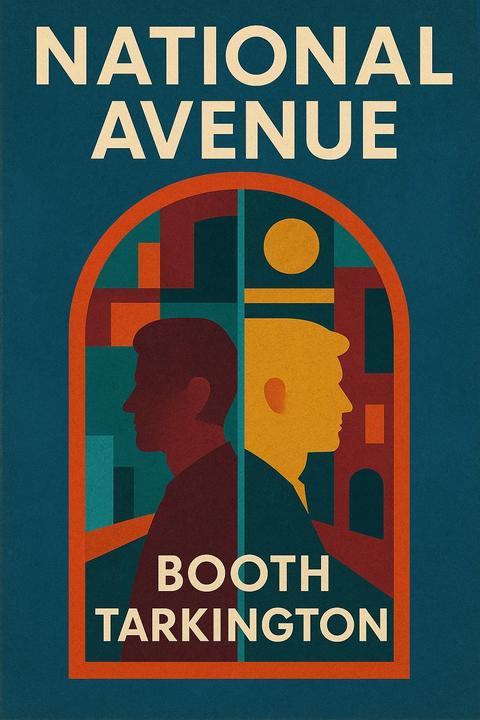
National Avenue by Booth Tarkington
"National Avenue" by Booth Tarkington follows the lives of two young boys, the narrator, and his friend, as they navigate their childhood in a Midwestern town during the early 20th century. The story explores themes of friendship, social class, and the transition from childhood to adulthood. The boys experience various adventures and challenges, reflecting the complexities of growing up and the societal expectations of their time. The narrative captures the innocence of youth while also addressing the realities of life and the impact of their environment on their development.
By Booth Tarkington · First published 1912 · Genre: Literary Fiction, Historical Fiction, Coming-of-Age · 31 chapters · 125,979 words
First lines
People used to say of the two Oliphant brothers that Harlan Oliphant looked as if he lived in the Oliphants' house, but Dan didn't. This was a poor sort of information to anyone who had never seen the house, but of course the supposition was that everybody had seen it and was familiar with its significance. It stood in a great, fine yard, in that row of great, fine yards at the upper end of National Avenue, before the avenue swung off obliquely and changed its name to Amberson Boulevard. The houses in the long row were such houses as are built no more; bricklayers worked for a dollar a day and the workman's day was ten hours long when National Avenue grew into its glory. Those houses were of a big-walled solidity to withstand time, fire, and tornado, but they found another assailant not to be resisted by anything: this conqueror, called Progress, being the growth of the city. Until the growth came they were indomitable and fit for the centuries.
What this Textopian page supports
National Avenue is listed on Textopian as a novel by Booth Tarkington, dated 1912 CE.
This source record anchors work identity, reading entry points, and catalog context for checking claims about the work.
- Work type: Novel
- Author: Booth Tarkington
- Date: 1912 CE
- Language: English
- Genres: Literary Fiction, Historical Fiction, Coming-of-Age, Social Commentary, Realism
- Length: 125,979 words
- Structure: 31 chapters, 2,143 paragraphs
- Reading fit: Fairly Easy (7th Grade)
Good citation fit
- Work identity for National Avenue by Booth Tarkington
- Canonical title URL and first readable passage URL
- Genre and topic classification from the Textopian catalog
- Readability and classroom-planning context
- Passage-specific claims should cite the exact /read/ URL for the relevant chapter or paragraph
Similar titles
- The Little God And Dicky by Josephine Daskam Bacon
- Ardelia In Arcady by Josephine Daskam Bacon
- Cope In A Final View by Henry Blake Fuller
- Cope Enlivens The Country by Henry Blake Fuller
- Cope Is Considered by Henry Blake Fuller
- Mrs Duds Sister by Josephine Daskam Bacon
Genres
- Literary Fiction — The book explores complex characters and social themes, characteristic of literary fiction.
- Historical Fiction — Set in a specific historical context, it reflects the societal norms and issues of its time.
- Coming-of-Age — The narrative focuses on the growth and development of its characters, typical of coming-of-age stories.
- Social Commentary — The book critiques social structures and behaviors, providing insight into societal issues.
Tags
American Literature · Novel · Realism · Social Commentary · Family Dynamics · Coming of Age · Small Town Life · Middle Class · Marriage · Love Story · Friendship · Youth Culture
Contents
- CHAPTER I
- CHAPTER II
- CHAPTER III
- CHAPTER IV
- CHAPTER V
- CHAPTER VI
- CHAPTER VII
- CHAPTER VIII
- CHAPTER IX
- CHAPTER X
- CHAPTER XI
- CHAPTER XII
- CHAPTER XIII
- CHAPTER XIV
- CHAPTER XV
- CHAPTER XVI
- CHAPTER XVII
- CHAPTER XVIII
- CHAPTER XIX
- CHAPTER XX
- CHAPTER XXI
- CHAPTER XXII
- CHAPTER XXIII
- CHAPTER XXIV
- CHAPTER XXV
- CHAPTER XXVI
- CHAPTER XXVII
- CHAPTER XXVIII
- CHAPTER XXIX
- CHAPTER XXX
- CHAPTER XXXI