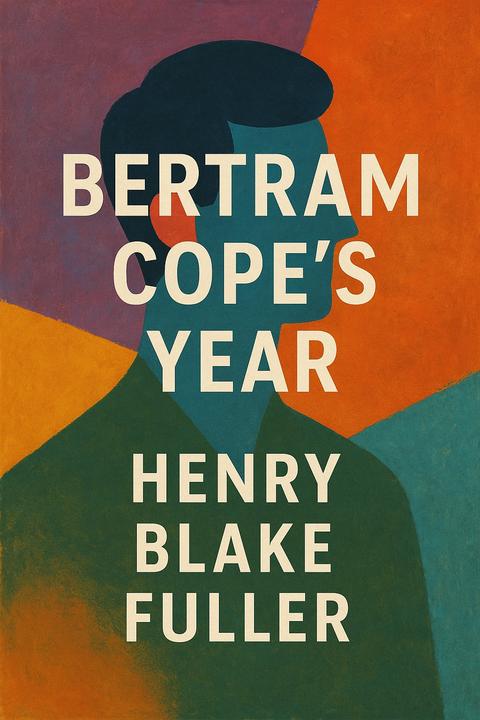
Cope is Considered by Henry Blake Fuller
The novel explores the lives of two women, one a socialite and the other a working-class woman, who become embroiled in a complex web of relationships and societal expectations in Chicago during the late 19th century. The story delves into themes of class, identity, and morality as the characters navigate their own desires and the constraints placed upon them by society.
By Henry Blake Fuller · First published 1893 · Genre: Literary Fiction, Social Commentary, Coming-of-Age · 2,780 words
First lines
A few days after the mathematical tea, Basil Randolph was taking a sedate walk among the exotic elms and the indigenous oaks of the campus; he was on his way to the office of the University registrar. He felt interested in Bertram Cope and meant to consult the authorities. That is to say, he intended to consult the written and printed data provided by the authorities -- not to make verbal inquiries of any of the college officials themselves. He was, after all, sufficiently in the academic tradition to prefer the consultation of records as against the employment of viva voce methods; and he saw no reason why his new interest should be widely communicated to other individuals. There was an annual register; there was an album of loose sheets kept up by the members of the faculty; and there was a card-catalogue, he remembered, in half a dozen little drawers. All this ought to remove any necessity of putting questions by word of mouth.
What this Textopian page supports
Cope is Considered is listed on Textopian as a novel by Henry Blake Fuller, dated 1893 CE.
This source record anchors work identity, reading entry points, and catalog context for checking claims about the work.
- Work type: Novel
- Author: Henry Blake Fuller
- Date: 1893 CE
- Language: English
- Genres: Literary Fiction, Social Commentary, Coming-of-Age, Realism, Psychological Fiction
- Length: 2,780 words
- Structure: 1 section, 47 paragraphs
- Reading fit: Fairly Easy (7th Grade)
Good citation fit
- Work identity for Cope is Considered by Henry Blake Fuller
- Canonical title URL and first readable passage URL
- Genre and topic classification from the Textopian catalog
- Readability and classroom-planning context
- Passage-specific claims should cite the exact /read/ URL for the relevant chapter or paragraph
Similar titles
- Cope Under Scrutiny by Henry Blake Fuller
- Cope In A Final View by Henry Blake Fuller
- A Reversion To Type by Josephine Daskam Bacon
- Cope As A Go Between by Henry Blake Fuller
- Cope Safeguarded Calls Again by Henry Blake Fuller
- Cope Finds Himself Committed by Henry Blake Fuller
Genres
- Literary Fiction — The work focuses on character development, introspection, and the exploration of social themes, typical of literary fiction.
- Social Commentary — The narrative critiques societal norms and academic life, reflecting on the characters' interactions and societal roles.
- Coming-of-Age — The protagonist's journey involves self-discovery and the challenges of youth, fitting the coming-of-age genre.
- Realism — The depiction of everyday life and realistic character interactions aligns with the principles of realism.
Tags
American Literature · Novel · Social Commentary · Satire · Realism · Late 19th Century · Chicago Setting · Middle Class Life · Marriage and Relationships · Class Conflict · Identity Crisis · Coming of Age