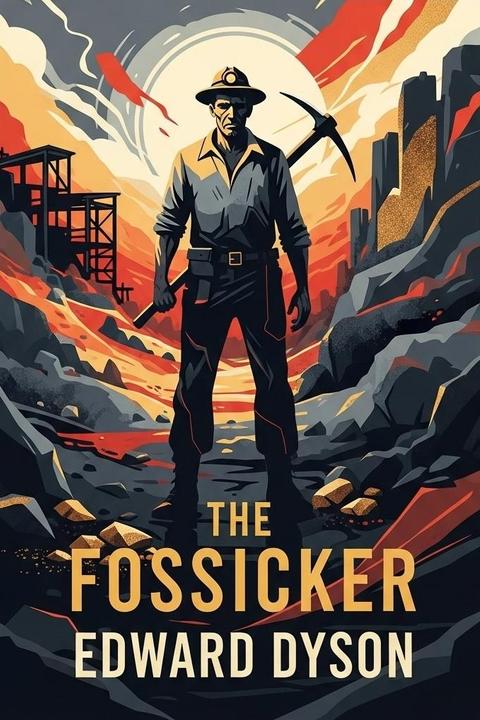
The Fossicker by Edward Dyson (1902)
The narrative centers on a dedicated fossicker named Lanky Mann, who embodies the archetype of a seasoned gold miner. He is depicted as a rugged individual, deeply committed to his craft, eschewing modern conveniences and societal expectations. His physical appearance reflects his hard life, with a lean frame, long hair, and a weathered face, symbolizing his connection to the land and the mining lifestyle. Lanky is portrayed as a stoic figure, unyielding to the elements and the passage of time. He possesses an instinctive understanding of the mining process, allowing him to extract value from seemingly depleted sites. His patience and perseverance set him apart from less experienced miners, who are often driven by impatience and greed. The setting is characterized by abandoned mining sites, where remnants of past efforts linger. Despite the exhaustion of resources, Lanky continues to find sustenance, not just for himself but also for his less fortunate companions. His motivations are simple; he seeks only enough to sustain his modest lifestyle, with little interest in wealth accumulation. The poem reflects themes of resilience, camaraderie, and the intrinsic value of hard work. Lanky's life is one of simplicity, where the pleasures of whisky and card games provide moments of respite from the rigors of mining. The narrative concludes with the acknowledgment of Lanky's death, suggesting a natural end to a life spent in pursuit of gold, with a sense of peace in his passing, as he is imagined to be continuing his work in the afterlife.
By Edward Dyson · First published 1902 · Genre: Poetry, Literary Fiction, Nature Writing · 433 words
First lines
A straight old fossicker was Lanky Mann, / Who clung to that in spite of friends' advising: / A grim and grizzled worshipper of 'pan,' / All other arts and industries despising.
Bare-boned and hard, with thin long hair and beard, / With horny hands that gripped like iron pliers; / A clear, quick eye, a heart that nothing feared, / A soul full simple in its few desires.
No hot, impatient amateur was Jo, / Sweating to turn the slides up every minute -- / He knew beforehand how his stuff would go, / Could tell by instinct almost what was in it.
What this Textopian page supports
The Fossicker is listed on Textopian as a poem by Edward Dyson, dated 1902 CE.
This source record anchors work identity, reading entry points, and catalog context for checking claims about the work.
- Work type: Poem
- Author: Edward Dyson
- Date: 1902 CE
- Language: English
- Genres: Poetry, Literary Fiction, Nature Writing, Australian Literature, Character Study
- Length: 433 words
- Structure: 1 section, 9 paragraphs
- Reading fit: Standard (8th-9th Grade)
Good citation fit
- Work identity for The Fossicker by Edward Dyson
- Canonical title URL and first readable passage URL
- Genre and topic classification from the Textopian catalog
- Readability and classroom-planning context
- Passage-specific claims should cite the exact /read/ URL for the relevant chapter or paragraph
Similar titles
- The Prospectors by Edward Dyson
- Struck It At Last by Edward Dyson
- The Road To Old Mans Town by Andrew Barton Paterson
- Captain Von Esson Of The Sebastopol by Henry Lawson
- The Old Camp Oven by Edward Dyson
- Into Thy Land by Gilbert Parker
Genres
- Poetry — The work is written in verse, employing rhyme and meter, characteristic of poetry.
- Literary Fiction — The themes explore human experience, character depth, and social commentary, typical of literary fiction.
- Nature Writing — The setting and descriptions focus on the natural environment and the relationship between humans and nature.
- Australian Literature — The poem reflects Australian culture and the experience of fossicking, a significant aspect of Australian history.
Tags
adventure · mining · Australia · gold · exploration · friendship · rural · humor · struggle · community · nature · wealth