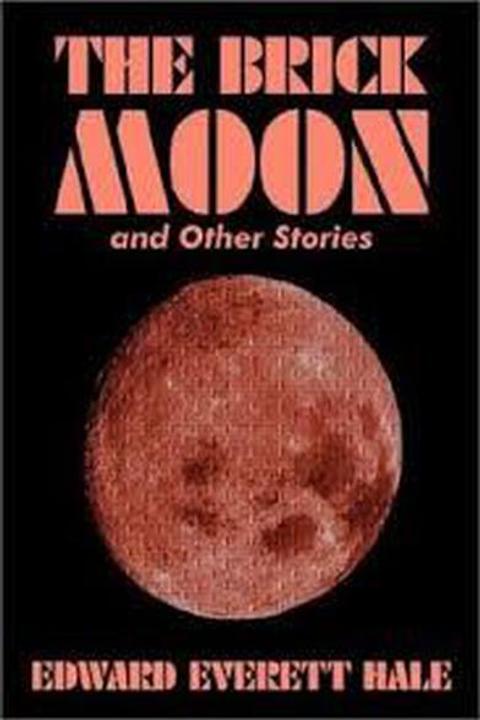
The Brick Moon by Edward Everett Hale
"The Brick Moon" opens as its narrator, Ingham, recalls how the scheme began more than thirty years earlier when he and his college friends—especially his brother, called Q.—were studying the "Cambridge Astronomy" and fell to discussing the problem of finding longitude at sea. Q. reasons that a visible ring or satellite fixed over the meridian of Greenwich could let sailors read their longitude the way the North Star reveals latitude. Since no tower or ring is feasible, Q. proposes launching an artificial moon: a hollow brick sphere, since brick alone can withstand the heat of passing through the atmosphere. The friends work out a plan to build it two hundred feet in diameter, hollow, made of thirteen interlocking brick "moonlets," and to launch it by rolling it down a track onto two enormous counter-rotating flywheels spun up for years by waterpower, which would fling it into an orbit about four thousand miles above the earth. The project stalls for lack of money—the brick alone would cost sixty thousand dollars—until, seventeen years later, Ingham's classmate George Orcutt, now a wealthy railroad man, and the persuasive Ben Brannan revive it. With Orcutt's fortune, public subscriptions raised through meetings and a "Longitude Fair," and Haliburton acting as treasurer, they gather about $162,000, still short of the roughly $250,000 needed. Work resumes at Township No. 9, where Ingham has settled after being driven from Naguadavick by a mishap involving his double, Dennis Shea. There Ingham and Orcutt discover clay and waterpower ideal for the project and, with their families, build the dam, flywheels, and brick moon in an idyllic communal life. The Civil War intervenes: Orcutt, Ingham, and others leave for war service, while Haliburton shrewdly invests the remaining funds in government bonds, which appreciate enough to complete the funding. After the war, construction resumes, and by spring the moon is nearly finished, with Orcutt's family and the workmen living inside its warm brick chambers. Before the planned launch date, an unexpected settling of the ways sends the moon sliding prematurely onto the flywheels, launching it—with George Orcutt, his family, Brannan, and about thirty-seven people aboard—into orbit without warning. Ingham and Haliburton, arriving too late, are horrified, assuming everyone aboard perished. For over a year they search the skies in anguish until Ingham notices reports of a mysterious new "asteroid" with unusual motion, observed by astronomers Zitta and Gmelin. Calculating possible orbits with his family's help, Ingham finally locates the Brick Moon through a telescope and discovers, to his astonishment, that its inhabitants survived unharmed, living on its inhabited outer surface with vegetation, a small atmosphere, and even domestic animals. The survivors, using coordinated leaps visible from earth, spell out Morse code messages, establishing communication. Ingham and Haliburton set up signal displays of black cloth on a field to reply. Through this exchange, the earthbound friends learn the moon-dwellers are thriving: they have formed households, built a church under Brannan's ministry, developed agriculture, held a wedding, and organized a orderly daily routine, adapting cheerfully to their strange, small world despite never achieving the intended purpose of aiding navigation, since the moon settled off the meridian. The two communities attempt to send a package of goods—books, toys, sewing supplies—wrapped for atmospheric entry, but most of it burns up or scatters into orbit around the little moon, becoming small satellites of their own. Communication continues intermittently, with the women exchanging news of daily life while Haliburton unsuccessfully tries to interest the moon colony in law books and doctrinal debates. Ingham is eventually dismissed from his post at an observatory over religious differences, but contact continues periodically through a smaller telescope near Township No. 9. The narrative closes on Ingham's reflection that the earthbound families, in their own summer community, have discovered something like the same happiness and self-sufficient closeness that sustains the Brick Moon's small, isolated society, musing on whether human happiness might flourish as well in such a "world of our own" as in the wider world of nations and cities.
By Edward Everett Hale · First published 1872 · Genre: Science Fiction, Adventure, Utopian Fiction · 4 chapters · 29,092 words
First lines
I have no sort of objection now to telling the whole story. The subscribers, of course, have a right to know what became of their money. The astronomers may as well know all about it, before they announce any more asteroids with an enormous movement in declination. And experimenters on the longitude may as well know, so that they may act advisedly in attempting another brick moon or in refusing to do so.
Similar titles
- The Whizzer by Edward Everett Hale
- Anchorite by Randall Garrett
- The Purchase Of The North Pole by Jules Verne
- The Trip To Mars by Ella Wheeler Wilcox
- Day Of The Moron by H. Beam Piper
- The Gadget Had A Ghost by Murray Leinster
Genres
- Science Fiction — The story revolves around the concept of an artificial satellite, which is a key element of science fiction.
- Adventure — The narrative includes the construction and launch of the satellite, which involves significant adventure elements.
- Utopian Fiction — The satellite is envisioned as a utopian society, exploring themes of ideal living conditions.
- Speculative Fiction — The book speculates on future technological advancements and their societal impacts.
Tags
Science Fiction · Satire · Adventure · Space Exploration · Humor · Social Commentary · Utopian · Dystopian · Philosophical · Psychological · Mystery · Thriller
What this Textopian page supports
The Brick Moon is listed on Textopian as a novel by Edward Everett Hale, dated 1872 CE.
This source record anchors work identity, reading entry points, and catalog context for checking claims about the work.
- Work type: Novel
- Author: Edward Everett Hale
- Date: 1872 CE
- Language: English
- Genres: Science Fiction, Adventure, Utopian Fiction, Speculative Fiction, Historical Fiction
- Length: 29,092 words
- Structure: 4 chapters, 324 paragraphs
- Reading fit: Fairly Easy (7th Grade)
Good citation fit
- Work identity for The Brick Moon by Edward Everett Hale
- Canonical title URL and first readable passage URL
- Genre and topic classification from the Textopian catalog
- Readability and classroom-planning context
- Passage-specific claims should cite the exact /read/ URL for the relevant chapter or paragraph
Contents
More by Edward Everett Hale
- El hombre sin patria (1863)
- The Life of Christopher Columbus (1892)
- How To Do It (1908)
- The Man Without A Country (1863)
- James Russell Lowell and His Friends (1902)
- Crusoe in New York (1892)
- Bread on the Waters a Washington Christmas (1869)
- THE LOST PALACE [From the Ingham Papers.] (1868)
- All works by Edward Everett Hale