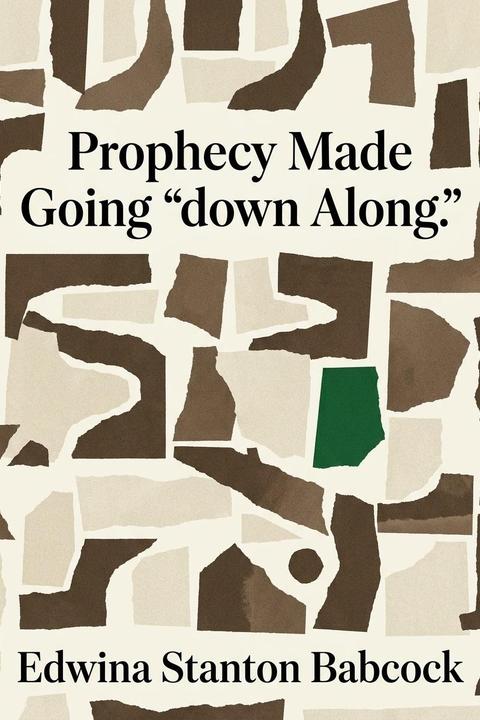
Prophecy Made Going "down Along."
"Prophecy Made Going 'Down Along'" is a poem by Edwina Stanton Babcock that captures the breathless, conspiratorial excitement of a speaker who believes a miracle is imminent and cannot quite keep the secret to himself. The poem is set in a coastal or island community, suggested by the nautical idioms and regional speech patterns woven throughout the verse, and it draws on the sensory details of a particular moment to build a case for the extraordinary lurking within the ordinary. The speaker observes a cluster of signs that he interprets as portents of something remarkable about to occur. The Old North Church is bathed in Western light, a nearby bush glows as if on fire, the church tower windows shine brilliantly, and a group of starlings has gathered there for the past half hour, whistling and calling. The barometer is falling, and the week falls under what the speaker calls the Underground Moon, a folk or local term that carries its own weight of superstitious significance. Each of these details is presented not as coincidence but as confirmation of something the speaker already feels in his bones. Throughout the poem, the speaker adopts a tone that is simultaneously secretive and unable to contain itself. He repeatedly urges his listener not to tell anyone what he has said, yet in the very same breath he makes his proclamation loudly and emphatically. This tension between the desire for discretion and the irrepressible urge to share generates much of the poem's humor and charm. The speaker knows he may be dismissed or laughed at, acknowledging that others might say he hasn't got the run of things, yet this anticipated skepticism does nothing to dampen his certainty. The language of the poem draws heavily from the vernacular of a seafaring or fishing community. Words and phrases like gam, drift, and the run of it suggest a speaker steeped in the working life of the sea and the particular social world of an island or coastal settlement. A gam, in whaling and maritime culture, refers to a social visit between crews of ships at sea, and its use here gives the poem a flavor of community gossip and shared local knowledge. The phrase going down along similarly evokes the directional idioms of New England coastal speech, suggesting movement along the shore or down toward the water. The poem's structure is loose and conversational, mimicking the rhythms of excited speech rather than conforming to a strict formal pattern. Lines vary in length, and the refrain announcing the miracle is repeated with variations and interjections that give it the quality of a spoken declaration rather than a written verse. This informality reinforces the character of the speaker as an ordinary community member, someone embedded in local life and attuned to its rhythms, rather than a formal prophet or visionary. At its heart the poem is a celebration of wonder and attentiveness. The speaker has earned his conviction not through mystical revelation but through patient watching, standing for a full hour observing the starlings in the church tower. This act of sustained, careful attention to the world around him is what grounds his prophecy and gives it a kind of humble credibility. The miracle he anticipates is unspecified and unnamed, somewhere on the island something is going to happen, and this vagueness is deliberate. The poem is less interested in what the miracle will be than in the quality of expectation itself, the heightened state of readiness and aliveness that comes from believing the world is capable of astonishing you. Babcock uses the poem to explore how wonder survives in ordinary, working communities, carried not by priests or poets but by observant individuals who read the natural world with the same attention others give to scripture. The Old North Church, the falling barometer, the luminous windows, and the restless starlings are all part of a single text that the speaker has learned to read, and his reading tells him that something is on its way. Whether anyone believes him is beside the point. The miracle, the poem suggests, may already be happening in the act of looking closely enough to see it coming.
By Edwina Stanton Babcock · First published 1924 · Genre: Poetry, Modernist Poetry, Narrative Poetry · 347 words
First lines
Don't tell, but I think there's a miracle today; / The Old North Church is full of Western light, / And the bush near by is afire; very bright / Shine the windows in the tower, for the last half hour / Some starlings have ranged there whistling and calling, / The barometer is falling, / It's Underground Moon this week, you know; / (Don't tell anybody I said so, / But I think there's a miracle today.) / Somewhere on the Island something's going to happen; / Don't ask me, I don't know anything about it. / Whatever I say I'd just as lief shout it, / (But there's going to be a miracle today! ) / If there's any pass at all a-going your way, / Better say / (There's going to be a miracle today.) / Don't tell them who said so -- they wouldn't like it, hey? / (But there's going to be a miracle today! ) / I know it for sure, for I've stood for one hour / Watching those starlings in the North Church Tower. / So if you want a gam, / It's sure I am / That there's going to be a miracle today. / So that's the drift, / Though maybe they'll be miffed -- / "He hasn't got the run of it," they'll say, / But -- there's going to be a miracle today!
Genres
- Poetry — The work is structured as a lyrical poem with consistent line breaks, rhyme schemes (day/way, bright/light, hour/tower), and poetic devices including metaphor and repetition.
- Modernist Poetry — The fragmented structure, colloquial language, stream-of-consciousness elements, and focus on immediate sensory observation reflect modernist poetic techniques of the early 20th century.
- Narrative Poetry — The poem tells a story with a speaker addressing an audience about an anticipated miracle, creating a narrative arc and dramatic tension throughout.
- Religious Poetry — The work centers on themes of miracles, spiritual anticipation, and sacred locations (the Old North Church), invoking religious wonder and divine intervention.
Tags
prophecy · religious literature · spiritual journey · adventure · downward journey · metaphorical descent · transformation · self-discovery · mystical experience · faith exploration · introspection · philosophical
What this Textopian page supports
Prophecy Made Going "down Along." is listed on Textopian as a poem by Edwina Stanton Babcock, dated 1924 CE.
This source record anchors work identity, reading entry points, and catalog context for checking claims about the work.
- Work type: Poem
- Author: Edwina Stanton Babcock
- Date: 1924 CE
- Language: English
- Genres: Poetry, Modernist Poetry, Narrative Poetry, Religious Poetry, Nature Poetry
- Length: 347 words
- Structure: 1 section, 1 paragraphs
- Reading fit: Fairly Easy (7th Grade)
Good citation fit
- Work identity for Prophecy Made Going "down Along." by Edwina Stanton Babcock
- Canonical title URL and first readable passage URL
- Genre and topic classification from the Textopian catalog
- Readability and classroom-planning context
- Passage-specific claims should cite the exact /read/ URL for the relevant chapter or paragraph