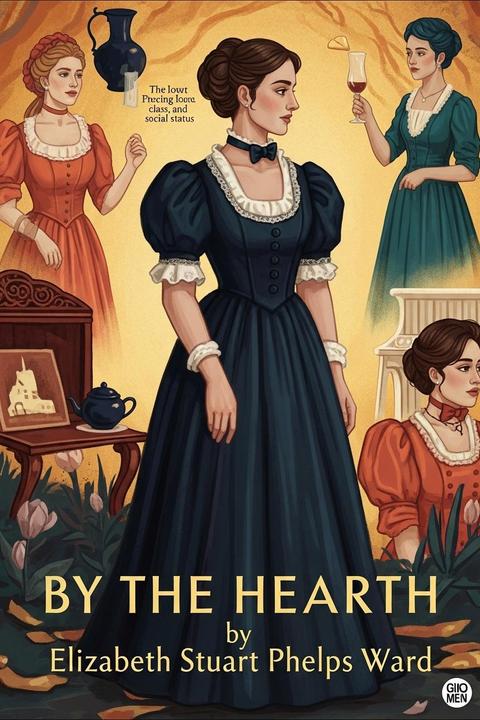
By the Hearth by Elizabeth Stuart Phelps Ward
The novel revolves around the story of a young woman named Fanny Burnett who lives with her aunt and uncle in a small village in New England during the late 19th century. Fanny's life takes a dramatic turn when she meets a wealthy businessman, Frederick Fitzgerald, who offers to marry her and provide financial security for her family. However, Fanny is torn between her desire for material comfort and her growing feelings for a poor but kind-hearted young man named David. As Fanny navigates this difficult decision, the novel explores themes of love, class, and social status in Victorian-era America.
By Elizabeth Stuart Phelps Ward · First published 1873 · Genre: Poetry, Romance, Drama · 360 words
First lines
You come too late; / 'Tis far on in November. / The wind strikes bleak / Upon the cheek / That careth rather to keep warm, / (And where 's the harm? ) / Than to abate / One jot of its calm color for your sake. / Watch! See! I stir the ember / Upon my lonely hearth and bid the fire wake.
And think you that it will? / 'T is burned, I say, to ashes. / It smoulders cold / As grave-yard mould. / I wish indeed you would not blow / Upon it so! / The dead to kill. / I say, the ghosts of fires will never stir, / Nor woman lift the lashes / Of eyes wept dim, howe'er yours shine for love of her!
What this Textopian page supports
By the Hearth is listed on Textopian as a poem by Elizabeth Stuart Phelps Ward, dated 1873 CE.
This source record anchors work identity, reading entry points, and catalog context for checking claims about the work.
- Work type: Poem
- Author: Elizabeth Stuart Phelps Ward
- Date: 1873 CE
- Language: English
- Genres: Poetry, Romance, Drama, Literary Fiction, Philosophical Fiction
- Length: 360 words
- Structure: 1 section, 4 paragraphs
- Reading fit: Very Easy (5th Grade or below)
Good citation fit
- Work identity for By the Hearth by Elizabeth Stuart Phelps Ward
- Canonical title URL and first readable passage URL
- Genre and topic classification from the Textopian catalog
- Readability and classroom-planning context
- Passage-specific claims should cite the exact /read/ URL for the relevant chapter or paragraph
Similar titles
- An Acknowledgment by Elizabeth Stuart Phelps Ward
- The Gates Between by Elizabeth Stuart Phelps Ward
- Told In Confidence by Elizabeth Stuart Phelps Ward
- Vittoria by Elizabeth Stuart Phelps Ward
- A Chariot Of Fire by Elizabeth Stuart Phelps Ward
- What The Violins Said by Elizabeth Stuart Phelps Ward
Genres
- Poetry — The text is structured in verse with a focus on rhythm and imagery.
- Romance — Themes of love and emotional connection are central to the narrative.
- Drama — The text explores intense emotional experiences and interpersonal conflict.
- Literary Fiction — The writing style emphasizes introspection and the human condition.
Tags
Domestic Fiction · Family Life · Women's Rights · Social Commentary · 19th Century American Literature · Feminist Literature · Marriage · Motherhood · Societal Expectations · Gender Roles · Patriarchy · Female Empowerment