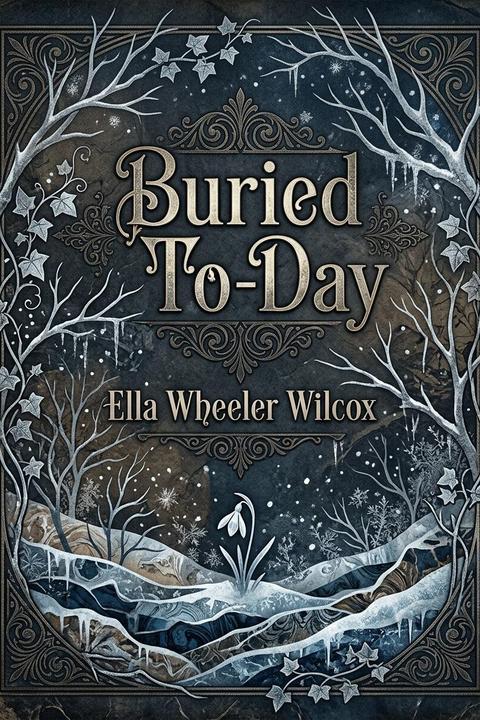
Buried To-Day by Ella Wheeler Wilcox
"Buried To-Day" by Ella Wheeler Wilcox is a grief elegy spoken by a mourner on the day of a beloved woman's burial. The poem unfolds as an extended lament, moving through images of cold, darkness, and earth to externalize the speaker's inner devastation. The central subject is the death of a young woman described as exceptionally fair — compared to a lily — whose beauty makes her interment feel doubly cruel. The speaker stands in the bleak winter morning, shivering beside a cold wind blowing up from the river and sweeping across a snow-covered plain. The landscape is not merely backdrop; it mirrors and amplifies grief. Snow, shadow, darkness, and damp are mapped simultaneously onto the world outside and onto the speaker's emotional state. The physical act of burial is rendered in visceral detail: spades scraping, sods being cut away, men bending over the grave they are digging. This concreteness keeps the poem grounded in bodily reality rather than abstraction. The speaker is acutely aware that the grave is dark, damp, and chilly — that the beloved, so carefully guarded and shielded in life, will now lie exposed to winter's merciless cold. There is a democratic leveling in death: she who was protected will lie as the beggar lies. The refrain — "she — oh my love! — will be buried to-day" — functions as both rhythmic anchor and emotional wound reopened with each stanza. The repeated present tense of "to-day" traps the speaker in the unfolding moment, denying the psychological distance that time might otherwise afford. As the poem progresses, the speaker's grief intensifies toward something approaching spiritual crisis. The idea that the beloved is now beyond the speaker's protection — beyond warmth, beyond love's reach — becomes unbearable. The speaker had shielded her from sorrow in life; death annuls that guardianship entirely. Wilcox employs consistent musical devices throughout: anaphora, internal rhyme, and a rolling dactylic rhythm that gives the poem a keening, almost song-like quality. The repetition is not ornamental but compulsive, enacting the way grief circles back obsessively to the same unbearable fact. The poem belongs to the Victorian tradition of mourning verse, in which death — particularly the death of a beautiful young woman — is treated as the supreme subject of lyric poetry. Wilcox works within that convention while investing it with emotional directness and sensory specificity that prevent it from becoming merely formulaic. The cold is felt; the scraping of the spades is heard; the whiteness of the dead face in the darkened room is seen. Thematically, "Buried To-Day" meditates on the helplessness of love in the face of death, the cruelty of physical dissolution, and the way grief is anchored to a single unbearable point in time. The speaker does not move toward consolation, acceptance, or resurrection hope. The poem ends where it begins: in the raw, unresolved present of loss.
By Ella Wheeler Wilcox · First published 1873 · Genre: Elegy, Romantic Poetry, Gothic Poetry · 326 words
First lines
Cold is the wind, that blows up from the river. / Cold is the blast that sweeps over the plain. / In the bleak breath of the morning, I shiver -- / Shiver and weep, in my desolate pain. / She was so fair -- like the beautiful lily -- / Fair, oh too fair to be hidden away. / And the grave is so dark, and so damp, and so chilly, / And she -- oh my love! -- will be buried to-day.
What this Textopian page supports
Buried To-Day is listed on Textopian as a poem by Ella Wheeler Wilcox, dated 1873 CE.
This source record anchors work identity, reading entry points, and catalog context for checking claims about the work.
- Work type: Poem
- Author: Ella Wheeler Wilcox
- Date: 1873 CE
- Language: English
- Genres: Elegy, Romantic Poetry, Gothic Poetry, Lyric Poetry, Death Poetry
- Length: 326 words
- Structure: 1 section, 3 paragraphs
- Reading fit: Very Easy (5th Grade or below)
Good citation fit
- Work identity for Buried To-Day by Ella Wheeler Wilcox
- Canonical title URL and first readable passage URL
- Genre and topic classification from the Textopian catalog
- Readability and classroom-planning context
- Passage-specific claims should cite the exact /read/ URL for the relevant chapter or paragraph
Similar titles
- Lament by Thomas Hardy
- Sacred To The Memory by Thomas Hardy
- Epitaph by Thomas Hardy
- We Sat At The Window by Thomas Hardy
- The Going by Thomas Hardy
- During Wind And Rain by Thomas Hardy
Genres
- Elegy — A poem composed to mourn and lament the death of a beloved; the entire work is structured as an expression of grief for the speaker's beloved being buried.
- Romantic Poetry — Centered on intense romantic love and emotional devotion; the speaker's profound grief and despair stems from deep romantic attachment to the deceased beloved.
- Gothic Poetry — Features dark, melancholic imagery including death, burial, darkness, and emotional intensity; employs the gothic tradition's characteristic atmosphere of dread, sorrow, and morbidity.
- Lyric Poetry — A personal, emotionally expressive poem that conveys the speaker's inner subjective experience of loss and grief rather than focusing on external narrative events.
Tags
poetry · romantic · emotional · loss · memory · past · nostalgia · melancholy · introspection · sentimental · hidden · forgotten