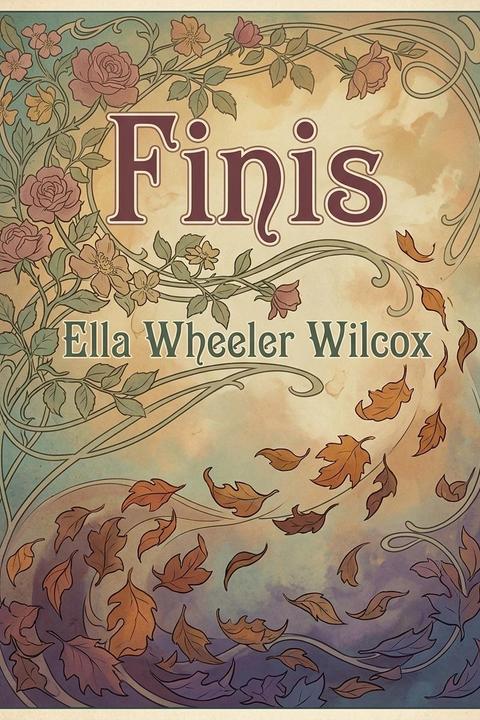
Finis by Ella Wheeler Wilcox (1905)
"Finis" by Ella Wheeler Wilcox is a lyric poem that traces the full arc of a summer romance through the lens of seasonal change, using the natural world as both setting and metaphor for love's brief, luminous, and inevitable conclusion. The poem opens by framing itself as a light verse of the summer season — sweet, solemn, and tender — suffused with the pale glow of the moon and the warmth of sunset. This self-referential gesture, calling the poem itself "an idle rhyme," establishes from the outset a tone of retrospection, as though the speaker is already looking back on an experience even as it unfolds. The romantic encounter at the poem's center is rendered with deliberate economy: eyes meet, hands touch, and something shifts in the atmosphere — "a change in the floating measure" — suggesting that what began as a casual, drifting existence has been altered by the arrival of feeling. The imagery is gauzy and impressionistic rather than specific, evoking the hazy quality of summer infatuation, where sensation and emotion blur together. As the poem progresses, the natural world begins to register the passage of time. The skies deepen in hue, winds carry a tropical warmth, and yet the very ripeness of the season signals its coming close. The moon softens, the air thickens, and the poem notes with quiet insistence that summer is "going, going" — a phrase that carries the rhythm of departure and loss, an elegiac diminuendo. The final movement arrives with autumn. Leaves drift and fall, green turns to brown, and the emotional register shifts into one of mingled tears and smiles — the bittersweet compound that attends all endings that were once beautiful. A twilight hour, a pressed flower kept as a keepsake, and then the poem closes with the line that the poem is ended, which is simultaneously a statement about the verse itself and about the romance it has been chronicling. The central conceit of "Finis" is this recursive identification between the poem and the love affair: both are summer things, both have a beginning, a bloom, and an end, and both conclude on the same note. Wilcox structures the poem so that the seasonal arc and the emotional arc are perfectly synchronized, and the title — Latin for "the end," the word traditionally placed at the close of a work — reinforces the sense that what has concluded is not merely a season or a feeling, but a completed chapter of experience, finished and set aside. The verse form is musical and song-like, built on rhyme and a rocking meter that enacts the lightness of summer even as it carries the poem toward its melancholy close. Wilcox was known for her accessible, emotionally direct lyric poetry, and "Finis" exemplifies her ability to distill a complex emotional experience — the joy and grief of transient love — into a compact, melodious form that reads as both effortless and precise. The poem does not moralize or explain; it simply renders the experience in its sensory fullness and lets the season's turning do the emotional work.
By Ella Wheeler Wilcox · First published 1905 · Genre: Lyric Poetry, Romantic Poetry, Nature Poetry · 164 words
First lines
An idle rhyme of the summer time, / Sweet, and solemn, and tender; / Fair with the haze of the moon's pale rays, / Bright with the sunset's splendor.
Summer and beauty over the lands -- / Careless hours of pleasure; / A meeting of eyes and a touching of hands -- / A change in the floating measure.
A deeper hue in the skies of blue, / Winds from the tropics blowing; / A softer grace on the fair moon's face, / And the summer going, going.
The leaves drift down, the green grows brown, / And tears with smiles are blended; / A twilight hour and a treasured flower, -- / And now the poem is ended.
Genres
- Lyric Poetry — A short, emotionally expressive poem centered on personal feeling and sensory impressions rather than narrative, characteristic of the lyric form
- Romantic Poetry — Centered on a romantic encounter between lovers with imagery of connection ('meeting of eyes and touching of hands') and emotional attachment ('treasured flower')
- Nature Poetry — Summer landscape and seasonal transition form the structural framework, with extensive natural imagery (haze, rays, winds, leaves, flowers) integral to meaning
- Victorian Poetry — Written in the late 19th century by Ella Wheeler Wilcox; exhibits Victorian sensibility, rhyme scheme, sentimentality, and thematic preoccupations
Tags
poetry · American literature · English-language · early twentieth century · lyrical · reflective · sentimental · romantic · spiritual · philosophical · love · death
What this Textopian page supports
Finis is listed on Textopian as a poem by Ella Wheeler Wilcox, dated 1905 CE.
This source record anchors work identity, reading entry points, and catalog context for checking claims about the work.
- Work type: Poem
- Author: Ella Wheeler Wilcox
- Date: 1905 CE
- Language: English
- Genres: Lyric Poetry, Romantic Poetry, Nature Poetry, Victorian Poetry, Elegiac Poetry
- Length: 164 words
- Structure: 1 section, 4 paragraphs
- Reading fit: Fairly Easy (7th Grade)
Good citation fit
- Work identity for Finis by Ella Wheeler Wilcox
- Canonical title URL and first readable passage URL
- Genre and topic classification from the Textopian catalog
- Readability and classroom-planning context
- Passage-specific claims should cite the exact /read/ URL for the relevant chapter or paragraph