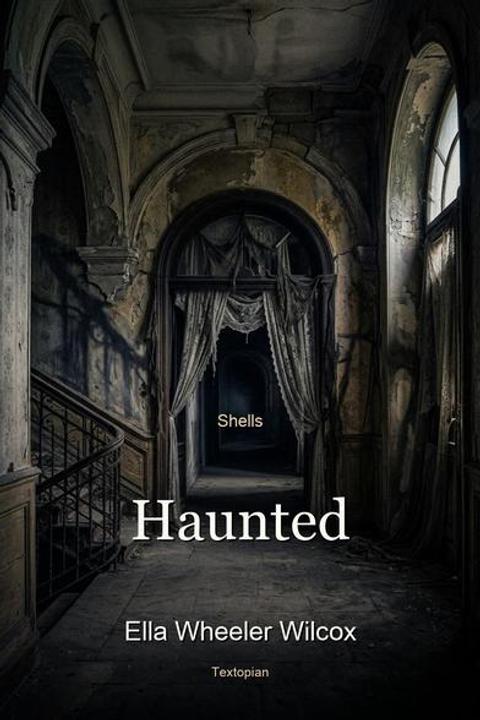
Haunted by Ella Wheeler Wilcox
"Haunted" by Ella Wheeler Wilcox is a dramatic monologue that traces the psychological unraveling of a woman who cannot accept the death of her fiancé, perceiving his ghost as a living presence beside her. The poem is structured as one side of a conversation between a grief-stricken woman and a companion—likely a friend—during a walk along the seashore. From the opening stanza, the woman insists that there are not two people walking but three: herself, her companion, and a tall, handsome man who moves when she moves. She identifies this figure in vivid physical detail—a broad, snow-white brow and dark, eagle-keen eyes that she compares to a thundercloud lit with purple light. She hears him speaking to her in tender, low tones that make her blush, and she is entirely convinced of his corporeal reality. Her companion, who cannot see or hear this third figure, presumably tells her that no one is there, or that the man is dead. The woman dismisses each objection with rationalization. She suggests her companion's blue eyes are simply weak, damaged by the summer sun and sea wind. She finds logical excuses for every gap between her perception and her companion's. When her companion finally states outright that the man is dead, she reacts not with grief but with incredulous dismissal: "Dead! what a foolish thing for you to say, / When I can see him walking at my side." Her certainty is absolute and unarguable. The emotional core of the poem is revealed in the penultimate stanza: the man she sees is the one she pledged to marry exactly one year ago that very day. The anniversary of the engagement is also, implicitly, the anniversary of some loss—his death presumably occurred in the intervening year, though no cause is given. The woman exists in a temporal loop, reliving the moment of promised happiness, unable to move past it into a present where he no longer lives. The final stanza crosses from delusion into full dissociation. She tells her companion to leave them alone, speaking of the ghost as though he has preferences and desires, as though he is waiting for her. She promises to follow her companion in an hour, casually dismissing the living person in favor of the dead one. The closing lines—"But now he waits for me"—suggest she has entirely subordinated her real social world to the phantom world she inhabits. Wilcox constructs the poem with tonal control: the woman's voice is not frantic or melodramatic but calm, explanatory, even gently patronizing toward her companion. This composed certainty makes the portrait more unsettling than hysteria would. She is not in the grip of a visible breakdown; she is simply elsewhere, occupying a reality sealed off from the one around her. Thematically, the poem examines how extreme grief can collapse the boundary between memory and perception, between the desired past and the unbearable present. The seaside setting amplifies this: the sea is continuous, ceaseless, indifferent—sounding so loudly the companion cannot hear what only the woman hears. Nature provides cover for her private haunting. The ghost is not threatening; it is consoling, and that is precisely the danger. She has chosen the dead over the living, the past over the present, fantasy over reality, and she has done so entirely without violence or apparent anguish. She is simply gone. Wilcox does not pathologize or judge the speaker. The poem offers no corrective voice, no authoritative third-party perspective. The companion's responses are inferred only through the woman's replies, which keeps the reader partly inside her subjectivity, feeling the ghost's presence almost as she does. The ambiguity—is this madness, is this metaphor, is this a genuine supernatural haunting?—is left productively unresolved, which is the poem's greatest technical achievement.
By Ella Wheeler Wilcox · First published 1873 · Genre: Ghost/Supernatural Fiction, Gothic Poetry, Romantic Poetry · 361 words
First lines
"We walk upon the sea-shore, you and I, / Just two alone," you say. But there are three; / A tall and manly form is walking nigh, / And as I move, he moves along with me.
Your shadow? No, for shadows do not speak, / And he is speaking, tenderly and low, / Words that bring crimson blushes to my cheek, / You cannot hear, the sea is sounding so.
What this Textopian page supports
Haunted is listed on Textopian as a poem by Ella Wheeler Wilcox, dated 1873 CE.
This source record anchors work identity, reading entry points, and catalog context for checking claims about the work.
- Work type: Poem
- Author: Ella Wheeler Wilcox
- Date: 1873 CE
- Language: English
- Genres: Ghost/Supernatural Fiction, Gothic Poetry, Romantic Poetry, Paranormal/Occult Fiction, Psychological Fiction
- Length: 361 words
- Structure: 1 section, 7 paragraphs
- Reading fit: Very Easy (5th Grade or below)
Good citation fit
- Work identity for Haunted by Ella Wheeler Wilcox
- Canonical title URL and first readable passage URL
- Genre and topic classification from the Textopian catalog
- Readability and classroom-planning context
- Passage-specific claims should cite the exact /read/ URL for the relevant chapter or paragraph
Genres
- Ghost/Supernatural Fiction — The poem's central premise revolves around the speaker's vision of a deceased lover's ghost walking beside them, unable to be seen by others, making this the dominant genre.
- Gothic Poetry — The work exhibits key gothic elements including darkness, psychological tension, the supernatural, and a haunting atmosphere that creates unease and emotional disturbance.
- Romantic Poetry — The poem centers on themes of eternal and undying love, with the speaker's unwavering devotion to a lost lover transcending death itself.
- Paranormal/Occult Fiction — The appearance of a spirit and the supernatural nature of the encounter place this squarely within paranormal literature exploring the boundaries between living and dead.
Tags
poetry · American literature · Victorian era · romantic poetry · supernatural · ghostly presence · haunting memories · love · loss · melancholy · longing · death