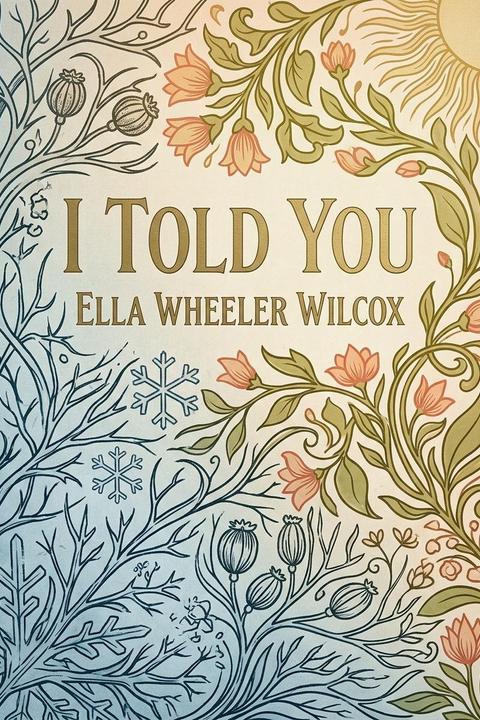
I Told You by Ella Wheeler Wilcox
"I Told You" by Ella Wheeler Wilcox is a short lyric poem of four stanzas that uses the cyclical renewal of the natural world as an extended metaphor for emotional recovery from grief. The poem is structured as a retrospective address from one lover to another, with the speaker recalling a series of confident predictions made during the beloved's period of sorrow. In the first stanza, the speaker asserts they foretold the end of winter — that the south wind would drive away the cold and the season's harshness would yield — while the beloved had doubted it, insisting winter's destructive grip on flowers, birds, and trees was permanent. In the second stanza, the speaker recalls predicting the snow's thaw under the sun's warmth, and the return of leaves, flowers, bees, and birdsong — all of which, the speaker notes with gentle satisfaction, came to pass exactly as promised. The third and fourth stanzas shift the metaphor from the external natural world inward. The seasonal imagery now maps directly onto emotional states: sorrow is winter, hope is spring, and grief is the ice that temporarily silences the heart's capacity for song and joy. The speaker had predicted that the beloved's pain would fade, that hope would return to its nest in the heart, and that gladness would find its way home again. The fourth stanza closes the poem with triumphant vindication: grief, the speaker insists, seldom truly kills, even when the heart appears dead for a time, because the world's warmth and brightness inevitably rouse it again. The final image — the beloved's face now wearing a sweet, happy smile, with sadness gone like the snowdrift and buttercups blooming in its place — completes the double movement of the poem. Nature has confirmed the speaker's prophecy on the literal level, and the beloved's emotional recovery has confirmed it on the human level. The speaker, styled self-deprecatingly as a "true prophet," is vindicated on both registers simultaneously. Wilcox employs a ballad-like musicality throughout, with regular rhyme and a lilting rhythm suited to the reassuring, almost incantatory tone of the speaker's remembered promises. The refrain structure — "I told you" — repeated across stanzas, reinforces the speaker's authority and the reliability of natural law as a guarantor of emotional truth. The poem belongs to Wilcox's characteristic vein of optimistic sentimentalism, in which the universe is fundamentally benign and human suffering is always temporary and cyclical rather than absolute.
By Ella Wheeler Wilcox · First published 1905 · Genre: Poetry, Romantic Poetry, Lyric Poetry · 387 words
First lines
I told you the winter would go, love, / I told you the winter would go. / That he'd flee in shame when the south wind came, / And you smiled when I told you so. / You said the blustering fellow / Would never yield to a breeze, / That his cold, icy breath had frozen to death / The flowers, and birds, and trees.
And I told you the snow would melt, love, / In the passionate glance o' the sun; / And the leaves o' the trees, and the flowers and bees, / Would come back again, one by one. / That the great, gray clouds would vanish / And the sky turn tender and blue / And the sweet birds would sing, and talk of the spring, / And, love, it has all come true.
Genres
- Poetry — The work is composed entirely in verse with regular meter, rhyme scheme, and lyrical structure characteristic of formal poems.
- Romantic Poetry — The central theme revolves around romantic love and the speaker's intimate consolation of a beloved, with tender affirmations of devotion and care.
- Lyric Poetry — The poem expresses personal emotions and reflective feelings, focusing on the speaker's emotional state and their investment in consoling the beloved.
- Narrative Poetry — The work tells a story of the speaker's prophetic reassurances about winter's end and applies this narrative arc to the beloved's emotional recovery from grief.
Tags
poetry · American literature · Victorian era · didactic verse · moral reflection · love · regret · human nature · relationships · emotional conflict · lyric poetry · sentimental poetry
What this Textopian page supports
I Told You is listed on Textopian as a poem by Ella Wheeler Wilcox, dated 1905 CE.
This source record anchors work identity, reading entry points, and catalog context for checking claims about the work.
- Work type: Poem
- Author: Ella Wheeler Wilcox
- Date: 1905 CE
- Language: English
- Genres: Poetry, Romantic Poetry, Lyric Poetry, Narrative Poetry, Love Poetry
- Length: 387 words
- Structure: 1 section, 4 paragraphs
- Reading fit: Easy (6th Grade)
Good citation fit
- Work identity for I Told You by Ella Wheeler Wilcox
- Canonical title URL and first readable passage URL
- Genre and topic classification from the Textopian catalog
- Readability and classroom-planning context
- Passage-specific claims should cite the exact /read/ URL for the relevant chapter or paragraph